WhatsApp Insurance Renewal Reminders for Indian Agents and Brokers
India has about 33 lakh life insurance agents, backed by another 27 lakh point-of-sales persons. Almost every one of them earns the larger part of their income from policies they sold years ago.
Over a ten-year horizon, renewal commission typically adds up to two or three times what the first-year commission paid. The book is the business. The first sale is just how a policy enters it.
So here is the uncomfortable number. India's 13th-month persistency averages around 63 percent, meaning more than a third of new life policies lapse before their first renewal. On the motor side it is worse: roughly 16.5 crore of India's 30.5 crore registered vehicles carry no valid insurance at all.
Some of that is the customer deciding they do not want cover. Most of it is nobody reminding them at the right moment, with the right link, in a place they actually read.
This guide covers how to fix that with WhatsApp. The cadence per product line. Why the insurer's own reminder can cost you the commission. The grace-period facts that make a message worth opening. And the ROI in rupees, against what it costs to run.
What this guide covers
- What a leaking book actually costs
- Why agents lose renewals they should have kept
- The insurer reminds them too, and that is the problem
- Why WhatsApp beats calls and SMS for this job
- Grace periods: the facts that make a reminder worth reading
- The cadence, by product line
- Templates, categories and what Meta rejects
- Wiring it up: the practical build
- ROI worked for a 400-policy agent and a 1,500-policy agency
- What it actually costs
- Compliance: IRDAI conduct, DPDP, opt-in and no DLT
- Seven mistakes that cost renewals
- Frequently asked questions
What a leaking book actually costs
Most agents track new business. Very few track the renewal rate on the book they already own, which is strange, because that is the number that compounds.
Take an agent with 400 active policies across motor, health and life. Assume an average annual premium of Rs 14,000 and an average renewal commission of 10 percent, which sits inside the normal range for general insurance lines.
| Renewal rate | Policies retained | Renewal commission earned |
|---|---|---|
| 70 percent | 280 | Rs 3,92,000 |
| 78 percent | 312 | Rs 4,36,800 |
| 85 percent | 340 | Rs 4,76,000 |
Eight points of renewal rate is worth roughly Rs 45,000 a year to this agent. Fifteen points is worth Rs 84,000. And unlike new business, it requires no prospecting, no meetings and no travel.
There is a second effect that matters more over time. A policy that lapses does not just cost this year's commission. It costs every renewal that policy would have produced for the rest of its life, and for a health or life policy that can be fifteen years. Valuing a lapse at one year of commission understates it by an order of magnitude.
A renewal reminder is the highest-return work an insurance agent can do, and it is the work that gets postponed first because it does not feel like selling.
Why agents lose renewals they should have kept
Agents do not forget renewals because they are careless. The structure of the job makes it hard.
The expiry dates live in six different places. An agent selling for four insurers has four portals, each with its own login, its own export format and its own renewal report. There is no single list of what expires next week. Building one by hand takes an afternoon, so it happens once a quarter at best.
The reminder is a phone call, and calls do not scale. Four hundred policies is roughly eight expiries a week. Eight calls sounds easy. Then count the ones nobody picks up, the callbacks, and the fact that a working customer is reachable for about ninety minutes a day.
Motor and health renewals cluster. Vehicle policies concentrate around registration months and around the March financial year end. Health policies cluster in the months families originally bought them, often around a tax-saving push in January to March. When forty renewals land in one fortnight, the calling approach collapses exactly when it matters most.
The customer has forgotten who you are. They bought once, twelve months ago. They have your number saved as "insurance" if at all. When a competing quote arrives from an aggregator, there is nothing on their phone reminding them that you exist.
Nobody owns the lapsed ones. Once a policy expires, it falls off every report the agent looks at. A policy that lapsed four months ago is invisible, even though a health policy inside its revival window is one of the easiest sales available.
The insurer reminds them too, and that is the problem
Here is the part that is specific to insurance, and it is the single most important paragraph in this guide.
Your insurer sends renewal reminders as well. Those messages carry the insurer's own renewal link. A customer who taps it renews straight on the insurer's portal. How that renewal is credited then varies. The agent who sold the policy can find the servicing credit has moved, or gone entirely.
So the agent is not competing with the customer's forgetfulness. The agent is competing with the insurer's marketing automation, an aggregator's retargeting ad, and a bank's cross-sell message, all landing in the same week.
The practical consequence is about timing, and it is simple. Your reminder has to arrive first. Insurer reminders typically start around thirty days before expiry. Say your first message lands at forty-five days. You framed the renewal. Your link is the one in the chat. The insurer's later message then reads as confirmation of something the customer already settled with you.
If your message lands at fifteen days, you are the third voice in a crowded week, and you are arguing against a link the customer has already tapped.
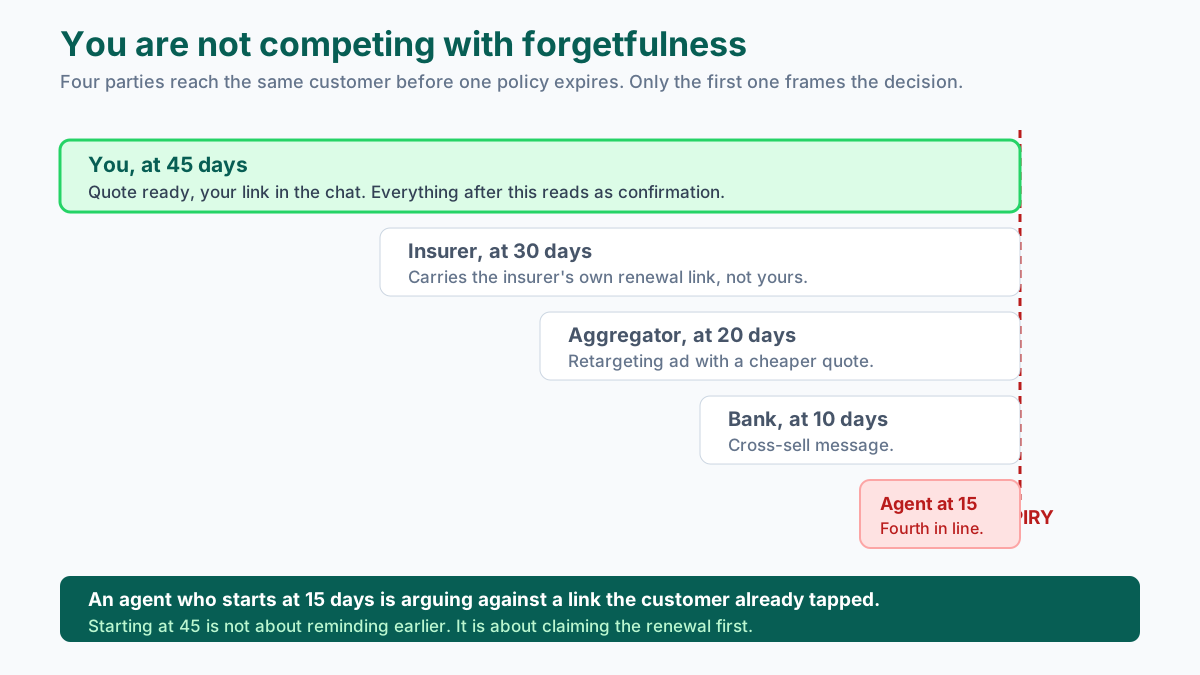
This is why an insurance renewal cadence starts earlier than one for a gym or a subscription. You are not just reminding. You are claiming the renewal before anyone else does.
Why WhatsApp beats calls and SMS for this job
Three requirements: it has to be read, it has to carry a link, and it has to let the customer ask a question without booking a call.
| Channel | Read rate | Carries a link | Setup | Cost |
|---|---|---|---|---|
| Phone call | High when answered | No | None | Your time, and it caps at about 20 a day |
| SMS | Low | Yes, often flagged | DLT registration, 2 to 4 weeks | Rs 0.15 to Rs 0.25 |
| Very low for this audience | Yes | Low | Near zero | |
| Personal WhatsApp | High | Yes | None | Free, but manual and unrecorded |
| WhatsApp Business Platform | High | Yes | Minutes | Rs 0.115 utility, Rs 0.8631 marketing |
Two things in that table deserve expanding.
SMS carries a registration tax that WhatsApp does not. Business SMS in India runs through TRAI's DLT framework. Entity registration, sender ID approval, template registration, and a wait of two to four weeks before the first message goes out. WhatsApp is not classified as telecom SMS, so DLT does not apply. Your obligations sit with Meta's business policy and the DPDP Act instead, and template approval is usually same-day.
Personal WhatsApp is what most agents already use, and it is the honest comparison. It works well at a hundred policies. At four hundred it starts to fail in specific ways. You cannot send to a list without doing it one chat at a time. There is no record of who was reminded and who was not. And the whole book lives on one phone. If that phone is lost or the number changes, so does the business.
The Business Platform keeps what works about WhatsApp and removes the ceiling.
Grace periods: the facts that make a reminder worth reading
A reminder that says "your policy is expiring" gets ignored. A reminder that says what the customer stands to lose gets opened. Insurance has unusually concrete answers here, and most customers do not know them.
Motor: there is no cover during the gap, and the NCB has a clock on it
A motor policy ends at midnight on the expiry date. There is no grace period on the cover itself. If the vehicle is driven the next morning, it is uninsured, and driving without valid third-party cover is an offence under the Motor Vehicles Act.
The part customers care about more is the No Claim Bonus. A claim-free record builds a discount on the own-damage premium that rises with each claim-free year and can reach half the own-damage component. Most insurers allow that accumulated bonus to be carried across if the policy is renewed within a grace window after expiry, commonly ninety days, with some insurers now allowing longer. Miss the window and the bonus resets to zero.
Confirm the exact window with the specific insurer before you quote it in a message, because it varies and it has moved in recent years. But the shape of the message is unbeatable: renewing late does not just leave a gap in cover, it can permanently erase a discount the customer spent five years earning.
Health: the grace period exists, and what it protects is the waiting periods
Health policies usually carry a grace period of fifteen to thirty days. Renew inside it and continuity is preserved. Miss it and the policy is treated as new.
That matters far more than most customers realise. A fresh policy restarts the waiting periods, including the one on pre-existing diseases, which commonly runs two to four years. A family that has already served three years of that waiting period and lets the policy lapse has thrown away three years of accrued protection, not one month of premium.
One important caveat to state clearly in any message: the grace period protects continuity, not cover. A claim arising during the gap is generally not payable.
Life: grace by premium mode, then revival
Life policies typically allow fifteen days of grace for monthly premium modes and thirty days for quarterly, half-yearly and annual modes. After that the policy lapses, and getting it back means going through revival, which can involve interest on unpaid premiums and sometimes fresh medical underwriting.
A lapsed life policy is not gone. Insurers run revival windows, often several years long. A list of lapsed policies inside their revival window is one of the most valuable and most ignored assets an agent holds.
The cadence, by product line
Different products need different timing, because what the customer loses is different and the grace rules are different.
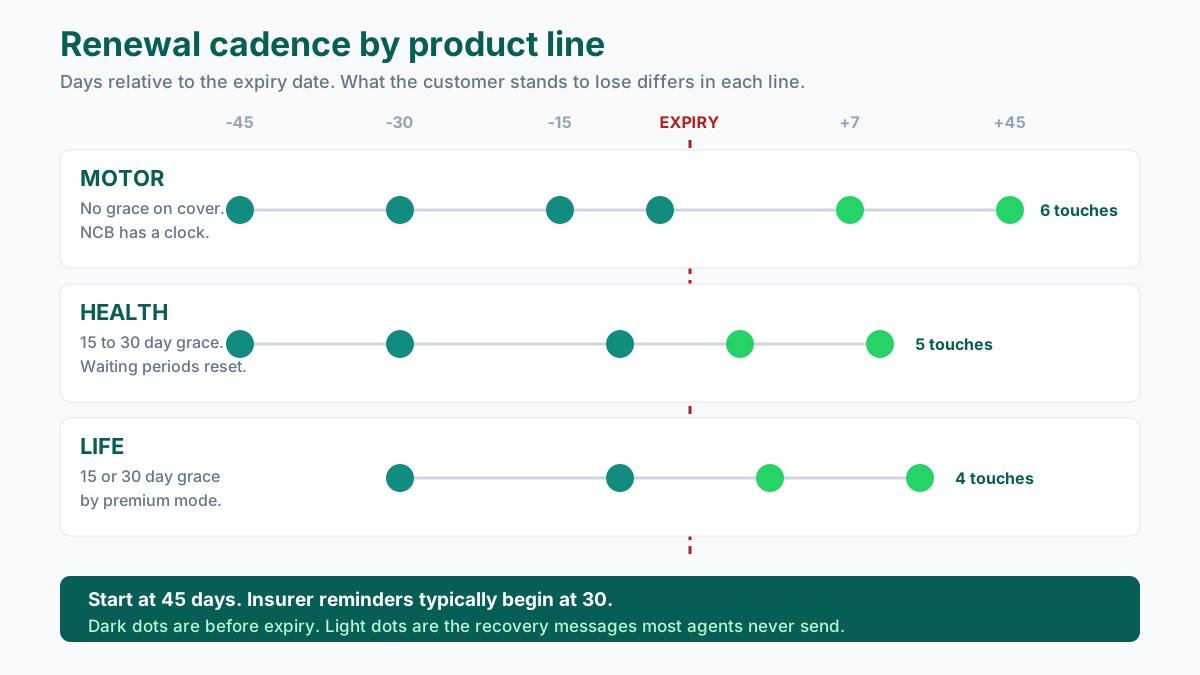
Motor: six touches, starting at 45 days
- D minus 45. Early and deliberately ahead of the insurer. "Your car policy with [insurer] expires on 14 November. Your renewal quote is ready. Reply QUOTE and I will send it."
- D minus 30. Send the actual quote with the renewal link. This is the message that claims the renewal.
- D minus 15. The NCB line. State the discount amount in rupees if you know it.
- D minus 3. Short and practical. Cover ends on this date, the vehicle should not be driven after it.
- D plus 7. The gap message. Uninsured now, and the bonus clock is running.
- D plus 45. Last call before the NCB window closes. This single message recovers policies that everyone else has written off.
Health: five touches, built around the grace period
- D minus 45. Heads-up plus a request to confirm whether anything has changed in the family, which is both service and an upsell opening.
- D minus 30. Renewal quote with the link, and any no-claim benefit or cumulative bonus stated.
- D minus 7. The continuity message. Name the waiting periods that renewal protects.
- D plus 3. Inside grace. Explain plainly that continuity is still safe but a claim in the gap is not covered.
- D plus 20. Final message before grace closes, with what restarting from scratch would mean.
Life: four touches, plus a separate revival list
- D minus 30. Premium due, amount, and the payment link.
- D minus 7. Reminder with the mode-specific grace period stated.
- D plus 5. Inside grace, with the date it ends.
- D plus 25. Grace ending, and what revival would involve.
Then run lapsed life policies as a separate campaign two or three times a year rather than as a cadence. A revival campaign against policies lapsed in the last two years is usually the best messaging an agent sends all year. The customer already believed in the product once. And the choice they face is losing everything they have paid in.
Templates, categories and what Meta rejects
Any message sent outside an open 24-hour conversation window must be a pre-approved template.
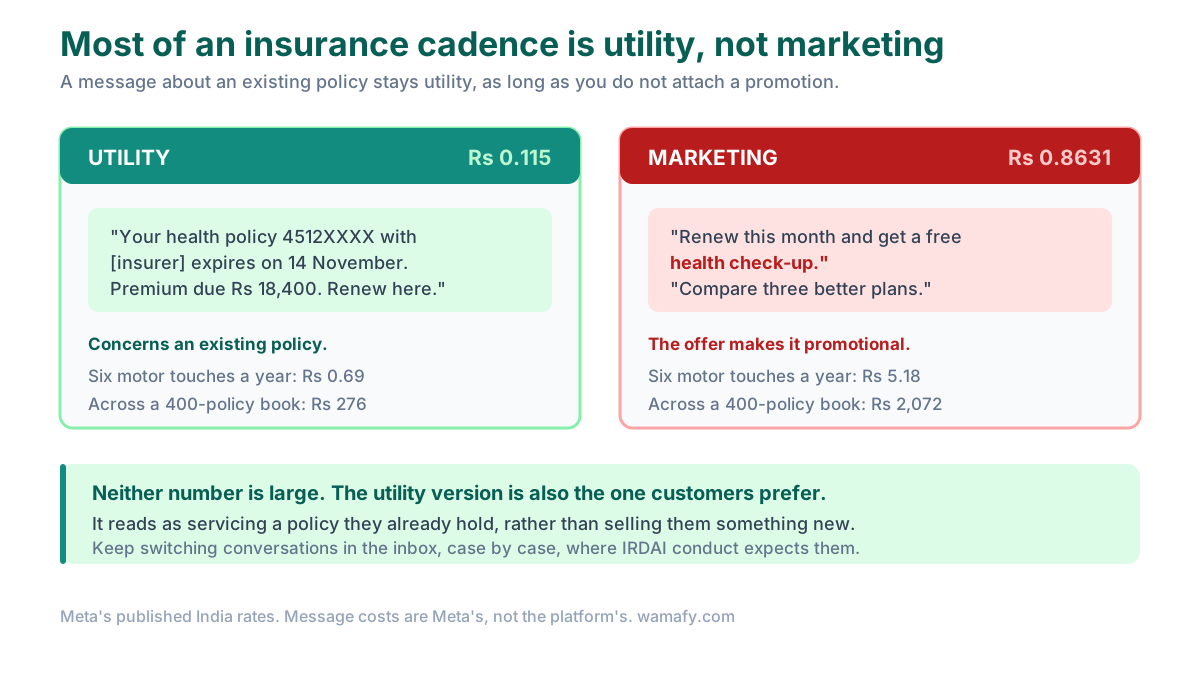
Category decides cost, and the gap is large. Utility templates cost Rs 0.115 per message in India. Marketing templates cost Rs 0.8631. Seven times more.
For insurance the good news is that most of this cadence is genuinely utility. A message about an existing policy's expiry, premium due, or grace period concerns an existing agreement. It stays utility as long as you do not attach a promotion.
- "Your health policy 4512XXXX with [insurer] expires on 14 November. Premium due Rs 18,400. Renew here." Utility.
- "Renew this month and get a free health check-up." Marketing.
- "Compare three better plans before you renew." Marketing, and it also invites a compliance question about how you present alternatives.
Running a six-message motor cadence entirely as utility costs about Rs 0.69 per policy per year. The same six as marketing cost Rs 5.18. Across a 400-policy book that is the difference between Rs 276 and Rs 2,072 a year. Neither is large, but the utility version is also the version customers prefer, because it reads as service rather than sales.
What gets insurance templates rejected:
- Guaranteed-return or guaranteed-approval language. Financial promises attract scrutiny and are also an IRDAI conduct problem.
- Shortened links. Use full domains. Shorteners get flagged, and in a financial context they also look like phishing to the customer.
- Missing variable examples. Every placeholder needs a realistic sample at submission.
- No identification. Name yourself and your agency in the message body. An unsigned message about money gets both rejected and ignored.
- Urgency theatre. Capitals, multiple exclamation marks and countdown language fail review.
Wiring it up: the practical build
Step 1: build one policy book
Export from every insurer portal you use and consolidate into one file. One row per policy: customer name, phone number, policy number, insurer, product line, premium, expiry date, and the renewal link if the insurer gives you a persistent one.
This is the whole job. Everything after it is configuration. Agents who skip this and try to run reminders out of four portals separately give up within a month.
Step 2: connect a business number
Use a business number rather than your personal one, and make sure the WhatsApp Business Account sits in your own Meta Business Manager. For an agent this matters more than for most businesses: the policy book and the conversation history attached to that number are your practice. They should not sit inside an account someone else controls.
Step 3: import and sanity-check
Upload the file. Numbers normalise to international format and duplicates drop out on import, which matters in a book where the same family often appears three times.
Then sort by expiry and read the next sixty days. Expect errors, especially on policies you inherited or took over from another agent.
Step 4: build templates per product line
Motor, health and life need their own templates because the grace-period facts differ. Around fifteen templates in total covers all three cadences. Submit them in one batch, at least a week before you need them.
Step 5: set the reminders running
This is what the Insurance Renewals add-on in Wamafy does. You import the policy book, and each policy's reminders fire against its own expiry date. The messages carry the insurer's renewal link, so the customer completes the renewal the normal way, and marking a policy as renewed advances it to the next term automatically.
It is Rs 499 a month and works on any plan, including Seed at Rs 799. No add-on in Wamafy is locked to a higher tier, so an individual agent does not have to buy agency-sized capacity to get the feature.
Step 6: work the replies
This is where the money is. Renewal reminders generate replies: questions about premium increases, requests to add a family member, someone asking about a policy for a relative. Those land in a shared inbox, and for an agency they can be assigned to whoever handles that line.
Treat the reply as the point of the exercise rather than a side effect. An agent who answers within the hour renews at a much better rate than one who answers in three days. The upsell talks start here too, not in a separate campaign.
ROI worked for a 400-policy agent and a 1,500-policy agency
Individual agent, 400 policies
Average annual premium Rs 14,000, average renewal commission 10 percent, current renewal rate 72 percent.
| Line | Working | Value |
|---|---|---|
| Renewals today | 400 at 72 percent | 288 policies |
| Renewals at 80 percent | 400 at 80 percent | 320 policies |
| Extra renewals | 32 policies | 32 |
| Extra commission this year | 32 at Rs 14,000 at 10 percent | Rs 44,800 |
| Platform cost | Rs 799 plus Rs 499, twelve months | Rs 15,576 |
| Message cost | About 2,400 messages, mostly utility | About Rs 600 |
| Net year one | About Rs 28,600 |
Year one roughly triples the cost. That is a reasonable return but not a dramatic one, and it would be dishonest to stop the table there, because year one is not where this pays.
Those 32 policies stay in the book. If they renew for another six years on average, and renewal commission holds, the same 32 policies produce around Rs 2.7 lakh in commission over that period. The reminder system did not earn Rs 28,600. It earned a retained book.
Agency, 1,500 policies and three staff
Same premium and commission assumptions, Bloom plan at Rs 1,599 for the extra inbox seats.
| Line | Working | Value |
|---|---|---|
| Extra renewals at an eight-point lift | 1,500 at 8 percent | 120 policies |
| Extra commission this year | 120 at Rs 14,000 at 10 percent | Rs 1,68,000 |
| Platform cost | Rs 1,599 plus Rs 499, twelve months | Rs 25,176 |
| Message cost | About 9,000 messages, mostly utility | About Rs 2,300 |
| Net year one | About Rs 1,40,000 |
The eight-point assumption is the one to challenge. If your current process is a call list you work when you have time, eight points is conservative. If you already run disciplined renewal calling with a dedicated person, the lift will be smaller, and the honest gain is the staff time released rather than the renewal rate.
What it actually costs
| Line | Cost | Note |
|---|---|---|
| Wamafy Seed | Rs 799 a month | 1 number, 3 teammates, 1,000 leads |
| Wamafy Bloom | Rs 1,599 a month | 2 numbers, 10 teammates, 10,000 leads |
| Insurance Renewals add-on | Rs 499 a month | Rs 399 billed annually. Works on any plan. |
| Utility template message | Rs 0.115 | Meta's India rate |
| Marketing template message | Rs 0.8631 | Meta's India rate |
| GST | 18 percent | On the subscription |
A note on lead limits, because it catches agents out. Seed holds 1,000 leads. A 400-policy book with one contact per policy fits easily. A 1,500-policy agency does not, which is why the agency example uses Bloom at 10,000.
Two honest caveats.
First, message rates are Meta's, not the platform's. Anyone charging more than Meta's published rate is adding a margin. Check the rate card of whoever you buy from against Meta's India rates rather than taking anyone's word for it. The breakdown of real WhatsApp marketing costs in India shows what to look for.
Second, from 1 October 2026 the free 24-hour service window closes, so replies your team sends inside it become billable at the utility rate. For an agent whose whole model depends on answering questions, this is worth knowing. It is still small, likely a few hundred rupees a year on a 400-policy book, but it is no longer zero.
Compliance: IRDAI conduct, DPDP, opt-in and no DLT
Insurance is a regulated business, so the messaging carries obligations that a gym's does not.
Say who you are. Every message should identify you and your agency or broking firm. Anonymous financial messages are a conduct problem and a customer-trust problem at the same time.
Do not promise outcomes. Keep guaranteed returns, guaranteed claim settlement and guaranteed approval out of templates entirely. It fails Meta's review and it sits badly against IRDAI conduct expectations on fair representation.
Be careful with comparison. Suggesting a customer move insurer at renewal is legitimate advice in the right circumstances, but a broadcast template that pushes switching to everyone is not advice, and it looks like churning. Keep switching conversations in the inbox where they belong, on a case-by-case basis.
Opt-in. You need permission to message on WhatsApp. For an agent this is usually simple, since the customer shared the number as part of a servicing relationship. Still, add a clear line to your proposal or onboarding form. It should say that you will send policy and renewal updates on WhatsApp. For existing customers, the cleanest route is a single message from your current personal WhatsApp asking whether they want updates on the business number.
DPDP Act. You are holding names, numbers, policy numbers, premiums and sometimes health declarations. Collect what you need, be clear what it is used for, and be able to delete it on request. A policy book inside a platform with access controls is a better answer here than a spreadsheet on a laptop.
No DLT. WhatsApp is not telecom SMS, so TRAI's DLT registration does not apply. Meta's template approval replaces it, and takes minutes rather than weeks.
Easy opt-out. Every marketing template needs one, and honour it immediately. A customer who cannot get out will block the number, which costs you every other message you would have sent them.
Seven mistakes that cost renewals
1. Starting at fifteen days. By then the insurer, an aggregator and possibly a bank have all reached the customer. Start at forty-five and you frame the decision instead of contesting it.
2. Sending the same message for motor, health and life. What the customer loses is completely different in each case. A generic "your policy is expiring" wastes the strongest argument you have.
3. Ignoring lapsed policies. The list of policies that lapsed in the last two years is an asset, particularly for life policies inside a revival window and motor policies inside the NCB window. Most agents never message it.
4. Quoting grace periods and NCB rules from memory. These vary by insurer and have changed in recent years. Getting it wrong in writing is worse than not mentioning it. Confirm with the insurer, then be specific.
5. Running everything as marketing templates. Seven times the cost for messages that read worse. Most of this cadence is genuinely utility.
6. Automating the reminder and abandoning the reply. A customer who asks "why has my premium gone up by Rs 3,000" and waits two days for an answer is a customer shopping for quotes. The reply is the renewal.
7. Treating this as a substitute for the relationship. This is the important one. Reminders handle the calendar. That frees your calling time for the talks that need a voice. A claim that went wrong. A family whose cover is now too small. A customer whose premium jumped after a claim. Automate the calendar work precisely so that the voice work does not have to be.
Frequently asked questions
When should an insurance agent send the first renewal reminder?
Forty-five days before expiry for motor and health, thirty for life. The reason is competitive rather than practical: insurers typically begin their own renewal reminders around thirty days out, and their message carries their renewal link. Arriving first means the customer associates the renewal with you.
Will the customer find renewal reminders annoying?
Not at this cadence, and not when the messages carry specific information the customer does not already have. A message stating that a five-year No Claim Bonus expires if the policy is not renewed within the grace window is useful. A message saying "renew now" three times in a week is not.
Do I need DLT registration to send these on WhatsApp?
No. DLT is TRAI's framework for telecom SMS and does not apply to WhatsApp. You need Meta template approval instead, which is usually same-day. Your obligations sit with Meta's business policy, IRDAI conduct rules, and the DPDP Act.
Can I include the renewal payment link in the message?
Yes. Use the insurer's own renewal link so the customer completes the renewal through the normal process and the policy is issued correctly. Wamafy sends the message and tracks the reminder; it does not process premiums or hold funds.
What happens to the No Claim Bonus if a motor policy lapses?
Most insurers let that bonus carry across if the policy is renewed within a grace window after expiry. Ninety days is the common figure, though some allow longer and the rules have moved in recent years. Beyond that window the bonus resets to zero. Confirm the exact period with the specific insurer before stating it to a customer, because it varies.
Does a health insurance grace period mean the customer is still covered?
No, and this is the most common misunderstanding. The grace period preserves continuity of waiting periods if the premium is paid within it. It does not provide cover during the gap. A claim arising between expiry and renewal is generally not payable, which is worth stating plainly in your reminder.
How many policies before this is worth automating?
Somewhere around 150 to 200. Below that, a well-kept calendar and personal WhatsApp will hold. Above it, the weekly expiry count passes what calling can cover, and renewals start slipping in the clustered months rather than evenly across the year.
Can an agency assign renewal conversations to different staff?
Yes. Replies land in a shared inbox and can be assigned, tagged and snoozed, which suits an agency splitting motor, health and life across people. Seed includes three teammates and Bloom includes ten.
What about policies I have already lost to lapse?
Message them as a separate campaign rather than adding them to a cadence. Life policies inside their revival window and motor policies inside the NCB window are the two highest-value groups. Two or three revival campaigns a year usually outperform any new-business campaign an agent runs.
Is there a plan I need to be on to get the Insurance Renewals add-on?
No. It is Rs 499 a month and works on every Wamafy plan, including Seed at Rs 799. The only thing to check is the lead limit: Seed holds 1,000 contacts, so a book larger than that needs Bloom.
Start with the next sixty days
Do not build the whole system first. Export every policy expiring in the next sixty days from your insurer portals into one spreadsheet. For most agents that is somewhere between forty and eighty policies.
Run the cadence against that list, by hand if necessary, and count what renews. That number is your baseline, and it is the only figure that tells you what a lift is worth in your particular book.
When you are ready to stop doing it by hand, start a 14-day free Wamafy trial. Your card is authorised when the trial begins and charged only on day 15. Import the policy book once, set the cadences per product line, and let every expiry date do the work it was always capable of doing.
Now wire it up →
Step-by-step Help guides for the moves above.