Why We Built Wamafy Without Per-Conversation Markup
Six months of talking to Indian SMB founders taught our team one thing fast. The hidden per-message markup is the single biggest source of bill anxiety in WhatsApp marketing. So when we built Wamafy, we left it out. This post explains why we made that choice, what it costs us, and why we believe WhatsApp marketing pricing transparency in India is overdue.
Wamafy is built and operated by kCube Consultancy Services Pvt. Ltd. Our team builds the platform, and we also run sales and support, which means we read every bill complaint ourselves. That is where this decision came from.
The bill that started this
Early on, we got on a call with a D2C founder in Pune. She sells home fragrance products and runs a small but busy Shopify store. She was happy with her WhatsApp tool. The inbox was clean. The broadcasts worked. But she had one nagging worry. Her monthly bill kept creeping up, and she could not explain why.
We opened her invoices together. Over six months, she had paid about Rs 47,000 more than Meta's own rates. That gap was pure platform markup on her messages. She never saw it as a line item. It was baked into a blended per-message price. She had no idea it was even there.
She was not careless. She is a sharp operator. The pricing was just built to hide the markup. That call stuck with us. If a smart founder cannot tell what she is paying Meta versus what she is paying her vendor, the pricing is broken.
How the markup math works under the hood
Here is the part most tools do not show you. Meta sets the base rate. As of 2026 in India, a marketing template message costs about Rs 0.8631 when Meta charges your provider. That is the wholesale price. Everyone pays it.
What changes is what your provider charges you on top. This extra slice is the markup. Most Business Solution Providers in India add anywhere from 10 percent to 60 percent on the marketing rate. Some go higher on certain message types. You rarely see the split. You just see a single number per message.
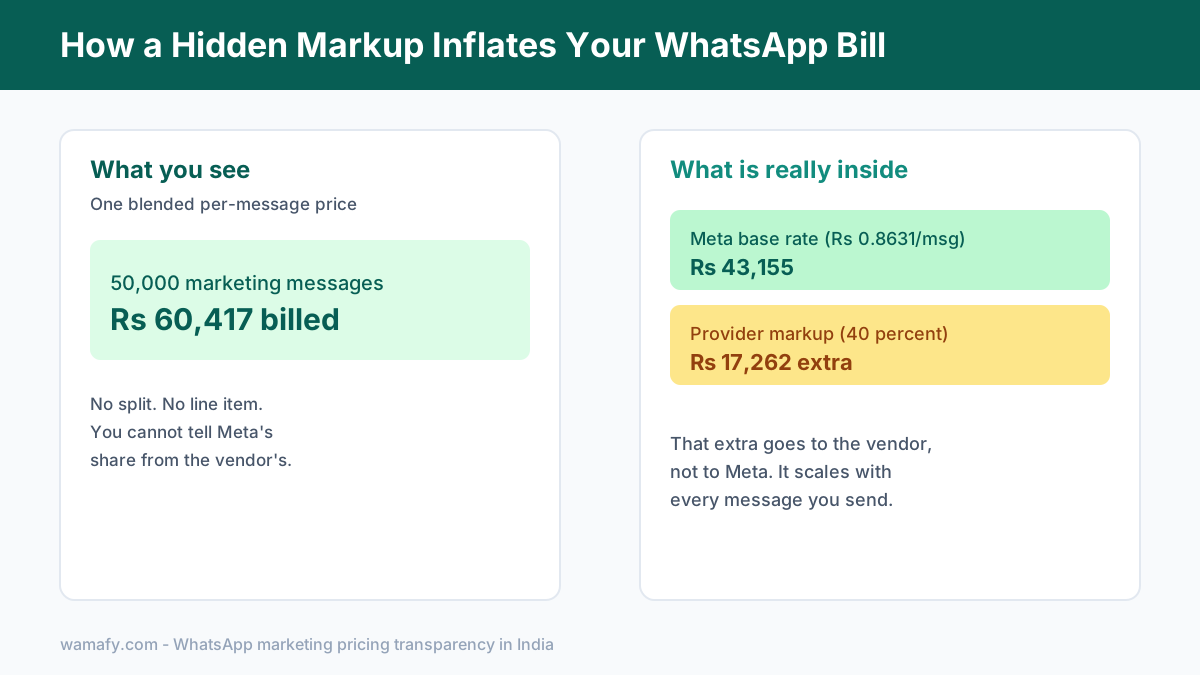
Let us put real figures on it. Say you send 50,000 marketing messages in a month, which is normal for a growing D2C brand during a sale.
- Meta's base cost: about Rs 43,155
- At a 20 percent markup: you pay about Rs 51,786, so Rs 8,631 extra
- At a 40 percent markup: you pay about Rs 60,417, so Rs 17,262 extra
That extra amount goes to your vendor, not to Meta. And it scales with every message you send. The more you grow, the more the markup costs you, which means your most successful months are also your most expensive ones relative to the value you receive. We wrote a fuller breakdown of these numbers in our guide to the real cost of WhatsApp marketing in India if you want the long version.
One detail trips up almost everyone we speak to. In July 2025, Meta moved from per-conversation billing to per-message billing, so each delivered template message is now charged on its own. Founders still call it per-conversation markup out of habit, but the mechanism is identical. A wholesale rate sits underneath, and a discretionary margin gets layered on top of it before the number reaches your invoice.
Why other providers charge markup
We want to be fair here. Markup is not evil. It is just the easiest way to scale revenue for a software business.
When your revenue is tied to message volume, growth is automatic. A customer who sends twice as many messages pays you twice as much, with no new selling. That is a clean model for the vendor. It is also why so many WhatsApp tools price this way.
Flat fees are harder. You have to guess usage, underwrite the risk, and accept that a heavy sender might cost you more than they pay. You give up the easy upside. We understand exactly why most providers do not do it. We just think it pushes the cost anxiety onto the customer, which is the wrong trade for the kind of business our team wants to build.
Why we chose not to
We made the call for three reasons, all rooted in how Indian SMBs actually think.
First, flat fees match how founders budget. A small business owner wants to know the monthly number. Rs 799 is a number you can plan around. A bill that swings with sends is not. WhatsApp marketing pricing transparency in India is not a feature. It is a basic respect for how people run their books.
Second, trust compounds. If a customer ever finds a hidden markup, the relationship is done. They feel tricked. No retention discount fixes that feeling. We would rather earn slower trust than spend years cleaning up a trust breach.
Third, price shock kills more relationships than anything else. A founder who opens a bill that is double last month's does not email support. They churn quietly and warn their network, and in the tight community of Indian D2C operators that warning travels remarkably fast. Predictable pricing is the cheapest churn prevention we know, because it removes the single moment where trust usually collapses.
There is a deeper cultural point underneath all of this. Indian small businesses have lived through decades of opaque vendor pricing, surprise renewal hikes, and fees that appear only at invoice time. When a founder finally finds a tool that shows the whole number upfront, the relief is genuine. We would rather be the boring, predictable option than the clever one that surprises you in month seven.
The honest trade-offs
This was not a free choice. It costs us real things, and we will name them.
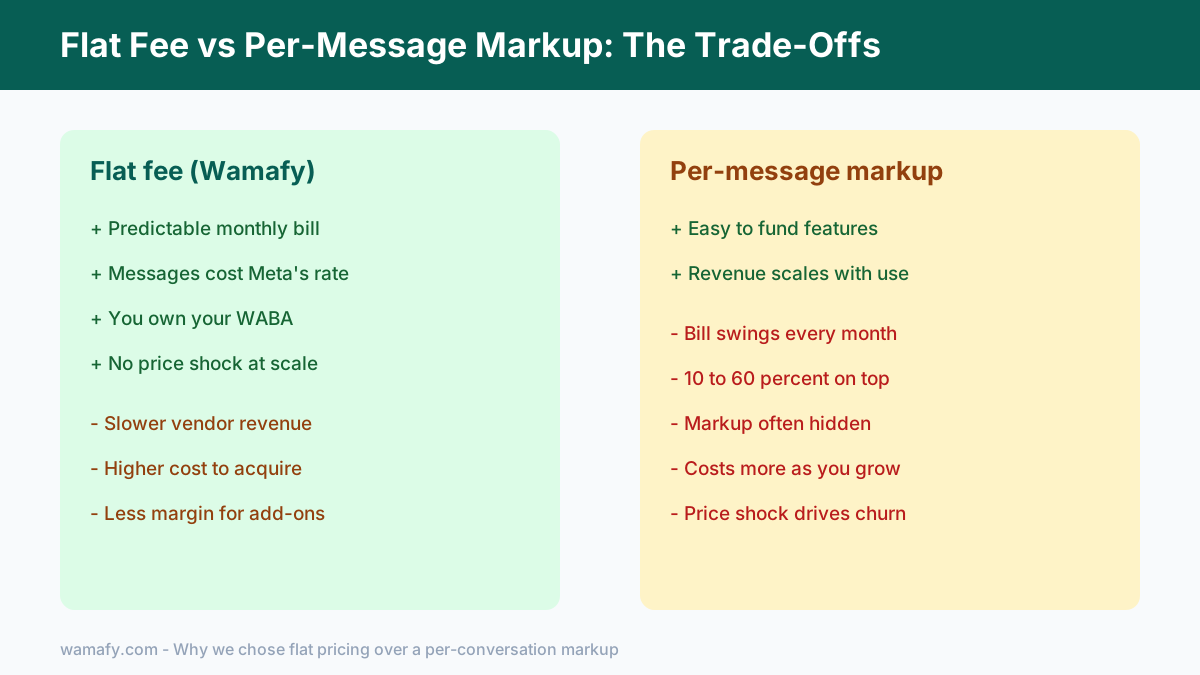
Our revenue per customer grows slower. When a customer sends more, Meta gets paid more, but we do not. Our plan price stays flat. That caps our upside on heavy users.
Our acquisition cost is higher per rupee earned. Because each customer pays a modest flat fee, we have to win more customers to hit the same revenue a markup vendor gets from fewer. That means more content, more support, more patience.
We also have less margin to fund extras. AI agents, a big integration marketplace, fancy add-ons. Those cost money to build. A markup vendor can fund them off message volume. We fund them off flat fees, which means we move slower. We will not pretend otherwise.
What this enables for the customer
The flip side is what you get. A bill you can predict before the month starts. When you scale, you scale with Meta directly, and only Meta's rate moves. There is no second meter running on top.
You also own your WhatsApp Business Account. Your templates and message history are yours. If Wamafy ever stops earning your business, you can walk. We think the right to leave is what keeps a vendor honest, so we built for it on purpose. If you are weighing tools, our comparison of Wamafy, WATI, and AiSensy lays out how the pricing models differ in practice.
The 12-month bet
Here is the wager. If flat-fee WhatsApp marketing is genuinely right for India, the numbers should prove it. By next June, we expect to see lower customer acquisition cost and higher lifetime value than markup-based providers.
The logic is simple. Honest pricing should lower churn. Lower churn lifts lifetime value. Word of mouth from happy founders should lower acquisition cost over time. Our team is tracking trial-to-paid conversion, monthly churn, and net revenue retention to see if it holds.
We might be wrong. Maybe heavy senders genuinely prefer paying per message because variable cost feels fairer when volume is unpredictable. Maybe flat pricing leaves too little margin to build the integrations and intelligence that ambitious teams eventually demand. Those are real possibilities, not rhetorical ones, and we are willing to find out in public rather than pretend we have already solved them.
What we would do differently
In hindsight, a few open questions nag at us. Should we add an optional usage tier for very heavy senders, so we can fund faster development? Should an AI add-on be a paid extra rather than something we delay?
We do not have clean answers yet. What we will not do is bury a markup inside the message price and call it a platform fee. Any future pricing change will be a visible line you can see and choose. That is the one rule we are not negotiating on. If you want a deeper look at how flat pricing stacks up against the ecosystem, our Wamafy vs Interakt comparison shows the gap on a real campaign.
Frequently Asked Questions
What is per-conversation or per-message markup on WhatsApp?
It is the extra amount a provider charges on top of Meta's own rate for each message or conversation. Meta sets a wholesale price, and many providers add 10 to 60 percent on it. The markup is often hidden inside a single blended per-message number.
How much does WhatsApp marketing actually cost in India?
Meta charges about Rs 0.8631 per marketing template message in 2026. On top of that you pay your provider's plan fee and any markup. With a no-markup tool, your message cost equals Meta's rate, and the plan fee is a flat, predictable monthly number.
Does Wamafy add any markup on WhatsApp messages?
No. You pay Meta's rate for messages, and a flat monthly plan fee to Wamafy. There is no per-message or per-conversation surcharge. Plans start at Rs 799 per month, and the messaging cost flows straight to Meta.
Why do most WhatsApp providers charge a markup?
Because revenue that scales with message volume is the easiest way to grow a software business. A flat fee is harder to underwrite, since heavy senders can cost more than they pay. Markup shifts that risk onto the customer in the form of an unpredictable bill.
Can I see exactly what I pay Meta versus the platform?
On a transparent platform, yes. Your messaging charges map directly to Meta's published rates, and your plan fee is a separate, fixed line. If a provider cannot show you that split clearly, that is usually a sign the markup is hidden.
Try it, and tell us where it breaks
If this resonates, see it on your own numbers. Start a 14-day free Wamafy trial. Card authorized during trial activation, charged only on day 15. Run a real broadcast, check the bill against Meta's rates, and tell us if anything does not add up. Our team reads the feedback ourselves, and the honest critiques are how this gets better.