WhatsApp Membership Renewal Reminders for Indian Gyms and Studios
Every January, an Indian gym fills up. Sign-ups run four to six times the normal monthly rate. The owner spends real money to make that happen, and it works.
By March, around 40 percent of those joiners have stopped turning up. By June, revenue is flat despite a record intake, and the owner is already planning next January's campaign.
The campaign is not the problem. The problem is that a gym spends its whole marketing budget on the one date it does not control, and nothing at all on the one date it does: the day a membership expires.
This guide is about that second date. It covers why renewal reminders on WhatsApp beat every other channel open to an Indian fitness business. It gives the exact cadence that works, the ROI in real rupees, and what it costs. It also covers where it will not help you at all.
What this guide covers
- The renewal maths nobody runs
- Why renewals get missed in most Indian gyms
- Why WhatsApp, and not SMS, calls or email
- The five-message renewal cadence
- Writing renewal templates Meta will approve
- Wiring it up: the practical build
- ROI worked for a 200 and a 600 member business
- What it actually costs
- Six mistakes that kill renewal campaigns
- Beyond gyms: studios, clubs and academies
- Compliance: DPDP, opt-in and why there is no DLT
- How this compares to gym management software
- Frequently asked questions
The renewal maths nobody runs
India has roughly 52,300 fitness facilities and about 15.1 million paid gym memberships. That is a penetration of under 1 percent of the adult population, which is why everyone talks about acquisition. It is also why almost nobody talks about retention.
Here is the number that should decide your marketing budget.
The global industry benchmark for annual retention sits around 66 percent, measured across more than 17,000 facilities. Strong boutique operators push 75 to 80 percent. Now apply that to a 200-member gym.
| Annual renewal rate | Members kept | New members needed just to stand still |
|---|---|---|
| 60 percent | 120 | 80 per year |
| 70 percent | 140 | 60 per year |
| 80 percent | 160 | 40 per year |
Moving from 60 to 80 percent halves your acquisition target. You are not chasing growth at that point, you are chasing 40 fewer strangers a year.
Work out what one sign-up costs you. Take last January's total spend on ads, banners, referral offers and free trials, and divide by the number of people who actually joined and paid. Most Indian gym owners have never done this sum. When they do, the figure usually lands somewhere between Rs 800 and Rs 2,000 per paying member.
At Rs 1,200 per sign-up, needing 40 fewer members a year is Rs 48,000 you do not spend. That is before counting the membership revenue you kept.
A renewal is the cheapest member you will ever get. They already know where the gym is, they already trust the trainers, and they have already paid you once.
Why renewals get missed in most Indian gyms
Almost no gym owner decides to ignore renewals. It breaks for structural reasons, and they are worth naming because each one has a different fix.
The expiry date lives in the wrong place. It is in a register, a spreadsheet, or in the software the front desk logs into but nobody opens after 6 pm. Nothing alerts anyone. The date passes silently.
The front desk is busy at exactly the wrong hours. Peak footfall is 6 to 9 am and 6 to 10 pm. That is also when a person is free to take a renewal call. Your staff cannot do both.
Nobody knows who is about to lapse. Ask most owners which members expire in the next 15 days and the honest answer is that they would have to go and look. If a question takes ten minutes to answer, it does not get asked weekly.
The awkward call problem. Asking for money on the phone feels like sales, so it gets postponed. A message does not feel like that, for either side.
Annual plans hide the problem for eleven months. Annual memberships in India typically run 20 to 30 percent cheaper per month than paying monthly, so a lot of members are on them. The lapse is invisible until it happens, all at once, twelve months after a January intake.
Every one of these is a calendar problem, not a marketing problem. That distinction matters, because calendar problems are the kind software actually solves.
Why WhatsApp, and not SMS, calls or email
A renewal reminder has to do three things. Get seen, be answerable in one tap, and carry a way to pay. Compare the options honestly.
| Channel | Gets seen | Can they reply | Setup friction | Cost per message |
|---|---|---|---|---|
| Phone call | Sometimes | Yes | None | Staff time at peak hours |
| SMS | Rarely read | No | DLT registration, 2 to 4 weeks | Rs 0.15 to Rs 0.25 |
| Almost never for this audience | Technically | Low | Near zero | |
| Personal WhatsApp | Yes | Yes | None | Free, but manual and capped |
| WhatsApp Business Platform | Yes | Yes | Setup in minutes | Rs 0.115 utility, Rs 0.8631 marketing |
Two lines in that table deserve more than a row.
SMS carries a registration tax. Business SMS in India runs through the TRAI-mandated DLT framework. You register the entity, register the sender ID, register every template, and wait. That is typically two to four weeks before you send anything. WhatsApp is not classified as telecom SMS, so DLT does not apply to it at all. Your compliance obligations sit with Meta's business policy and India's DPDP Act instead. For a gym owner who wants reminders running next week, that difference is the whole decision.
Personal WhatsApp is the real incumbent, and it is the honest comparison. Most Indian gyms already send renewal messages from a staff phone. It works until it does not. You cannot broadcast beyond a small list without triggering limits, there is no record of who was messaged, the number belongs to whoever holds the phone, and when that person leaves, so does the member list. It does not scale past roughly the point where you stop remembering names.
The Business Platform fixes the scale and ownership problems while keeping the thing that made WhatsApp work in the first place, which is that people actually read it.
The five-message renewal cadence
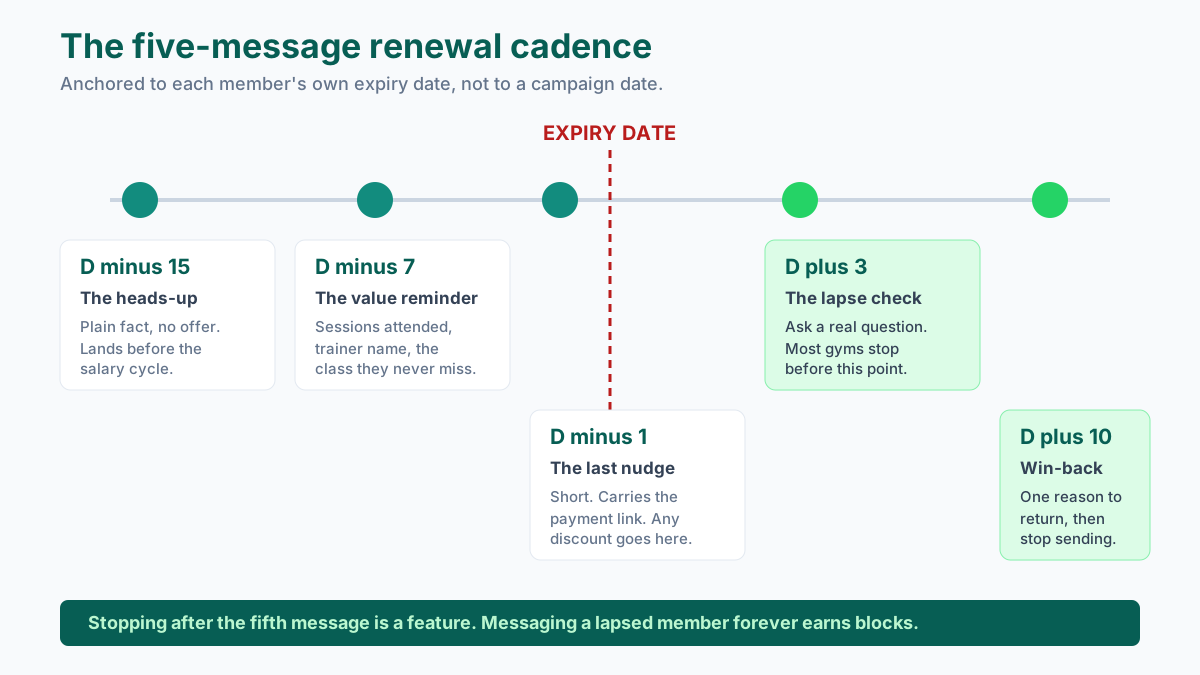
This is the part most people get wrong by doing too much. Five messages across roughly a month, anchored to the expiry date, is enough. More than that is nagging, and nagging costs you the member you were trying to keep.
Call the expiry date D.
D minus 15: the heads-up
Not a sales message. A statement of fact with a renewal option attached. "Your membership at [gym] runs until 28 October. Renewing now keeps your current rate. Tap to renew." Nothing more.
Fifteen days matters because the member has a salary cycle. A reminder that lands three days before expiry competes with rent.
D minus 7: the value reminder
This is the one message where you earn the renewal rather than just request it. Reference what they actually did. Sessions attended, a class they come to every week, their trainer's name. A member who trained 60 times last quarter should be told that number.
If your records cannot support this, send a simpler version rather than a fake one. Members notice invented enthusiasm.
D minus 1: the last practical nudge
Short, specific, and carrying the payment link. "Your membership ends tomorrow. Renew here to keep your slot and your rate." If you offer a renewal discount, this is where it goes, not earlier.
D plus 3: the lapse check
Most gyms stop at expiry. This is the message that separates a 65 percent renewal rate from a 75 percent one.
Three days after lapsing, the member has not decided to quit. They have decided nothing. They just got busy. A message that asks rather than sells works best here: "Your membership ended on Tuesday. Did you want to continue, or should we keep your locker free?" That last clause gets replies, because it is a real question with a real consequence.
D plus 10: the win-back, then stop
One final message with a genuine reason to return. A restart offer, a new batch timing, a class that started since they left. Then stop.
Stopping is a feature. A lapsed member who keeps getting messages blocks the number, and blocks damage your quality rating for every other member on the list.
Writing renewal templates Meta will approve
Any message you send outside an open 24-hour conversation window has to be a pre-approved template. Getting these right saves days of rejection.
Category decides your cost, and the difference is large. A utility template costs Rs 0.115 per message in India. A marketing template costs Rs 0.8631. That is a sevenfold gap, so it is worth understanding where the line sits.
A message about an existing transaction or account status can qualify as utility. A message promoting an offer is marketing. In practice:
- "Your membership expires on 28 October. Renew here." Usually approved as utility, because it concerns an existing agreement.
- "Flat 20 percent off annual renewals this Diwali." Marketing, without question.
- "Your membership expires on 28 October. Renew this week for 20 percent off." Meta will categorise this as marketing, because of the offer.
The practical consequence is to keep your discount out of the first two reminders. Run D minus 15 and D minus 7 as clean utility templates, then spend the marketing rate only on the messages where an offer genuinely changes the outcome. On a 200-member list that single decision is the difference between a few hundred rupees a year and a few thousand.
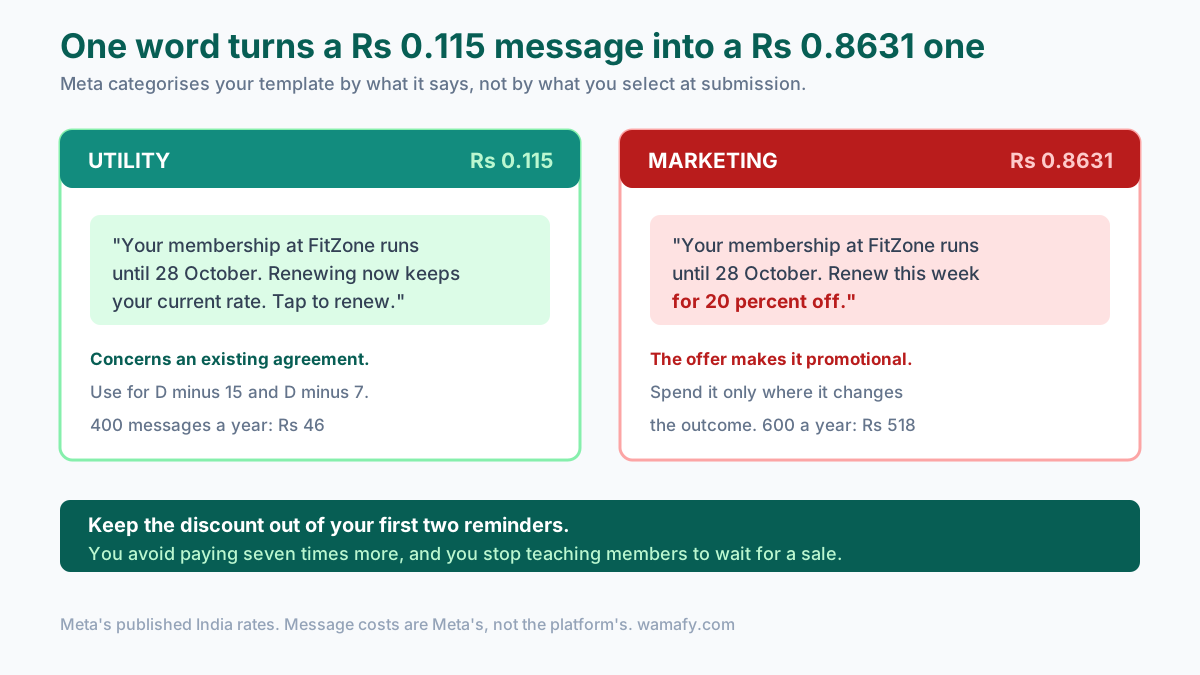
Note that Meta reviews the category it thinks your template belongs to, not the one you select. Writing a promotional line into a utility template gets it re-categorised or rejected.
Four things that get renewal templates rejected:
- Unfilled variable examples. Every placeholder needs a realistic sample value at submission. "Hi {{1}}" with no example is an automatic rejection.
- Shouting. Full capitals, rows of exclamation marks, and aggressive urgency language all fail review.
- Shortened links. Link shorteners get flagged. Use your full domain.
- Vagueness. A template that does not make clear who is writing and why gets rejected. Name the gym in the message body.
Submit your templates at least a week before you need them. Approval is usually fast, but a rejection plus a rewrite plus a resubmission is not.
Wiring it up: the practical build
The whole setup is an afternoon of work, and most of it is data cleaning rather than technology.
Step 1: get the member list into one file
One row per member. Name, phone number in the format your records use, membership type, start date, expiry date, and amount paid. Export it from whatever you use now, including a spreadsheet.
This step takes longer than everything else combined, and it is the step that decides whether any of this works. A reminder sent on the wrong expiry date is worse than no reminder.
Step 2: connect the number
Use a business number, not a personal one. Embedded signup takes a few minutes. The important part for a gym owner is ownership: the WhatsApp Business Account should sit in your own Meta Business Manager, so your number, your templates and your member list stay yours if you ever change platform.
Step 3: import and check the dates
Upload the file. Numbers get normalised to international format and duplicates removed on import, which matters more than it sounds in a business where the same person often appears twice with two phone numbers.
Then sort by expiry date and read the next 30 days. You will find errors. Everyone does.
Step 4: build and submit templates
Five templates matching the cadence above. Two utility, three carrying whatever offer you use. Submit them together.
Step 5: set the reminders running
In Wamafy this is what the Membership Renewals add-on does. You import the member book, set the reminder cadence once, and each member's reminders fire against their own expiry date rather than a campaign date you have to remember. Your own payment link goes in the message, the money reaches your account directly, and marking a member as renewed advances them to the next cycle automatically.
It is a Rs 499 a month add-on, and it works on any plan including Seed at Rs 799. No add-on in Wamafy is locked to a higher tier, which for a single-location gym means the entry plan is genuinely the entry plan.
Step 6: watch the replies
This is the step people skip. Renewal reminders generate replies: questions about timing changes, requests to pause, people asking about a friend joining. Those replies land in a shared inbox, and answering them within the day is where a chunk of the renewal lift actually comes from.
ROI worked for a 200 and a 600 member business
Real numbers, with assumptions stated so you can substitute your own.
A 200-member neighbourhood gym
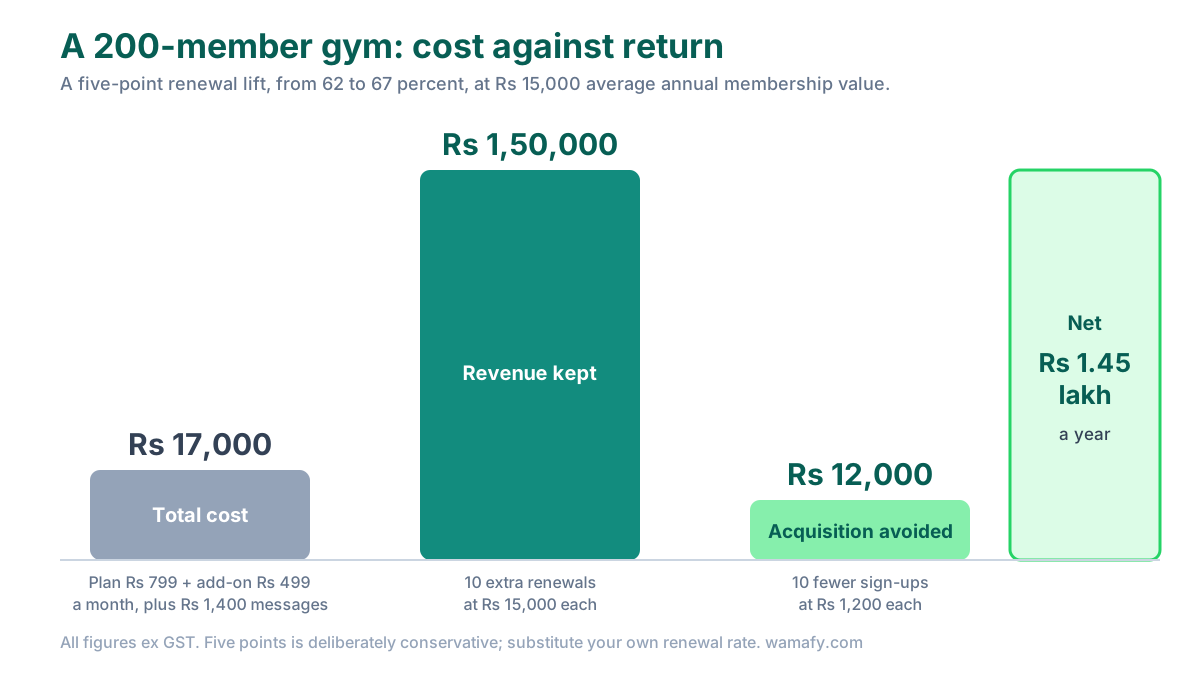
Assume a mid-range city gym. Average membership value of Rs 15,000 a year, which is consistent with mid-range Indian pricing of Rs 1,500 to Rs 4,000 a month with the usual annual discount. Assume a current renewal rate of 62 percent, which is slightly below the global benchmark and realistic for a gym doing renewals by memory.
| Line | Working | Value |
|---|---|---|
| Members renewing today | 200 at 62 percent | 124 |
| Members renewing at 67 percent | 200 at 67 percent | 134 |
| Extra renewals | 10 members | 10 |
| Revenue retained | 10 at Rs 15,000 | Rs 1,50,000 a year |
| Acquisition avoided | 10 fewer sign-ups at Rs 1,200 | Rs 12,000 a year |
| Platform cost | Rs 799 plus Rs 499, twelve months | Rs 15,576 a year |
| Message cost | See below | About Rs 1,400 a year |
| Net | About Rs 1,45,000 a year |
That is a five-point lift, which is deliberately conservative. It is one extra member in twenty. If your current process is genuinely nothing, the lift is usually larger than that, but five points is a number you can defend to yourself before you spend anything.
A 600-member multi-batch gym
Same assumptions, three times the members, and a Bloom plan at Rs 1,599 because you now have more than three staff who need inbox access.
| Line | Working | Value |
|---|---|---|
| Extra renewals at a five-point lift | 600 at 5 percent | 30 members |
| Revenue retained | 30 at Rs 15,000 | Rs 4,50,000 a year |
| Platform cost | Rs 1,599 plus Rs 499, twelve months | Rs 25,176 a year |
| Message cost | 3,000 reminders, mixed categories | About Rs 4,200 a year |
| Net | About Rs 4,20,000 a year |
The pattern to notice is that the cost barely moves while the return scales with your member count. Renewal reminders are one of the few things in a gym's budget where the economics improve as you grow.
What it actually costs
No estimates, no ranges where a real number exists.
| Line | Cost | Note |
|---|---|---|
| Wamafy Seed | Rs 799 a month | 1 number, 3 teammates, 1,000 leads |
| Wamafy Bloom | Rs 1,599 a month | 2 numbers, 10 teammates, 10,000 leads |
| Membership Renewals add-on | Rs 499 a month | Rs 399 billed annually. Works on any plan. |
| Utility template message | Rs 0.115 | Meta's India rate |
| Marketing template message | Rs 0.8631 | Meta's India rate |
| GST | 18 percent | On the subscription |
Message costs for a 200-member gym, running the five-message cadence with two utility and three marketing messages per member per year:
- 400 utility messages at Rs 0.115 is Rs 46
- 600 marketing messages at Rs 0.8631 is Rs 518
- Add replies and ad-hoc messages, and the realistic annual figure is around Rs 1,400
Two honest caveats on cost.
First, the message rates are Meta's, not the platform's. Any provider charging you more than Meta's published rate is adding a margin. Wamafy passes them through, but you should check this with whoever you buy from rather than take anyone's word for it, including this page. The full breakdown of WhatsApp marketing costs in India shows how to read a rate card.
Second, from 1 October 2026 the free 24-hour service window closes. Replies your staff send inside it become billable at the utility rate. For a gym answering renewal questions this is small, likely a few hundred rupees a year, but it is no longer zero and it is worth knowing before it appears on a bill.
Six mistakes that kill renewal campaigns
1. Starting with a dirty member list. Wrong expiry dates produce wrong reminders, and a member told their membership expires when it does not will trust nothing you send afterwards. Spend the afternoon on the spreadsheet.
2. Leading with the discount. If your first reminder offers 20 percent off, you have taught every member to wait for the discount. Renewal offers should appear late in the cadence and only for members who did not respond to the plain version. Otherwise you are paying to discount people who would have renewed anyway.
3. Sending everything as marketing. Running all five messages at the marketing rate instead of categorising the first two as utility costs you roughly seven times more on those messages, for no benefit.
4. Expecting reminders to fix an attendance problem. This is the big one. A member who stopped coming in week three will not renew because of a well-timed message. Reminders recover members who drifted, not members who were never onboarded. If 40 percent of your January intake disappears by March, the fix is a day-three check-in and a first-month plan, not a better expiry reminder ten months later. Renewal reminders and onboarding solve different problems, and only one of them is a calendar problem.
5. No one watching the inbox. Reminders generate replies. Unanswered replies are worse than no campaign, because the member now knows you sent an automated message and ignored their response.
6. Never stopping. Two post-expiry messages, then silence until they come back. Continuing past that earns blocks, and blocks degrade delivery for your whole list.
Beyond gyms: studios, clubs and academies
Anything sold as a fixed-term membership has the same shape, and the same cadence works with small adjustments.
| Business | What changes |
|---|---|
| Yoga and pilates studios | Shorter cycles, often monthly. Compress the cadence to D minus 7, D minus 2 and D plus 3. |
| Dance and martial arts academies | Term-based and often tied to a child's school calendar. Send to the parent's number, and reference the batch rather than the individual. |
| Sports clubs and swimming pools | Annual, seasonal, and highly weather-dependent. Time the win-back to the start of the season, not the lapse date. |
| Cricket academies and coaching centres | Renewal decisions cluster around exam results and school terms. Avoid sending during board exam weeks. |
| Residential society facilities | Annual, low churn, but heavy on paperwork. The reminder matters less than the payment link. |
One India-specific timing note that applies across all of these. Demand spikes in January, again around Ugadi and Gudi Padwa, and mildly before wedding season. It falls through the monsoon and through the festive months. If you are choosing when to push win-back offers at lapsed members, the weeks running into January and the fortnight after a regional new year will outperform a random Tuesday in August by a wide margin.
Compliance: DPDP, opt-in and why there is no DLT
Three things to get right, none of them onerous.
Opt-in. You need permission to message a member on WhatsApp. For a gym this is straightforward, because it can sit in your membership form: a line stating that you will send membership and renewal updates on WhatsApp, with the member's signature on the form. Keep the forms. Some members joined before you added that line. The cleanest route there is to message them once from your existing personal WhatsApp, ask if they want updates on the business number, and import the ones who say yes.
DPDP Act. India's data protection law applies to the member data you hold: names, numbers, attendance, payment records. The practical obligations for a gym are to collect only what you need, tell members what you use it for, and be able to delete a member's data if they ask. Storing the member book in a platform rather than on a departed employee's phone is an improvement on both counts.
No DLT. Worth restating because it surprises people who have run SMS before. WhatsApp is not telecom SMS, so TRAI's DLT registration does not apply. There is no entity registration, no sender ID approval, and no template registration with a telecom operator. Meta's own template approval replaces all of it, and it takes minutes rather than weeks.
What you do still need is an easy opt-out. Every marketing template should carry one, and honouring it immediately is not optional. A member who wants out and cannot get out will block the number, which costs you more than the member.
How this compares to gym management software
The obvious question: your gym software probably already claims to send reminders. Should you just use that?
Sometimes, yes. Here is the honest comparison.
Indian gym management platforms run from about Rs 500 a month for basic tools to Rs 2,000 to Rs 5,000 for mid-range, and Rs 5,000 to Rs 15,000 for premium studio software. They handle things a messaging platform does not: attendance, biometric entry, trainer rostering, invoicing, and often UPI auto-debit.
Use your gym software's reminders if it already holds accurate expiry dates, it sends on WhatsApp rather than SMS, and you are happy with the message quality. That is the simplest setup and you should not add a second tool for the sake of it.
Add a messaging platform if any of these apply. The reminders go out as SMS. There is no two-way inbox, so replies vanish. You cannot see delivery and read status. The templates cannot be edited properly. Or the WhatsApp sending is resold at a markup rather than billed at Meta's rates.
That last point is the one to check first. A number of gym platforms bundle WhatsApp sending and charge Rs 0.50 to Rs 0.85 per message for it. Meta's utility rate is Rs 0.115. On a few thousand reminders a year the difference is not enormous, but you should know you are paying it, and it grows with every class alert and payment receipt you add.
The other structural difference is ownership. When a gym platform sends WhatsApp messages on your behalf, the WhatsApp Business Account is frequently theirs, not yours. Ask the question directly before you build anything on top of it, because it determines whether you can leave.
Frequently asked questions
How many renewal reminders should a gym send?
Five across roughly a month works well: fifteen days before expiry, seven days before, one day before, three days after, and ten days after. The two messages after expiry do a disproportionate amount of the recovery, because a lapsed member has usually not decided to quit. Stop after the fifth message.
Will renewal reminders annoy members?
Not at this frequency, and not when the first two messages are factual rather than promotional. Complaints come from volume and from irrelevance, not from being reminded that something you pay for is expiring. The risk rises sharply if you keep messaging after a member has clearly lapsed, which is why the cadence ends.
Can I send renewal reminders from my personal WhatsApp instead?
You can, and many gyms do. It works until you reach the point where broadcast limits, missing records, and the fact that the member list lives on one employee's phone start to cost you. It also gives you no delivery data, so you cannot tell whether a message was seen. The switch is usually worth making somewhere around 150 to 200 members.
What does it cost to run this for a 200-member gym?
About Rs 1,298 a month for the plan plus the Membership Renewals add-on, ex GST, and roughly Rs 1,400 a year in message costs. That is close to Rs 17,000 a year in total. A five-point renewal lift on 200 members at Rs 15,000 average membership value returns about Rs 1,50,000.
Do I need DLT registration to send WhatsApp reminders in India?
No. DLT is TRAI's framework for telecom SMS and does not cover WhatsApp. You do need Meta template approval, which usually takes minutes to a few hours rather than the two to four weeks DLT registration takes. Your compliance obligations sit with Meta's business policy and the DPDP Act.
Can I take the renewal payment inside WhatsApp?
You send your own payment link in the message and the member pays through your existing gateway, so the money reaches your account directly. Wamafy does not hold or process your funds. This means you keep your current settlement terms and you are not adding a payment intermediary.
What if my expiry dates are messy or spread across registers?
Fix that first, before you send anything. A reminder based on a wrong date damages trust more than no reminder at all. Consolidate into one spreadsheet with one row per member, sort by expiry date, and read through the next thirty days manually. Errors surface quickly when the list is sorted.
Will this fix members who stopped attending?
Mostly no, and it is worth being clear about it. Reminders recover members who drifted away from a habit they still want. They do not recover someone who never built the habit. If a large share of your intake stops attending within the first six weeks, the problem is onboarding, and a day-three check-in with a beginner plan is the intervention that works there.
Is there a tier I need to be on to get renewal reminders?
No. The Membership Renewals add-on is Rs 499 a month and works on every Wamafy plan, including Seed at Rs 799. Add-ons are not locked to higher tiers, so a single-location gym does not have to buy capacity it will not use to get the feature it needs.
How long does setup take?
An afternoon, of which most is cleaning the member list. Connecting a number takes minutes, importing the list takes one upload, and template approval is usually same-day. Submit templates about a week before you need them so a rejection does not cost you a renewal cycle.
Start with one month of expiries
Do not build the whole system first. Pull the list of members expiring in the next thirty days, which is usually somewhere between fifteen and forty people, and run the cadence on them by hand if you have to.
Count how many renew. That number is your baseline, and it is the only figure that tells you whether any of this is worth automating in your particular gym.
When you are ready to stop doing it by hand, start a 14-day free Wamafy trial. Your card is authorised when the trial begins and charged only on day 15, so a full renewal cycle fits inside the window. Import the member book, set the cadence once, and let the expiry dates do the work they were always capable of doing.
Now wire it up →
Step-by-step Help guides for the moves above.