A WhatsApp Ordering System for Restaurants in India
Ask a restaurant owner what Swiggy costs them and you will usually hear a number between 18 and 25 percent. That is the base commission, and it is not what leaves the account.
Add the per-order platform fee, GST, and the discounts you are expected to co-fund. The real deduction on an Indian food order runs closer to 25 to 35 percent. Against cloud-kitchen margins that sit below 10 percent, that is the whole business.
But the commission is the visible cost. There is a second one that never appears in any spreadsheet, and it is the one that decides whether you still have a kitchen in three years.
You do not get the customer.
Their name, their number, what they ordered, how often they order, the fact that they always ask for extra green chutney. All of it sits on the aggregator's servers. You cannot send them a Friday special. You cannot win them back after six quiet weeks. Every single repeat order from that customer is charged at full commission, forever, because you have no way to reach them without paying the toll again.
This guide is about building the other channel. A WhatsApp ordering system for restaurants in India takes the order, takes the money and tracks the delivery. And it leaves you holding the customer list.
What this covers
- What an aggregator order actually costs
- The cost nobody puts in the spreadsheet
- Why the usual escape routes fall short
- Why WhatsApp fits food ordering specifically
- The setup playbook, step by step
- What the customer actually experiences
- Working a live service
- The ROI maths, with real numbers
- Getting your first 100 direct orders
- Trade-offs and mistakes
- Frequently asked questions
What an aggregator order actually costs
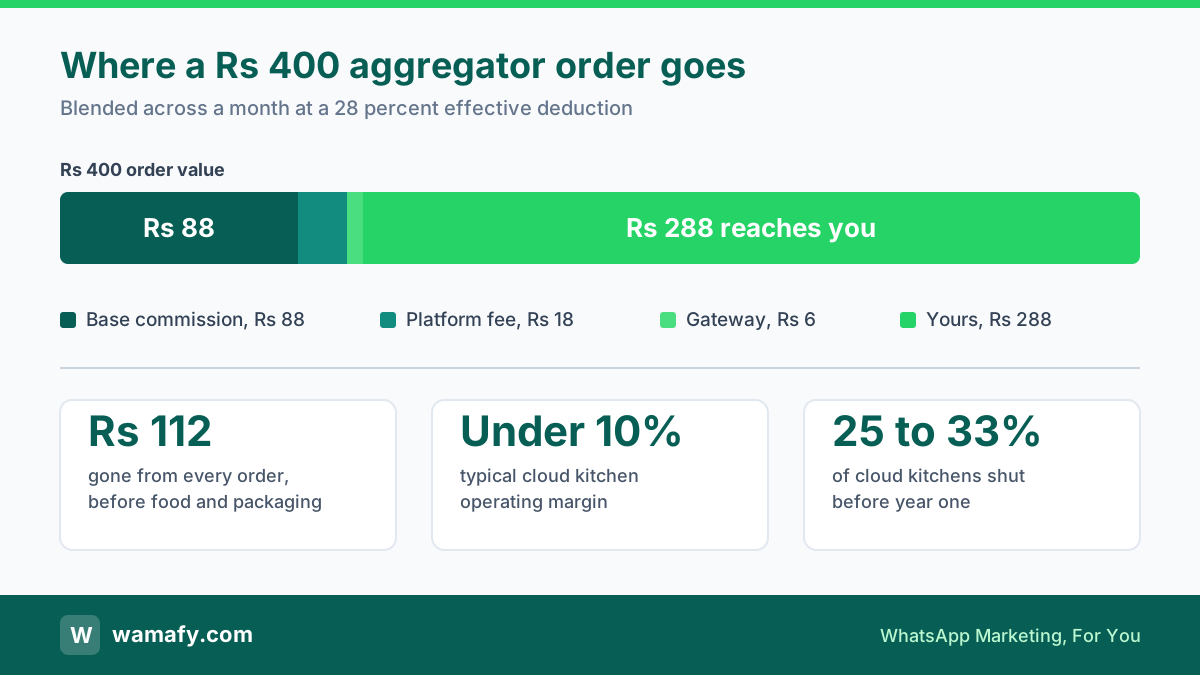
Take a Rs 400 order. Here is roughly where it goes on a major platform in 2026.
| Line | Typical | On a Rs 400 order |
|---|---|---|
| Base commission | 17 to 28 percent | Rs 68 to Rs 112 |
| Platform fee per order | Around Rs 17.58 | Rs 18 |
| Payment gateway charge | 1 to 2 percent | Rs 4 to Rs 8 |
| Discounts you co-fund | Often 10 percent, on the orders that carry one | Rs 0 to Rs 40 |
| Blended deduction across a month | 25 to 35 percent | Rs 100 to Rs 140 |
The last row is not the sum of the rows above it. The worst case on every line almost never lands on the same order, and not every order runs a discount. What matters is the blended figure across a month, and for most Indian kitchens that sits between 25 and 35 percent.
The base commission is negotiable and varies by city, cuisine, how old your outlet is and how hard you pushed. The rest mostly is not.
Now put that against your food cost, your rent, your staff and your packaging. Roughly a quarter to a third of cloud kitchens in India close before their first anniversary, and this arithmetic is a large part of why.
The cost nobody puts in the spreadsheet
Here is the number that matters more than the commission.
Around 70 percent of first-time restaurant guests never order a second time. The average repeat rate sits near 38 percent, with about nine days between repeat orders. Below 25 percent and you have a leak. Above 40 percent and you have a business that can survive without anybody else's app.
Repeat orders are the cheapest revenue in food. You already paid to win that customer once. The second order should cost you almost nothing.
On an aggregator, it costs you the same 25 to 35 percent as the first one. Forever. And you have no way to prompt it, because you do not have the customer's number.
Kitchens with their own direct channel report much higher repeat rates, around 30 percent better than those relying on aggregators. That is not because the food is different. It is because you can send a message.
The commission is what an aggregator charges you. The customer list is what it keeps.
Why the usual escape routes fall short
Every restaurant owner has been sold one of these. All three are real options, and all three have a catch worth knowing before you spend money.
Your own app
The pitch is control. The reality is a home screen that is already full. Your biryani place has to beat the bank app and the cab app for a slot, and it will not. You pay to build it, you pay to maintain it, you pay to get installs, and the install is where you lose almost everyone. Apps work for chains with daily-habit frequency. For a single kitchen, the download is a wall.
Your own website
Better than an app, because there is nothing to install. But a website has no distribution of its own. You still have to get someone to type your name into a browser, and the customer has to remember you exist at the moment they are hungry. It also does nothing about the repeat problem unless you separately capture and message the customer.
ONDC
Genuinely worth looking at. Commission runs around 3 to 5 percent against 25 to 30 on the big platforms, it is live across 600-plus cities, and it lets you keep pricing control. The catch is that ONDC is still a marketplace: discovery is someone else's, and buyer-side adoption is uneven by city and category. Treat it as a second, cheaper aggregator rather than as your own channel.
None of these are wrong. But notice that none of them start where your customer already is.
Why WhatsApp fits food ordering specifically
Your customers already message you. That is not a theory. It is happening in your phone right now. People ask whether you deliver to their area, what is on today, and how much for two portions.
Four things make WhatsApp fit food better than it fits most categories.
- Nothing to install. The channel has near-total reach in India and zero acquisition friction. No download, no signup, no password.
- Ordering is conversational anyway. Food orders involve questions. Is the paneer spicy? Can you make it less oily? A chat handles that; a checkout page does not.
- The thread is the receipt. Your customer scrolls up and finds their last order. Reordering is a matter of asking.
- You own the contact. This is the whole point. Once someone orders from your number, they are yours to message, within the rules.
The honest limit: WhatsApp gives you no discovery. An aggregator puts you in front of people who have never heard of you. WhatsApp only works with people who already know your name. That is why the answer is almost never "leave the aggregators", and almost always "stop paying full price on the customers you already earned".
The setup playbook, step by step
A food flow needs things a generic online store does not. It has to know whether you can even reach the customer. And it has to treat delivery and pickup as different journeys. Here is the order to build it in.
1. Your identity and receipt numbers
Logo, address, phone, GST and FSSAI go on the receipt PDF as your letterhead. Set your own order numbering too, with a prefix and a starting number, so you get ORD-0001 rather than a random string. The number is stamped on the order when it is placed and stays with it, so changing the prefix later does not rewrite old receipts.
2. Hours, and what happens when you are shut
Set the days and times you take orders. A customer who messages at 11.40pm gets told when you open, instead of being walked through a menu you cannot cook from. Hours run in your workspace timezone, not the customer's phone.
These are workspace defaults. A branch that opens later can override them and keep everything else.
3. Delivery reach and charges
This is the part that separates a food flow from a shop flow. You set:
- Delivery radius - the straight-line distance a branch will serve.
- Delivery fee - added to delivery orders only.
- Free delivery above - the order value where the fee is waived.
- Delivery and pickup switches - turn either off entirely.
Two rules that trip people up. A pickup order never carries a delivery fee, whatever the total. And the fee applies only below the free-delivery threshold. Say the fee is Rs 50 and delivery is free above Rs 300. A Rs 200 order pays Rs 50. A Rs 350 order pays nothing.
4. Your branches
Each branch gets its own location. That pin plus the radius is what decides which kitchens a given customer can even see. A chain with four outlets across a city stops sending south-side customers to the north-side kitchen, because the system will not offer it.
5. The menu
Dishes carry a name, description, price and course. Photos help, with one caveat worth planning around: WhatsApp shows three photos per screen, so a course with four photographed dishes becomes two screens for the customer to scroll.
A dish is available at every branch unless you say otherwise. A chain can give one outlet its own price, or mark a dish unavailable there, without touching the others.
If you already have a menu in a spreadsheet, import it. Download the template first so the headers match, and rows are matched on dish name, which means re-importing a corrected sheet updates your menu instead of duplicating it.
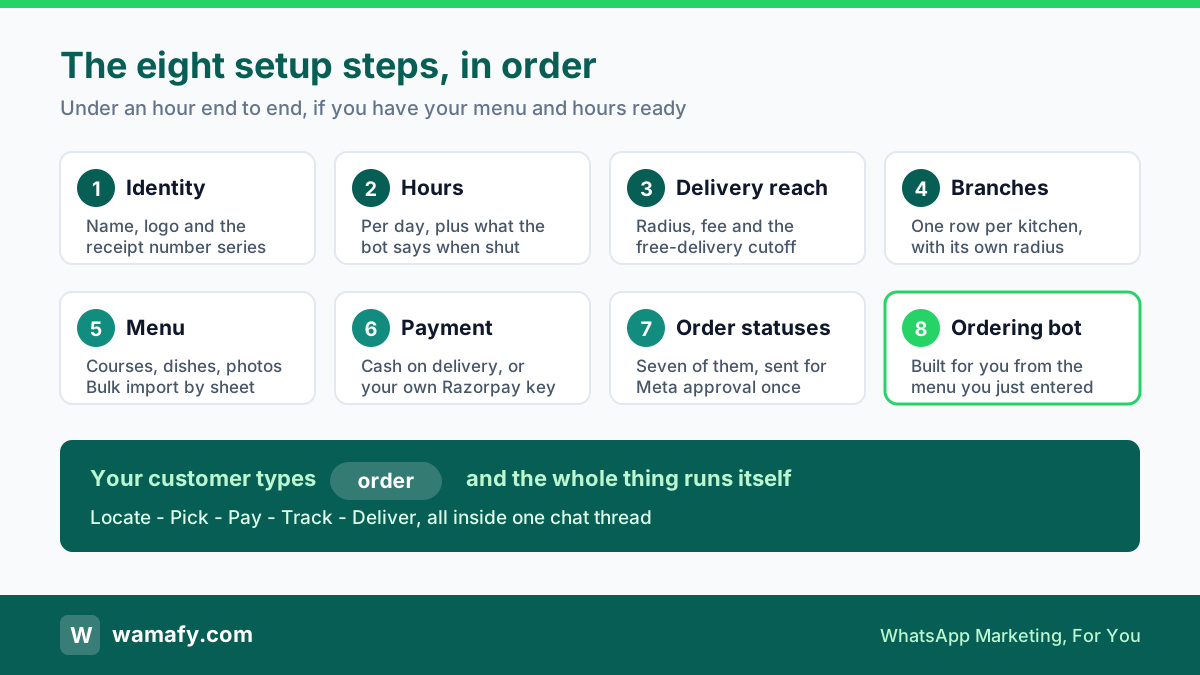
6. How customers pay
Three real paths, and you can offer more than one.
| Path | What the customer gets | What you do |
|---|---|---|
| Payment gateway | A real payment link for the order total | Nothing. The gateway confirms it. |
| UPI | Your QR and UPI ID with the amount | Check the screenshot they send. |
| Pay on delivery | No payment step at all | Collect at the door. |
If you offer both a pay-now method and cash, the customer picks in the conversation. If you only have one, nothing is asked. Every order records which way it went, so you always know whether the money is in or riding back with the driver.
Worth saying plainly: the order is created before any payment step. Plenty of Indian kitchens take cash at the door, and the flow does not assume otherwise.
7. Status templates
WhatsApp only lets you message a customer outside a 24-hour window using a template Meta has approved, and most order updates fall outside that window. You need seven. Order confirmed. Out for delivery. Out for delivery with rider details. Ready for pickup. Delivered or collected. Cancelled. And the job message that goes to your driver.
Meta usually reviews these in minutes. Until one is approved that status simply is not announced, which never blocks you from moving the order along. For wording that clears review first time, see these WhatsApp template message examples.
8. Build the ordering bot
The conversation and the order form are generated from everything above. Customers start it by messaging order, menu or food.
One habit to build: rebuild after you change anything a customer sees. A dish, a price, availability, a branch, your hours, how you take payment. The menu is baked into the form, so until you rebuild, customers keep seeing yesterday's version. This is the single most common support question, and it is entirely avoidable.
What the customer actually experiences
The sequence is deliberately ordered so nobody wastes effort.
- They message order. If you are shut, they are told when you open, and it stops there.
- Delivery or pickup? Skipped entirely if you only do one.
- For delivery, they share their location. Only branches that genuinely reach that pin are offered, nearest first. If none do, they are told, and offered collection instead.
- The address is asked after the branch, not before. Repeat customers get their saved addresses first.
- The menu opens as a form. They pick dishes and quantities; the total is worked out from your prices and your delivery rule.
- Payment, the way you set it up.
- A receipt on your letterhead, with their order number.
Notice step four. Ask for the address only after a branch is matched. It is a small decision, and it removes the most annoying failure in food ordering. Nobody wants to type out a full address and then be told you do not deliver there.
There is a nice detail for gift and family orders too. If the pin someone shared and the address they picked are far apart but both inside your delivery area, they are asked which one to use. That is what lets a customer sitting in an office order dinner to their parents' house.
Working a live service
During service you keep one screen open. Filter by status, by delivery or pickup, by online payment or cash, and by branch. Search a name or a phone number when someone calls.
Each row moves the order forward, and what it offers depends on the order. A pickup order is offered "ready for pickup" and never "out for delivery", so a customer walking in is never told a rider is coming. A cash order can go straight from awaiting payment to out for delivery, because the money arrives with the driver.
Every status that matters is announced once. Reopening an order to fix a typo does not fire a second "your order is on its way".
Sending an order out with a driver
This part is worth understanding, because it is where most delivery software asks you to buy something else.
Marking an order out for delivery asks for the delivery person's name and number. Both or neither: telling a customer "someone is on the way" with no number to call is worse than saying nothing.
When you fill them in, three things happen:
- Your customer gets the on-its-way message naming the driver and their number.
- Your driver gets the job: order number, customer name and number, the delivery address, and a tappable map pin. Riders navigate by the pin, because a typed Indian address often is not findable.
- The driver closes the order by replying DELIVERED with the order number, for example delivered 1001. That marks it delivered and tells the customer.
The driver needs no app and no account. For a kitchen running two bike riders, that is the difference between a system you can actually adopt and one you cannot.
The ROI maths, with real numbers
Here is the honest version, including the costs.
What it costs to run
| Line | Monthly |
|---|---|
| Wamafy plan (Seed) | Rs 799 |
| Restaurant & Delivery add-on | Rs 999 billed annually |
| Status messages, 300 orders at 3 utility templates each | About Rs 104 |
| GST at 18 percent | About Rs 324 |
| All in | About Rs 2,225 |
Utility templates cost roughly Rs 0.115 each in India against about Rs 0.8631 for marketing ones. Order confirmations and delivery updates are utility. Categorising them correctly is an eightfold difference on your message bill, and it is the most common avoidable cost in this whole setup. There is more on that in the guide to the real cost of WhatsApp marketing in India.
What it saves
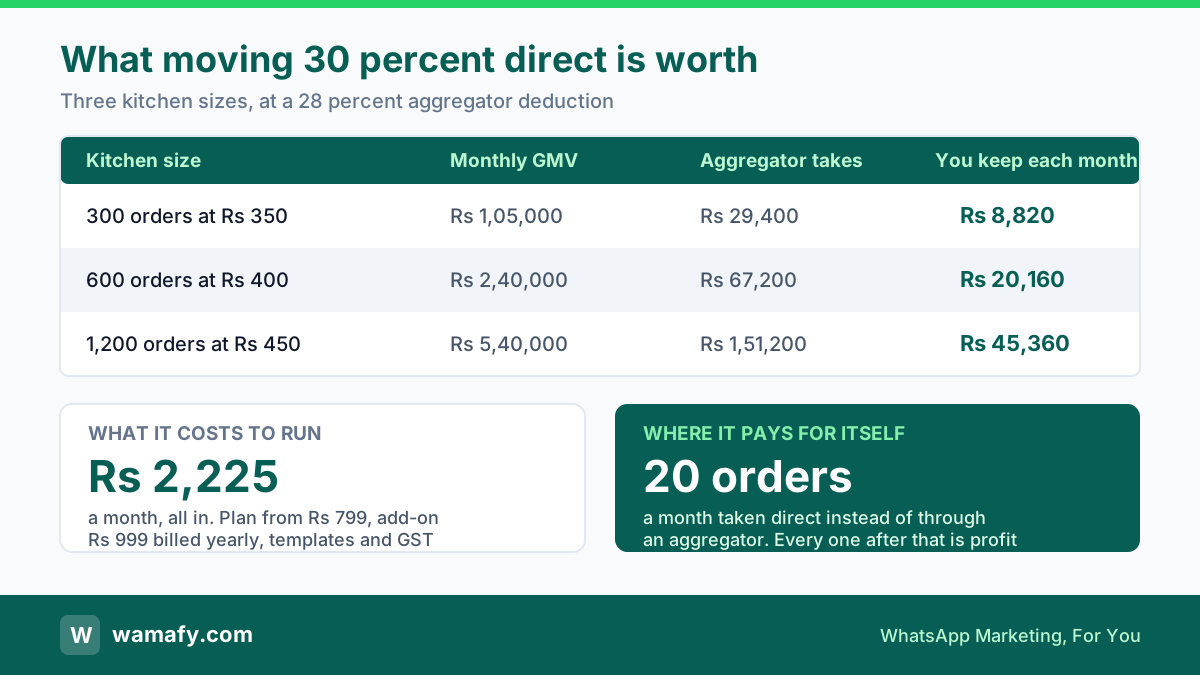
Assume a 28 percent effective deduction, which is mid-range for 2026.
| Kitchen size | Monthly GMV | Aggregator takes | Move 30% direct, save |
|---|---|---|---|
| 300 orders at Rs 350 | Rs 1,05,000 | Rs 29,400 | Rs 8,820 |
| 600 orders at Rs 400 | Rs 2,40,000 | Rs 67,200 | Rs 20,160 |
| 1,200 orders at Rs 450 | Rs 5,40,000 | Rs 1,51,200 | Rs 45,360 |
At a Rs 400 average order and a 28 percent deduction, every direct order keeps about Rs 112 in your account. Around 20 direct orders a month covers the entire subscription. A kitchen doing 600 orders needs to shift one in thirty to break even.
That is the part worth sitting with. This is not a bet that has to work at scale to pay off. It pays off at twenty orders.
Getting your first 100 direct orders
Here is what most guides skip. Setting up an ordering system does not create demand. You have built a channel; now people have to use it.
This is the hard part, and worth being blunt about. Do nothing to drive customers to your number and you will get almost no orders. Then you will decide the channel does not work.
What actually moves it:
- Put a card in every aggregator order. The one moment you have a customer's attention is when they open the bag. Put a small printed card in every bag. Your number, a QR to the chat, and a real reason to switch. Free delivery, an extra portion, ten percent off. Nothing else you do will convert as well. Check your aggregator's terms first, since some restrict this.
- Put the QR on the table, the counter and the bill. Dine-in customers are your warmest list and almost nobody captures them.
- Reply to the people already messaging you. You probably have dozens of conversations asking "do you deliver to X". Those people already tried.
- Use your Instagram bio. Food is a visual category and most kitchens already post. A click-to-WhatsApp link in the bio turns followers into a list.
- Ask at the door. A rider handing over a bag can say one sentence: next time, message us directly and delivery is free.
Expect the switch to be gradual. Customers have habits, and the aggregator app is a habit. Twenty percent of your existing customers over six months is a realistic, and very profitable, outcome.
Once they are on your list, the second half of the value opens up: you can message them. A Friday special to 400 past customers costs about Rs 345 in marketing templates and reaches a group with a 38 percent baseline repeat rate. That is the part an aggregator will never let you do.
Trade-offs and mistakes
Five things worth knowing before you start, including the ones that argue against doing this.
You still need the aggregators
They provide discovery. A new customer in your area who has never heard of you will find you there, not on WhatsApp. The goal is not to leave; it is to stop paying full commission on customers you have already won. Kitchens that go direct-only usually discover their order count falls faster than their costs.
Delivery is now your problem
The aggregator was doing something real for that commission. On direct orders you need your own riders or a logistics partner. If you have no delivery capability at all, start with pickup only, prove the channel, then add delivery.
Forgetting to rebuild the bot
Change a price, forget to rebuild, and customers keep ordering at the old price all week. Make it part of the same habit as updating the menu board.
Sending too much
You now have a list, and the temptation is to message it constantly. Two to four marketing messages a month is the range that works. Weekly is fine if every message carries a real offer. Twice a week and you start collecting blocks, which lower your quality rating and cut how many customers you are allowed to message at all.
Treating the external-menu shortcut as equivalent
You can point the bot at your own existing ordering website instead of using the menu form. It keeps branch matching, which your site does not know how to do. But it costs you order history, totals, repeat-order data, delivery status, receipts and revenue attribution. If you already have a working site, it is a reasonable bridge. As a destination, it gives back most of what you came for.
Frequently Asked Questions
What does an aggregator really cost per order in India?
The base commission is usually 17 to 28 percent. Add the per-order platform fee, payment charges and co-funded discounts, and the real deduction lands between 25 and 35 percent. On a Rs 400 order that is roughly Rs 100 to Rs 140.
Do I have to leave Swiggy and Zomato to do this?
No, and you probably should not. Aggregators give you discovery you cannot replicate on WhatsApp. The aim is to move repeat customers onto your own channel while keeping the platforms for new-customer reach.
How many orders do I need for this to pay for itself?
At a Rs 400 average order and a 28 percent effective deduction, each direct order keeps about Rs 112. Around 20 direct orders a month covers the plan, add-on, messages and GST.
Can customers order for pickup as well as delivery?
Yes, and the two are treated as different journeys. A pickup order never asks for a delivery address and never carries a delivery fee. If you only offer one of them, the customer is never asked to choose.
What if a customer is outside my delivery area?
They are told so, and offered collection instead. Because branch matching happens from their shared location before the address is requested, nobody types out a full address only to find out nothing reaches them.
Do my delivery riders need an app?
No. The rider gets the job as a WhatsApp message. It carries the order number, customer details, address and a tappable map pin. They close it by replying DELIVERED with the order number. No app, no account, no training.
Can I take cash on delivery?
Yes. The order is created before any payment step, so cash works exactly as it does today. Each order records whether it was paid online or is coming back with the driver.
How do I handle multiple branches with different prices?
One shared menu, with per-branch price overrides and per-branch out-of-stock marking. The customer's shared pin decides which branch they order from, so the right prices and availability follow automatically.
What does this cost to run?
A Wamafy plan from Rs 799 a month plus the Restaurant and Delivery add-on at Rs 999 a month billed annually, which is about Rs 1,800 before GST. Order status messages are utility templates at roughly Rs 0.115 each.
Is WhatsApp ordering compliant in India?
Order confirmations and delivery updates are service and utility communication to customers who placed an order, which is straightforward. Promotional broadcasts need opt-in and an easy way out. The general rules are covered in the guide to WhatsApp marketing compliance in India.
Where to start
Do not try to move your whole business in a week. The kitchens that make this work follow roughly the same path.
- Set up branches, radius, menu and hours. An afternoon.
- Turn on pickup only if you have no riders yet. Prove the flow.
- Put a card in every aggregator bag and a QR on every table.
- Add delivery once orders are actually arriving.
- After a month, message your list once with a Friday special and watch what a repeat order costs when nobody takes a cut.
The commission you save is the part you will notice first. The list you build is the part that matters in year three.
Wamafy is an official Meta Tech Provider with no markup on Meta's message rates. Plans start at Rs 799 a month, and the Restaurant and Delivery add-on is Rs 999 a month billed annually. Start a 14-day free trial and set up your first branch this week. The card is authorised when the trial begins and charged only on day 15.
For the wider picture of what a WhatsApp channel does for a small business, see growing your business on WhatsApp.
Now wire it up →
Step-by-step Help guides for the moves above.