What a Big Billion Days Week Actually Costs on WhatsApp
Most posts about WhatsApp campaign cost for a festive sale stop at the broadcast bill. That is the line you can see coming. The invoice Meta sends you in November has three more lines on it, and one of them did not exist last year. This post builds the full bill for the 8 to 16 October sale week on a real list of 8,000 contacts, then shows what a platform markup does to that number, then shows why this is the first sale week where the support line is not free. If you have not put these numbers in a sheet yet, do it before 5 October.
The dates first, because they moved. Flipkart confirmed on 16 September that Big Billion Days 2026 opens on Friday 9 October, with early access for Plus, Black and Flipkart card members on Thursday 8 October. Amazon's Great Indian Festival opens on Thursday 8 October, Prime members from the 7th. Neither has announced an end date; the pattern is about a week, so plan for 8 to 16 October, which sits inside Navratri. Earlier estimates, including one on this blog, had the sale in the last week of September. That was wrong.
The short version. On 8,000 contacts, a properly segmented sale week costs about Rs 24,300 in Meta fees before GST, and marketing messages are 96 percent of it. A per-message markup of 20 percent adds about Rs 4,700 to the same week. And because the sale now falls after 1 October, your support replies during it are billable for the first time, and so are the returns and delivery questions in the week after.
The message plan a sale week actually produces
The Big Billion Days plan laid out a five-step arc across the sale week: an early-access teaser, a day-one offer, a mid-sale proof message, a price-drop alert, and a last call. Sending all five to everyone is the expensive mistake. Segmented, the same list looks like this.
| Segment | Contacts | Steps they get | Marketing messages |
|---|---|---|---|
| Past buyers, last 12 months | 2,000 | All five | 10,000 |
| Cart abandoners, last 90 days | 900 | Day one and last call | 1,800 |
| Browsers and opt-ins, never bought | 5,100 | Teaser, day one, last call | 15,300 |
| Total | 8,000 | 27,100 |
Then the messages the sale itself creates. Say the week produces 600 orders. Each order gets three utility messages: confirmation, shipped, delivered. That is 1,800 utility messages. And people reply. A sale week on 8,000 contacts typically opens 1,200 to 1,800 inbound conversations: "is this in stock", "where is my order", "can I change the size". Call it 1,500 conversations at four replies each, or 6,000 service messages from your team and your chatbot.
Those three volumes, 27,100 marketing, 1,800 utility and 6,000 service, are the whole week. Everything below is those numbers multiplied by a rate.
The Meta bill for a festive sale week
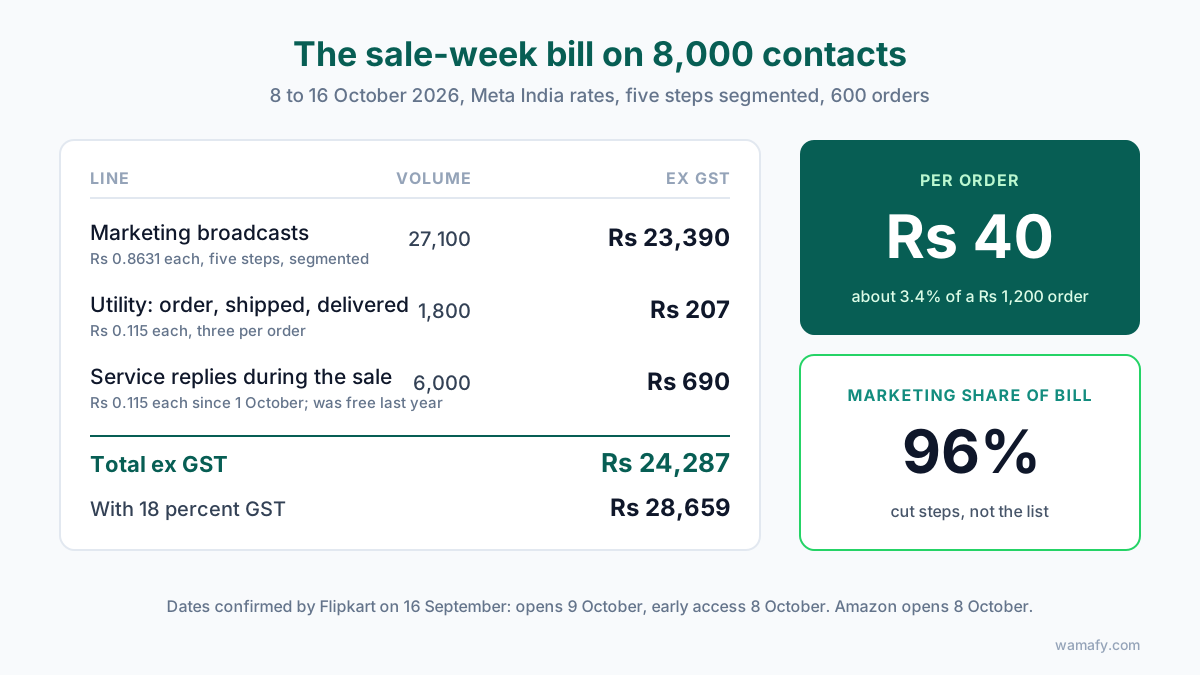
India rates as of September 2026: a marketing template is Rs 0.8631 a message. Utility and authentication templates are Rs 0.115. Service replies inside the 24-hour window were free until 30 September; from 1 October they are billed at the utility rate too, and this sale is the first one that falls on the far side of that date. GST at 18 percent sits on all of it.
| Line | Volume | Rate | Cost ex GST |
|---|---|---|---|
| Marketing broadcasts, five steps segmented | 27,100 | Rs 0.8631 | Rs 23,390 |
| Utility: order, shipping, delivery updates | 1,800 | Rs 0.115 | Rs 207 |
| Service replies during the sale (billable from 1 October) | 6,000 | Rs 0.115 | Rs 690 |
| Total ex GST | Rs 24,287 | ||
| Total with 18 percent GST | Rs 28,659 |
Two things to read off that table. Marketing is 96 percent of the bill; the utility line is a rounding error and the support line is small. And per order, the week costs about Rs 40 in messaging before GST. If your average order is Rs 1,200, that is 3.4 percent of revenue on the channel that produced it. Keep that ratio in your head; it is the number to protect.
The support bill nobody budgets, and why this is the first sale week that has one
Look at the third line again. Six thousand replies, Rs 690. Last year that line was Rs 0. It is how WhatsApp worked: a customer messaged you, and for 24 hours you could reply as much as you liked at no charge. During a sale that window is where most of your support volume lives, so most stores have never seen a support cost on their WhatsApp bill.
That ended on 1 October. The free service window closed, and replies your team or your chatbot send inside it are charged at the utility rate, Rs 0.115 each in India. Had the sale run in September as first expected, it would have been the last free week. It did not; it opens on 8 October, so it is the first sale week that carries a support line. The 30-day plan for the service message change goes through the mechanics. Not a crisis: Rs 690 on a Rs 24,000 week. But a line that goes from zero to something, on the highest-volume week of the year, deserves a row in the sheet.
There is one exception worth knowing. Conversations that start from a click-to-WhatsApp ad, or a Facebook call-to-action button, still open a 72-hour free window once you reply. If your sale traffic comes from ads that land in WhatsApp, a good share of your support stays free.
What a 10 to 30 percent markup adds to the same week
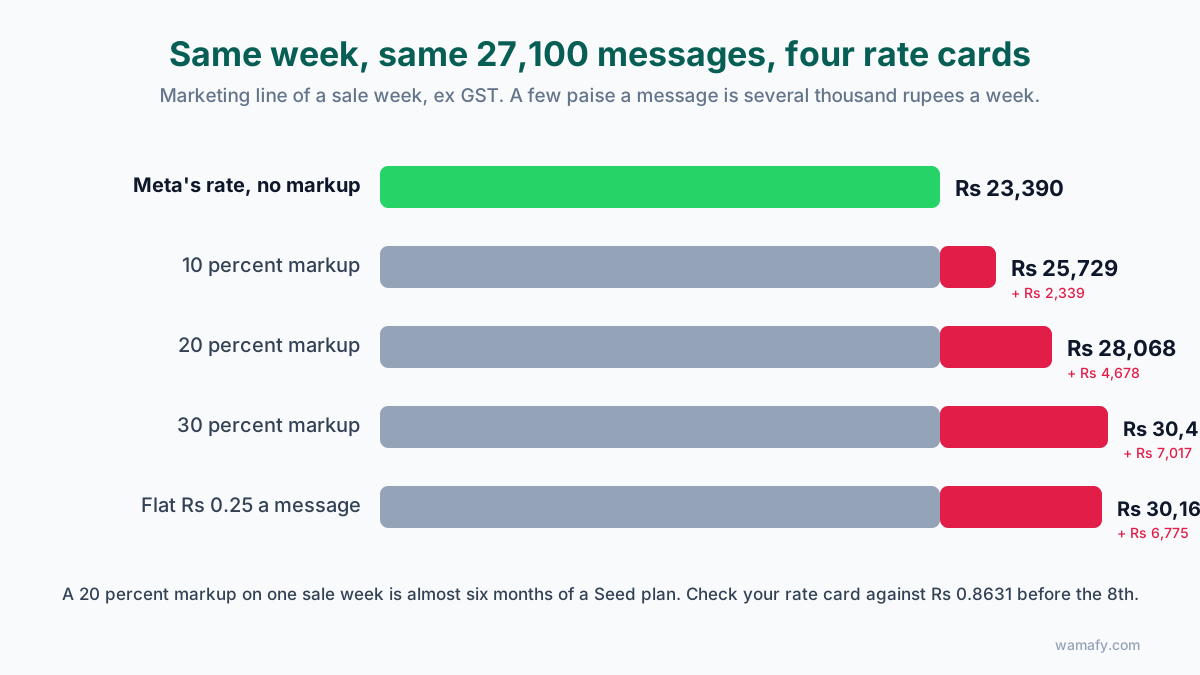
The table above is what Meta charges. It is not what most Indian SMBs pay, because most WhatsApp platforms add a per-message or per-conversation markup on top of Meta's rate. The markup is usually described as small. On a sale week it is not.
| Platform pricing | Marketing line | Added to the week | Week total ex GST |
|---|---|---|---|
| Meta's rate, no markup | Rs 23,390 | Rs 0 | Rs 24,287 |
| 10 percent markup | Rs 25,729 | Rs 2,339 | Rs 26,626 |
| 20 percent markup | Rs 28,068 | Rs 4,678 | Rs 28,965 |
| 30 percent markup | Rs 30,407 | Rs 7,017 | Rs 31,304 |
| Flat Rs 0.25 per message | Rs 30,165 | Rs 7,225 (incl. utility) | Rs 31,512 |
A 20 percent markup adds Rs 4,678 to one week. That is almost six months of a Seed plan. Across the four festive spikes from Onam to Diwali, the same markup on the same list runs past Rs 15,000. The real cost of WhatsApp marketing in India walks through how these markups are structured; the point here is narrower. Check your platform's per-message rate against Rs 0.8631 before the 8th, because the sale week is when the gap is widest.
Wamafy passes Meta's rates through with nothing added, which is the reason the numbers in this post are Meta's numbers and not a range. The cheapest platform comparison puts the subscription prices side by side if you want that view too.
The week after the sale is the bigger support bill
The sale closes on or about 16 October. What happens in the days after it: deliveries from the last two sale days, exchange requests, "the size is wrong", "where is my refund". Post-sale support volume peaks in the week after a sale, not during it, and every reply in that week is billable now.
Budget it. On the 8,000-contact store above, the week after the sale typically brings 2,000 to 2,500 inbound conversations. At four replies each, that is up to 10,000 service messages. At Rs 0.115, that is about Rs 1,150 before GST, more than the support line during the sale itself. Small against the marketing line, but it is new, it lands on the same invoice as the sale, and it keeps running every month afterwards, straight into the Diwali week.
Three things reduce it without reducing service. Put a "where is my order" button in your delivered template, so the customer gets the answer without opening a conversation. Let the chatbot answer the first message and only hand off when it has to; three bot replies at Rs 0.115 is still cheaper than one human reply that turns into six. And send the shipping update proactively as a utility template, because a customer who knows where the parcel is does not ask.
Where to cut if the number is too high
If Rs 28,659 is more than the sale can carry, the instinct is to trim the list. Do not. A smaller list is fewer orders at the same cost per order. Cut steps instead, and cut them from the segments that convert worst.
| Cut | Saves ex GST | What it costs you |
|---|---|---|
| Drop the teaser to browsers | Rs 4,402 | Little. Browsers act on day one and last call, not on a teaser. |
| Drop the mid-sale proof to past buyers | Rs 1,726 | Some. Past buyers are the segment that responds to proof. |
| Drop the price-drop alert to past buyers | Rs 1,726 | Some. Often the second-best performer. |
| Drop the last call to anyone | Rs 6,905 if to all | A lot. Last call and day one carry most of the revenue. Never cut this. |
| Cut the browser list in half | Rs 6,601 | Half the browser orders, at the same cost per order. The wrong cut. |
Dropping the teaser to browsers takes the week from Rs 24,287 to Rs 19,885 before GST and costs almost nothing in revenue. That is the first cut. If you need a second, drop the price-drop alert to browsers too. Leave past buyers alone; they are the cheapest revenue you have.
The one-page sale-week budget sheet
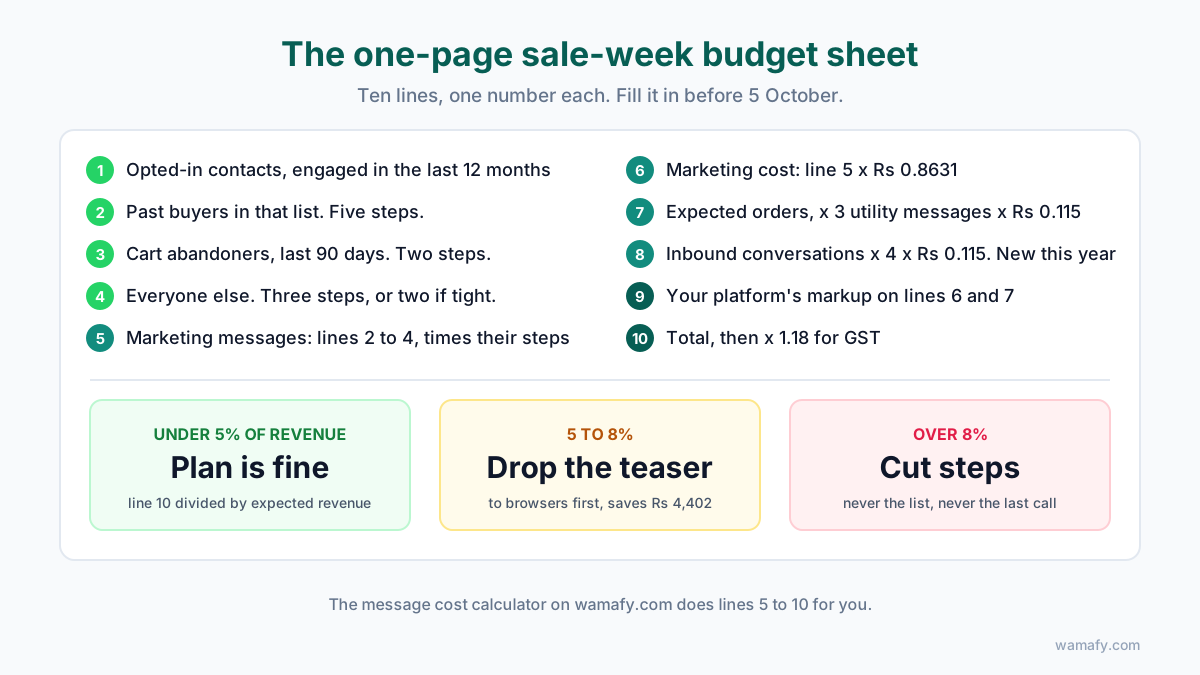
Fill this in before 5 October, while there is still time to change the plan and get templates approved. Ten lines, one number each.
- Opted-in contacts, after removing anyone who has not engaged in 12 months.
- Past buyers in that list. They get all five steps.
- Cart abandoners, last 90 days. Two steps.
- Everyone else. Three steps, or two if the budget is tight.
- Marketing messages: the sum of the three lines above, times their steps.
- Marketing cost: line 5 times Rs 0.8631.
- Expected orders, and utility messages at three per order times Rs 0.115.
- Expected inbound conversations during the sale, times four, times Rs 0.115. New this year.
- Your platform's markup on lines 6 and 7. Zero on Wamafy; check your own.
- Total, then times 1.18 for GST.
Then divide line 10 by line 7. If messaging is under 5 percent of expected revenue, the plan is fine. If it is over 8 percent, go back to the cuts table. The message cost calculator does lines 5 to 10 for you if you would rather not build the sheet.
Frequently Asked Questions
Is a utility message always cheaper than a marketing message?
Yes, by about seven and a half times in India: Rs 0.115 against Rs 0.8631. But the category is set by Meta when the template is approved, based on content, not by you. An "order shipped" message is utility. An "order shipped, and here is 10 percent off your next one" message is marketing, and gets billed as one.
Should I hold budget back for Diwali?
Yes. Roughly 90 percent of festive WhatsApp volume in 2026 lands in October and November, and Diwali is on 8 November. Spend what the September sale can carry, using the sheet above, and keep the larger share for the Dhanteras to Diwali window. The festive season budget guide splits it across the four spikes.
What does a sale week cost per order?
On the 8,000-contact plan above, about Rs 40 per order before GST at Meta's rates, or around 3.4 percent of a Rs 1,200 order. With a 20 percent platform markup it is closer to Rs 48. Under 5 percent of revenue is comfortable; over 8 percent means cutting steps.
Are replies during the sale free?
No, not this year. Replies inside the 24-hour window were free until 30 September; from 1 October they are charged at the utility rate, Rs 0.115 in India, and the sale opens on 8 October. On 6,000 replies that is Rs 690. Conversations that start from a click-to-WhatsApp ad keep a 72-hour free window.
When exactly is Big Billion Days 2026?
Flipkart confirmed on 16 September 2026 that the sale opens on Friday 9 October, with early access for Plus, Black and Flipkart credit card members on Thursday 8 October. Amazon's Great Indian Festival opens on 8 October, with Prime early access from the 7th. Neither has published an end date; plan for roughly 8 to 16 October and watch for the official close.
How much does a per-message markup really add?
On 27,100 marketing messages, a 20 percent markup adds about Rs 4,678 to one sale week, and a flat Rs 0.25 per message adds about Rs 7,225. Over a full festive season on the same list, a 20 percent markup runs past Rs 15,000. Check your platform's rate card against Rs 0.8631 before the sale.
Can I reduce the bill by sending to fewer people?
You can, but it is the wrong cut. A smaller list is fewer orders at the same cost per order. Drop a step from the segment that converts worst, usually the teaser to browsers, and keep the full list for day one and last call.
Know the number before the 8th
A sale week is where a year of pricing decisions shows up on one invoice. Build the sheet, check your platform's rate against Meta's, and decide your cuts now rather than on day four when the bill is already half spent. If you want the Meta rate with nothing on top, with rate caps and scheduling so the week does not hit your daily limit on day one, Wamafy is built for exactly this week.
Start a 14-day free Wamafy trial. Your card is authorised when the trial starts and charged only on day 15.