Service Messages Become Chargeable Oct 1: Your 30-Day Plan
The short answer: on 1 October the free 24-hour service window closes. Replies your team or chatbot send inside it become billable, and utility templates lose their in-window free status. You have four working weeks and a festive season landing on top. Here is the checklist, plus the honest number. For most Indian SMBs this is a few hundred rupees a month, not a crisis. The exception is your chatbot, and almost nobody has looked at that yet.
What actually becomes billable
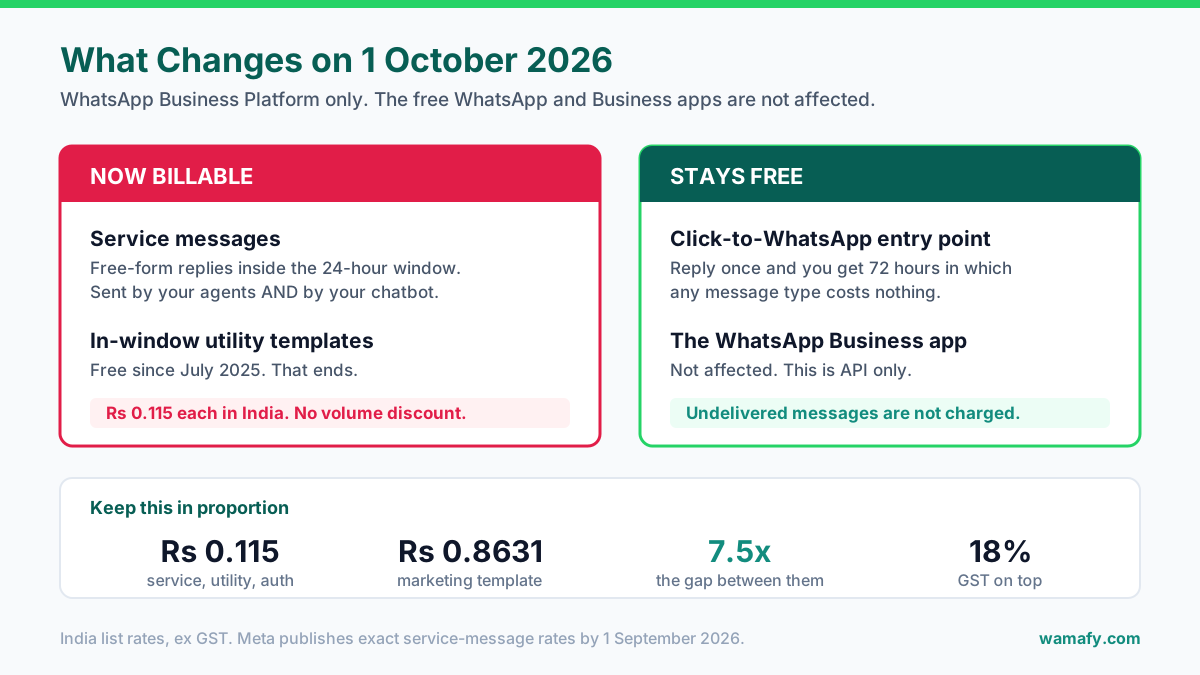
Two things stop being free on the WhatsApp Business Platform on 1 October 2026.
- Service messages. These are the free-form replies you send inside the 24-hour window, after a customer messages you first. Your agents send them. So does your chatbot.
- Utility templates sent in-window. These have been free since July 2025. That ends.
Meta has said both will be charged at the utility and auth rate for each country. In India that is Rs 0.115 today. The exact figures are due by 1 September. Treat Rs 0.115 as a planning number. Check it before you sign off a budget.
One detail that is easy to miss. Templates get volume discounts as you send more. Service messages do not. The rate stays flat however many you send. So the line that grows fastest with your business is also the one you cannot negotiate down.
Work out your exposure first
Before you change anything, get one number: how many messages you sent inside the service window last month. Most teams have never looked at this, because it has been free and free things do not get measured.
Pull it from your platform's message export. Count three buckets.
- Agent replies sent within 24 hours of a customer message.
- Chatbot messages fired on an inbound.
- Utility templates that went out while a window was already open.
Here is a worked example for a business handling 1,000 customer conversations a month.
| Bucket | Working | Monthly cost |
|---|---|---|
| Agent replies | 4 per conversation, 4,000 at Rs 0.115 | Rs 460 |
| Chatbot messages | 3 per inbound, 3,000 at Rs 0.115 | Rs 345 |
| In-window utility templates | 500 at Rs 0.115 | Rs 58 |
| Total | ex GST | Rs 863 |
That is Rs 1,018 with GST. For most SMBs the number lands in that range. It is worth saying plainly: this is not the crisis some of the coverage suggests. Your marketing templates at Rs 0.8631 are still the expensive part, by a wide margin.
Two things change that picture. Support-heavy trades, like a restaurant, clinic or travel desk, run three times the replies per chat. And October is festive, so your volume will not look like September's.
Your chatbot is probably the biggest line
This is the part almost nobody has checked.
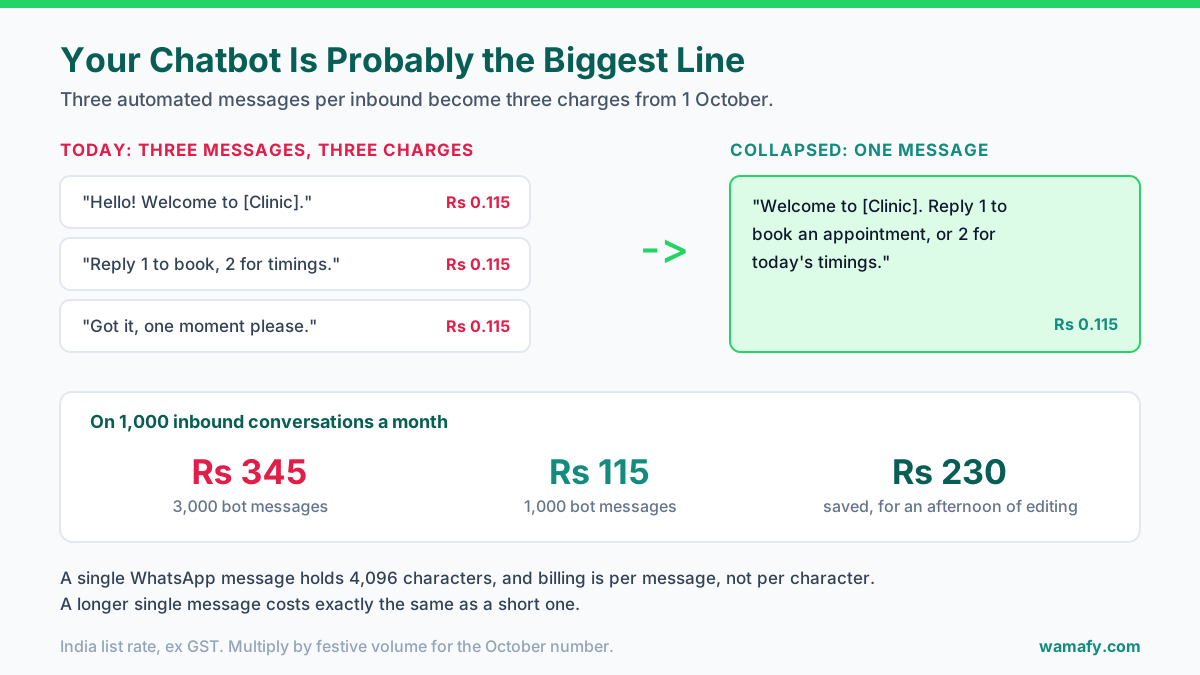
A rule-based chatbot usually answers an inbound with a greeting, then a menu, then a confirmation. Three messages where one would do. Until now that cost nothing, so nobody trimmed it. From 1 October every one of those is a charge.
In the table above, the bot alone is Rs 345 a month. That is 40 percent of the total. Collapse three messages into one and it drops to Rs 115. You save Rs 230 a month for an afternoon of editing. The customer also gets a cleaner reply.
The saving is small in September. It is not small in a festive month at three times the volume, and it is not small a year from now.
The habits that formed while messages were free are the ones that cost you money now. A chatbot that says hello, then asks what you need, then repeats what you said, was always clumsy. It just never had a price tag.
Week 1: audit, 1 to 4 September
Do not change anything yet. Just find out what you actually send.
- Export last month's messages and split them into the three buckets above.
- Read a sample of twenty real conversations end to end. Count how many messages it took to answer a simple question.
- Write down every automated flow that fires on an inbound. Most teams find one or two they had forgotten about.
- Note which flows are a real back and forth. The rest could be one template carrying the whole answer.
You are looking for one thing: messages that exist out of habit rather than purpose.
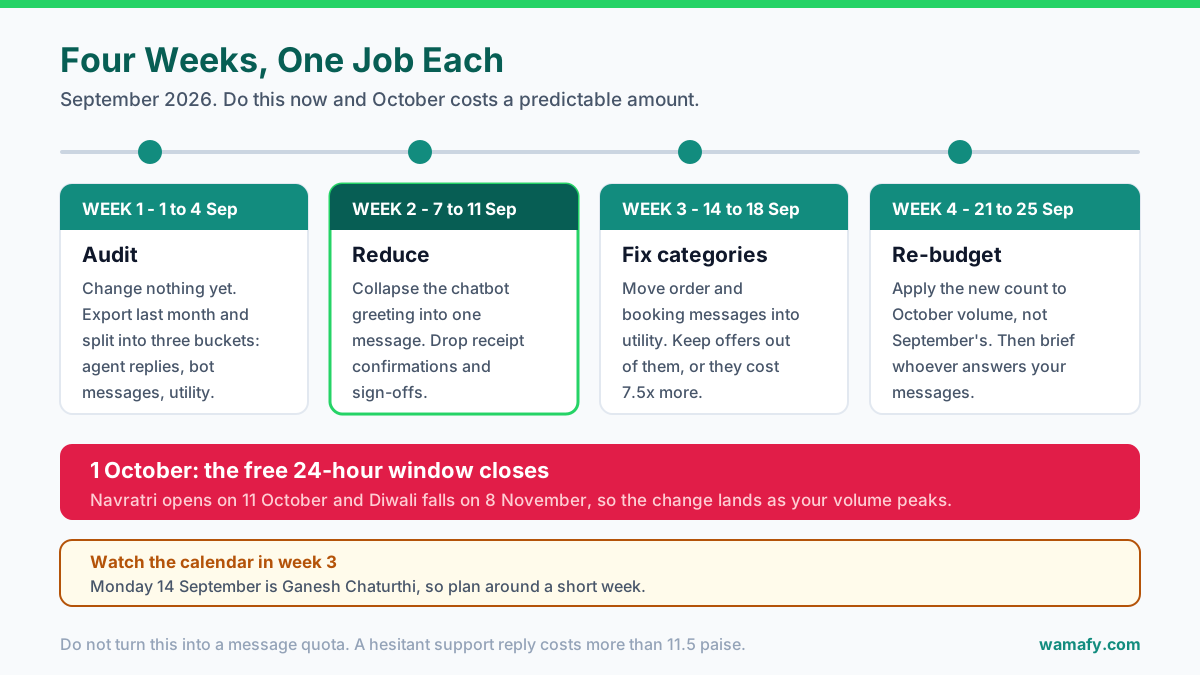
Week 2: reduce, 7 to 11 September
Now cut. The goal is fewer messages carrying the same information, not worse service.
- Collapse the chatbot greeting. Merge hello, menu and instruction into one message. This is the single biggest saving available to you.
- Stop confirming receipt. "Thanks, we have received your message" followed by the actual answer is two charges. Lead with the answer.
- Put the whole answer in one message. Agents often send a reply, then a link, then a follow-up question. One message can carry all three.
- Remove the sign-off. "Is there anything else?" at the end of every conversation is a charge that adds nothing.
One fact makes all of this easier. A single WhatsApp message holds up to 4,096 characters. Almost nothing you send needs to be split across two messages, let alone three. Billing is per message, not per character, so a longer single message costs the same as a short one.
A fair target is cutting messages per chat by a third. The customer should notice nothing except a faster answer.
Week 3: fix the categories, 14 to 18 September
Note that Monday 14 September is Ganesh Chaturthi, so plan around a short week.
The job here is making sure every message is in the cheapest category it legitimately belongs to.
- Move what belongs in utility. Order updates, booking reminders and delivery alerts are utility messages. If any go out as marketing, you pay Rs 0.8631 instead of Rs 0.115. That is 7.5 times more.
- Check what your chatbot sends on its own. A bot that adds an offer line to a service reply can push that message into a costlier category.
- Keep offers out of order messages. A discount code inside an order update is the most common way a utility template gets re-graded.
This work pays off twice. It cuts your bill today, and it cuts your exposure after 1 October.
Week 4: re-budget and brief the team, 21 to 25 September
Two jobs. Update the numbers, then tell the people who send the messages.
For the budget, apply your reduced message count to October volume, not September volume. Retail and D2C get Navratri from the 11th, then the run-up to Diwali on 8 November. Two to three times normal volume is a fair assumption. The festive budget guide has the full worked plan across the season.
The brief for the team is short. It matters more than the budget.
From 1 October every reply you send inside the 24-hour window costs the business money. Not much per message. It adds up across thousands. Answer in one message where you can. Do not send filler.
Do not turn this into a message quota. A support person who hesitates before answering a customer costs you far more than 11.5 paise.
The one thing that stays free
One window stays free. Conversations that start from a click-to-WhatsApp ad, or a Facebook call-to-action button, still open a free entry point window. Reply once and you get 72 hours. Any message type inside it costs nothing.
That does not change on 1 October. It gets more valuable, now that the normal service window is metered. Run click-to-WhatsApp ads in the festive season and those chats cost nothing to serve for three days. Wamafy captures those leads and routes them into a chatbot or Flow, and sends conversion events back through the Conversions API. The ad itself is still built in Meta Ads Manager.
Why a markup hurts more after 1 October
Most WhatsApp platforms in India add a per-message markup on top of Meta's rate. It is usually 10 to 30 percent.
Until now that markup applied to your templates. From 1 October it applies to a whole new category of messages that used to be free, including every automated chatbot reply. Nothing about your business changed. But the number of billable messages just went up, and so did the cut somebody takes on each one.
This is worth checking on your invoice in October rather than assuming. If your platform charges a percentage per message, ask them specifically what they will charge on service messages. Wamafy passes Meta's rate through with no markup, so a service message costs what Meta charges and nothing more.
For the background on how per-message billing has behaved since it replaced conversation pricing, see one year of per-message pricing. For the full cost stack, see the real cost of WhatsApp marketing in India.
Frequently Asked Questions
What exactly changes on 1 October 2026?
Free-form service messages sent inside the 24-hour customer service window become billable, and utility templates lose their in-window free status. Both are expected to be charged at the utility and authentication rate, which is Rs 0.115 in India today. Meta publishes exact rates by 1 September 2026.
Does this affect my chatbot?
Yes, and it is usually the largest single line. Every message your chatbot sends inside the service window is billable from 1 October. A bot that sends a greeting, a menu and a confirmation is three charges per inbound instead of none.
Are failed or undelivered messages still free?
You are billed on delivered messages. A message that fails to deliver is not charged. Confirm it on your first October invoice. This is the sort of thing that gets billed wrongly in a pricing transition.
Do service messages get volume discounts?
No. Templates have volume tiers, service messages do not. The per-message rate stays flat no matter how many you send, which is why reducing message count matters more than negotiating rates.
Does the click-to-WhatsApp free window still apply?
Yes. Conversations that begin from a click-to-WhatsApp ad or a Facebook call-to-action button still open a 72-hour free entry point window once you reply. Any message type inside that window is free, and this does not change on 1 October.
Is the WhatsApp Business app affected?
No. This applies to the WhatsApp Business Platform, which is the API. The free WhatsApp app and the WhatsApp Business app are not affected.
Four weeks is enough, if you start now
The work here is not difficult. An afternoon on the chatbot. A morning on template categories. A short conversation with whoever answers your messages. What makes it urgent is the calendar. Do it in September and October costs a predictable amount. Leave it and you are auditing message flows in the middle of Navratri.
Wamafy passes Meta's rates through with no per-message markup. So what changes on 1 October is what Meta charges, not what a platform adds on top. Plans start at Rs 799 a month. Start a 14-day free trial to see your own message costs before the change lands. A card is authorized when the trial begins and charged only on day 15.