Big Billion Days and Great Indian Festival: Your WhatsApp Plan
Updated 20 September 2026. The first version of this post, written on 2 September, planned around a late-September sale based on the last three years. Flipkart confirmed the real dates on 16 September and they are two weeks later. Every date below has been corrected.
The short answer: Flipkart Big Billion Days 2026 opens on Friday 9 October, with early access for Plus, Black and Flipkart credit card members on Thursday 8 October. Amazon's Great Indian Festival opens on Thursday 8 October, Prime members from the 7th. Neither has announced an end date; plan for roughly 8 to 16 October. That gives you under three weeks. Most of that time goes on template approval, not on writing copy. Here is the plan, the INR maths, and the one thing that changed on 1 October.
The confirmed dates
Flipkart announced Big Billion Days 2026 on 16 September, alongside its "Luck Badal Sakta Hai" campaign. Amazon published its dates the same week. Here is the window:
| Event | 2026 date | Status |
|---|---|---|
| Amazon Prime early access | Wed 7 October | Confirmed by Amazon |
| Flipkart Plus, Black and card-member early access | Thu 8 October | Confirmed by Flipkart |
| Amazon Great Indian Festival opens | Thu 8 October | Confirmed by Amazon |
| Big Billion Days opens | Fri 9 October | Confirmed by Flipkart |
| Sale closes | Around Fri 16 October | Not announced; past years ran about a week |
Plan for the 8th. If the close date lands a day or two either side of the 16th, nothing in this plan breaks. Your templates are already approved and your segments are already built. You just move the last-call send.
The bigger point is what this window sits inside. The sale opens a week after the 1 October change to WhatsApp service-message pricing, runs through the start of Navratri on 11 October, and closes three weeks before Diwali on 8 November. So the three biggest selling moments of the year now run back to back, all under the new pricing. September is preparation. October is when everything sends.
Your real deadline is 1 October
Here is where most sale plans fall over. You cannot broadcast a marketing message on WhatsApp without an approved template. Approval is usually quick. Sometimes it takes minutes. But two things change in festive season.
First, review queues get slower as every business in the country submits festive copy at once. Second, rejections cost you a full cycle. You fix the copy, resubmit, and wait again.
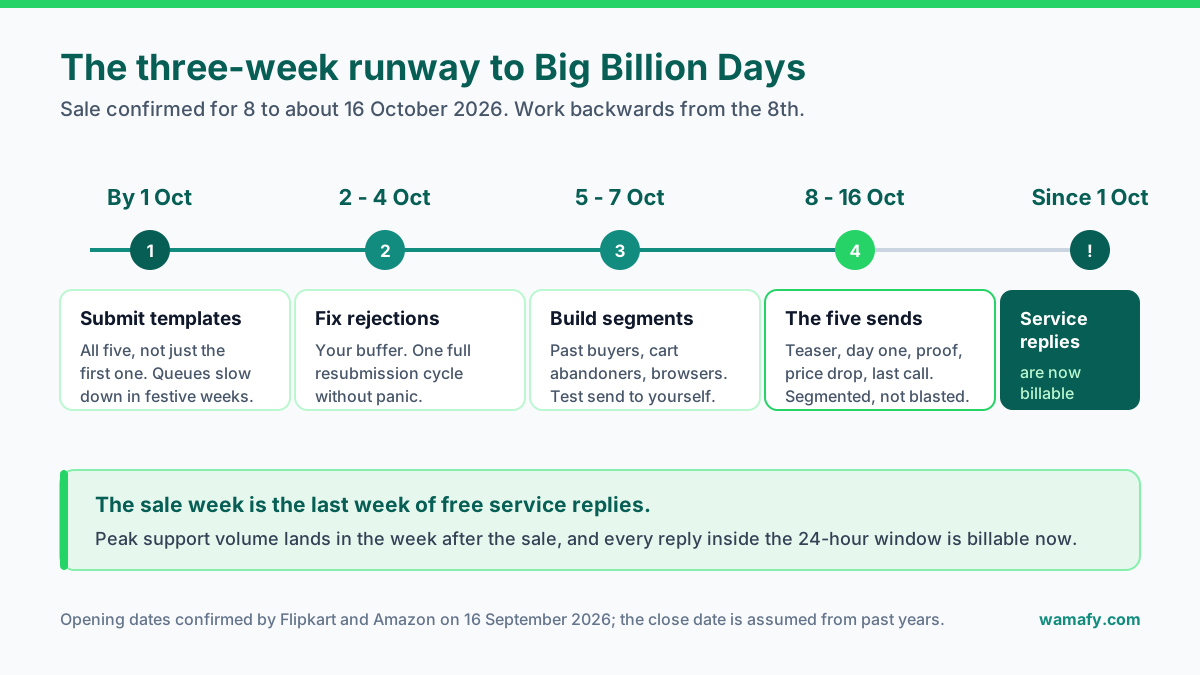
So work backwards from the 8th:
- By 1 October: every sale template submitted. All five of them, not just the first.
- 2 to 4 October: fix and resubmit anything rejected.
- 5 to 7 October: build segments, upload lists, run a test send to your own number.
- 8 October: early access message goes out.
That gives you two clear buffers. Use them. A template stuck in review on the 8th is a week of revenue you do not get back.
What gets rejected in a rush
Most festive rejections are the same handful of mistakes:
- Variables at the very start or end of the message body.
- Two variables next to each other with no text between them.
- Vague placeholder examples in the sample values. Put real text in there.
- Aggressive claims like "lowest price guaranteed" with nothing to back them.
- A marketing offer submitted under the utility category. This one gets you reclassified, not just rejected.
If you want the formats that pass first time, the 2026 template message examples post has the exact structures.
The five messages that carry a sale week
A sale week is not one broadcast. It is also not a daily blast. Five messages, spaced across nine days, is the shape that works for most Indian stores.
| # | When | Message | Job it does |
|---|---|---|---|
| 1 | Mon 21 or Tue 22 | Early access teaser | Warms the list. Sets the date in their head. |
| 2 | Wed 23, morning | Day one, live now | Your single biggest revenue message. |
| 3 | Fri 25 or Sat 26 | Mid-sale proof | Best sellers, what is moving, social proof. |
| 4 | Sun 27 or Mon 28 | Price drop or low stock | Pulls the fence-sitters. |
| 5 | Tue 29 or Wed 30, evening | Last call | Deadline pressure. Often the second best performer. |
Two rules matter more than the copy.
Send on the right days. Day one and last call carry most of the revenue. Do not put your best offer in the middle. And check your own send-time data rather than guessing, which the best time to send a WhatsApp broadcast in India post covers with real numbers.
Never send all five to everyone. That is the fastest way to burn a list and your quality rating. Which brings us to segments.
Segment, or pay for people who were never going to buy
Every marketing message costs the same whether the person buys or not. At Rs 0.8631 a message in India, a bad segment is a real bill.
Four segments cover almost every store:
- Past buyers, last 12 months. Send all five. This group has the best return by a distance.
- Cart abandoners, last 30 days. Send messages 2 and 4 only. They already know what they want. Two nudges is enough.
- Browsers and opt-ins who have never bought. Send 1, 2 and 5. Skip the middle two.
- Cold contacts with no opt-in. Send nothing. Ever.
That last one is not a soft suggestion. Messaging people who never opted in gets you blocked, and blocks drive your quality rating down mid-sale. A red rating in the middle of Big Billion Days cuts your daily limit at the exact moment you need it most.
The maths on segmenting
Take a store with 8,000 contacts. Blast all five messages to all of them and that is 40,000 marketing messages. At Rs 0.8631 that is Rs 34,524 before GST.
Segment it properly and the same week looks like this: 2,000 past buyers get five, 900 abandoners get two, 5,100 browsers get three. That is 10,000 plus 1,800 plus 15,300, or 27,100 messages. Rs 23,390 before GST.
You saved Rs 11,134 and you almost certainly sold more, because the people who were going to unsubscribe never got messages four and five.
If you sell on Flipkart or Amazon, this is different
This is the part marketplace sellers get wrong, so be clear about it.
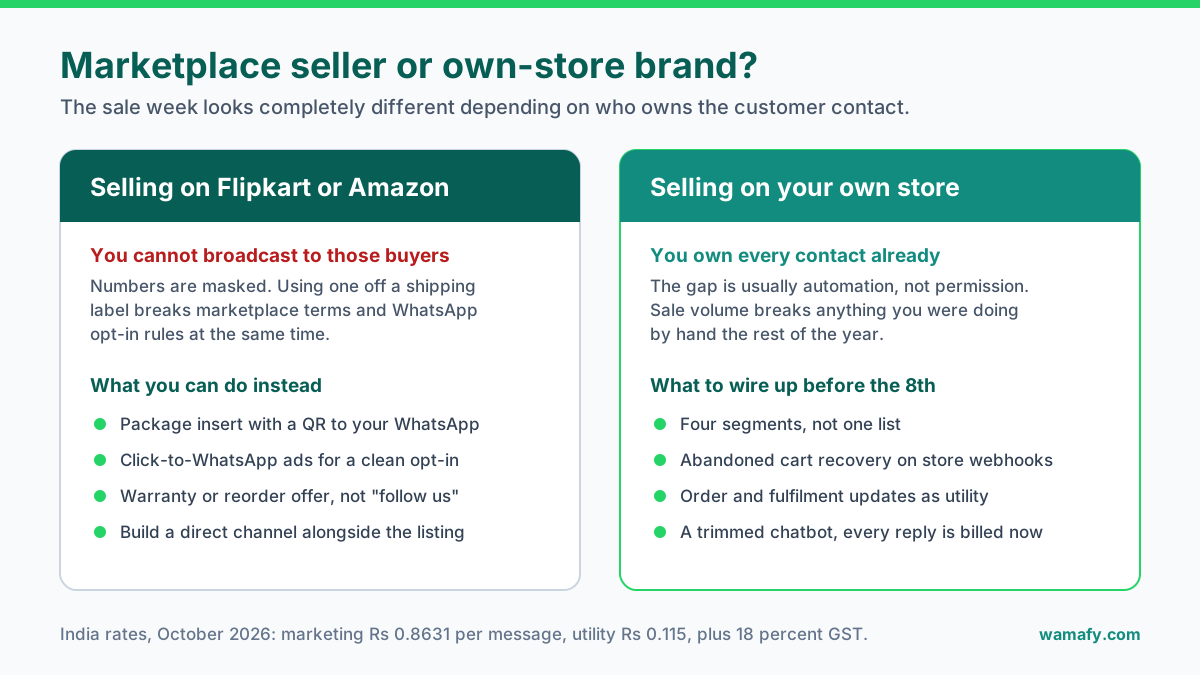
You cannot WhatsApp a marketplace customer. Flipkart and Amazon do not hand you the buyer's phone number. It is masked. Even if you have it from a shipping label, using it for marketing without opt-in breaks both the marketplace terms and WhatsApp's own rules.
So what can a marketplace seller actually do in that week?
- Package inserts. A card in the box with a QR code to your WhatsApp and a real reason to scan. A warranty registration or a discount on a direct reorder works better than "follow us".
- Click-to-WhatsApp ads. Run the ad in Meta Ads Manager, land the lead in a WhatsApp chat, capture it there. That lead is yours, with a clean opt-in.
- Your own site. If you sell direct as well as on marketplaces, every direct order is a contact you own. That is the whole argument for a D2C channel alongside the marketplace.
Own-store brands have the opposite problem. You have the contacts. What you usually lack is the automation to use them at sale volume. If you are on Shopify, a native integration can fire order confirmations, fulfilment updates and abandoned cart recovery straight off the store's webhooks. Wamafy offers this as a Rs 499 a month add-on on every plan, including the Rs 799 Seed plan.
What a sale week actually costs
India rates as of September 2026: marketing messages are Rs 0.8631 each. Utility and authentication messages are Rs 0.115. GST of 18 percent sits on top of all of it.
Here is a smaller store running roughly 5,000 marketing messages across the week:
| Line | Volume | Rate | Cost ex GST |
|---|---|---|---|
| Marketing broadcasts | 5,000 | Rs 0.8631 | Rs 4,315.50 |
| Utility: order and shipping updates | 1,800 | Rs 0.115 | Rs 207.00 |
| Service replies during the sale (billable since 1 October) | 2,500 | Rs 0.115 | Rs 287.50 |
| Total | ex GST | Rs 4,810.00 | |
| With 18 percent GST | Rs 5,675.80 |
And the same week at four times the volume:
| Line | Volume | Rate | Cost ex GST |
|---|---|---|---|
| Marketing broadcasts | 20,000 | Rs 0.8631 | Rs 17,262.00 |
| Utility: order and shipping updates | 6,000 | Rs 0.115 | Rs 690.00 |
| Service replies during the sale (billable since 1 October) | 8,000 | Rs 0.115 | Rs 920.00 |
| Total | ex GST | Rs 18,872.00 | |
| With 18 percent GST | Rs 22,268.96 |
Two things to notice. Marketing messages are almost the entire bill. And the support side of the week now costs something, which it never did before; this is the first sale to run after the 1 October change.
One more note on the bill itself. If your platform adds a per-conversation markup on top of these Meta rates, a sale week is where that hurts most, because it multiplies against your highest volume of the year. Wamafy passes Meta's rates through with no markup, which is the reason it was built that way.
The bill changed on 1 October, a week before the sale
This is the detail almost nobody has connected, and it is worth five minutes.
On 1 October the free 24-hour service window closed. Every free-text reply your team or chatbot sends inside that window is now billable at the utility and authentication rate, Rs 0.115 in India. When the sale was expected in late September it would have been the last free week. It is not: the sale opens on 8 October, so every reply during it, and every reply in the returns fortnight after it, is on the bill.
Now put those two facts together. Your highest support volume of the year is the week after a sale: where is my order, can I exchange this, the size is wrong, I want a refund. "Where is my order" queries usually peak five to ten days after a sale ends, once courier networks are at their most backed up. Count forward from 16 October and that wave lands in the last ten days of October, straight into the Dhanteras run-up. It is the first sale-week support volume anyone has ever paid for.
Be honest about the size of it. For the bigger store above, 12,000 service replies across the returns fortnight is Rs 1,380 before GST, or about Rs 1,628 with it. That is not a crisis. It is a line item that did not exist in your last budget, arriving on abnormally high volume.
Two things are worth doing before the 8th:
- Audit your chatbot. A bot that sends four messages where one would do now costs four times as much. Chatty bots became expensive on 1 October.
- Move repeat answers into the flow. Order status, return policy and delivery timelines are the top three questions of a returns week. Answering them in a structured flow beats an agent typing the same reply 300 times.
The full four-week version of this is in the service message charges plan.
Pacing, so you are not rate-limited on day one
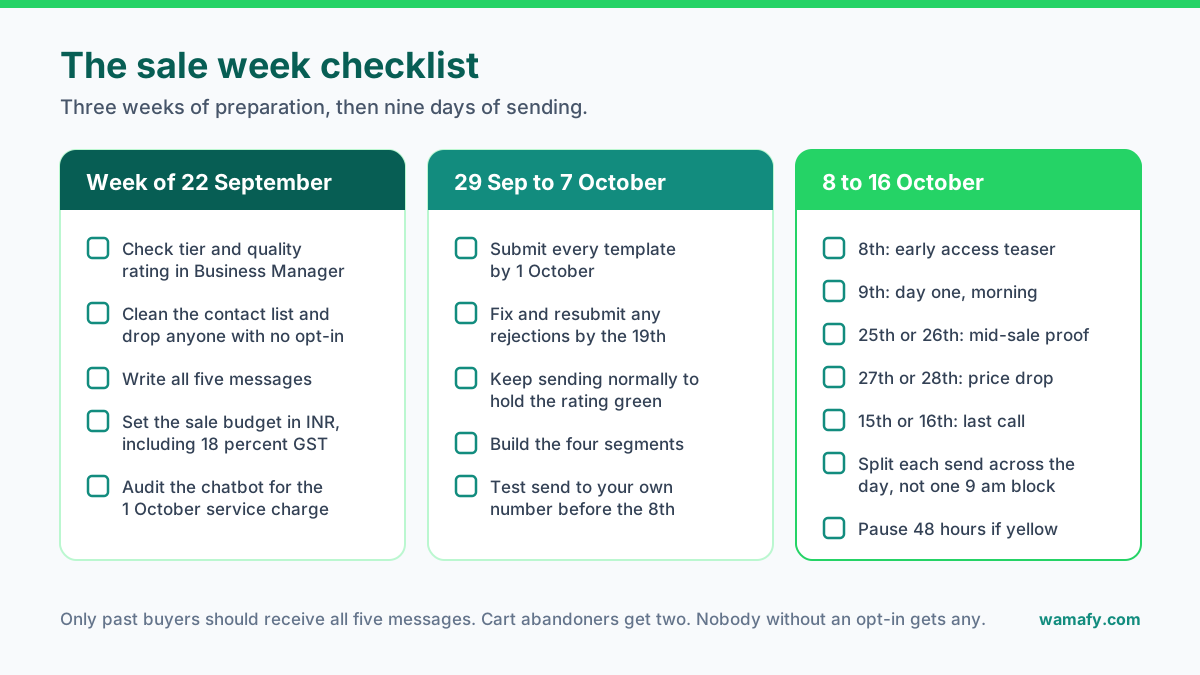
WhatsApp caps how many unique contacts you can reach with template messages in 24 hours. The tiers run 250 for unverified accounts, then 1,000, 10,000, 100,000 and unlimited. Since October 2025 that limit is shared across your whole Meta Business Portfolio, not per number. Three numbers on a 10,000 limit share 10,000 between them.
Tier upgrades depend on two things: consistent sending volume and a green quality rating. Meta now reviews accounts for upgrades every six hours, which is faster than it used to be. But it will not lift you from 1,000 to 20,000 the night before a sale.
So ramp through the fortnight before:
- Week of 22 September: check your current tier and quality rating in Business Manager. Do this today if you have not.
- Week of 29 September: send your normal campaigns. Keep the rating green. Do not experiment with aggressive copy this fortnight.
- Week of 5 October: a slightly larger send to a warm segment. You are showing Meta consistent volume, not spiking.
- 8 to 16 October: the sale sends, split across the day rather than fired at 9 am in one block.
If your rating slips to yellow at any point, pause marketing sends for 48 hours and let it recover. A yellow rating freezes your tier. A red one cuts your limit. Neither is something you want on the 8th.
Frequently Asked Questions
When is Flipkart Big Billion Days 2026?
Flipkart confirmed on 16 September 2026 that Big Billion Days opens on Friday 9 October, with early access for Plus, Black and Flipkart credit card members on Thursday 8 October. Amazon's Great Indian Festival opens on 8 October, Prime members from the 7th. No end date has been announced; past years ran about a week, so plan for 8 to 16 October.
Can I send WhatsApp messages to customers who bought from me on Flipkart?
No. Marketplaces mask buyer phone numbers, and using a number from a shipping label for marketing breaks both the marketplace terms and WhatsApp's opt-in rules. Collect your own contacts instead, through package inserts with a QR code or click-to-WhatsApp ads.
How long does WhatsApp template approval take?
Usually minutes to a few hours, but queues slow down in festive weeks when everyone submits at once. A rejection costs you a full resubmission cycle. Submit sale templates by 1 October to leave room for one fix.
How many WhatsApp broadcasts is too many in one sale week?
Five across nine days works for most stores, and only past buyers should receive all five. More than that to a single contact drives blocks, and blocks damage the quality rating that controls your daily sending limit.
What is the daily messaging limit on the WhatsApp Business API?
Tiers run 250 unique contacts a day for unverified accounts, then 1,000, 10,000, 100,000 and unlimited. Since October 2025 the limit is shared across all numbers in your Meta Business Portfolio rather than applied per number.
Do service messages cost money during the sale?
Yes. Free-text replies inside the 24-hour window were free until 30 September 2026; from 1 October they are billable at the utility and authentication rate, Rs 0.115 in India. The sale opens on 8 October, so every reply during it counts. On 8,000 replies that is Rs 920 before GST.
Start this week, not on the 8th
The work that decides how this sale week goes is the work you do in the next fourteen days: templates submitted, segments built, quality rating green, chatbot trimmed now that every reply is on the bill. The sending part is easy. The preparation is what people run out of time for.
If you want to run the whole week from one place, with segments, scheduled broadcasts and delivery tracking in a single view, Wamafy is an official Meta Tech Provider with a 14-day free trial. Your card is authorized when the trial starts and charged only on day 15, and you pay Meta's message rates directly with no per-conversation markup on top.