WhatsApp AI Chatbot Rules in 2026: What Meta Actually Banned
You have probably heard that Meta banned AI chatbots on WhatsApp. That is not what happened.
Meta banned one specific thing. It did so eight months ago. And for almost every Indian business running a WhatsApp bot, it changes nothing at all.
What does change things is a pricing shift landing on 1 October. That one is not a policy question, it is a bill. Here is what is actually true about both.
What Meta actually changed, and when
Meta updated the WhatsApp Business Solution Terms in October 2025. The change took effect on 15 January 2026. Businesses signing up for API access from 15 October 2025 onward were covered straight away.
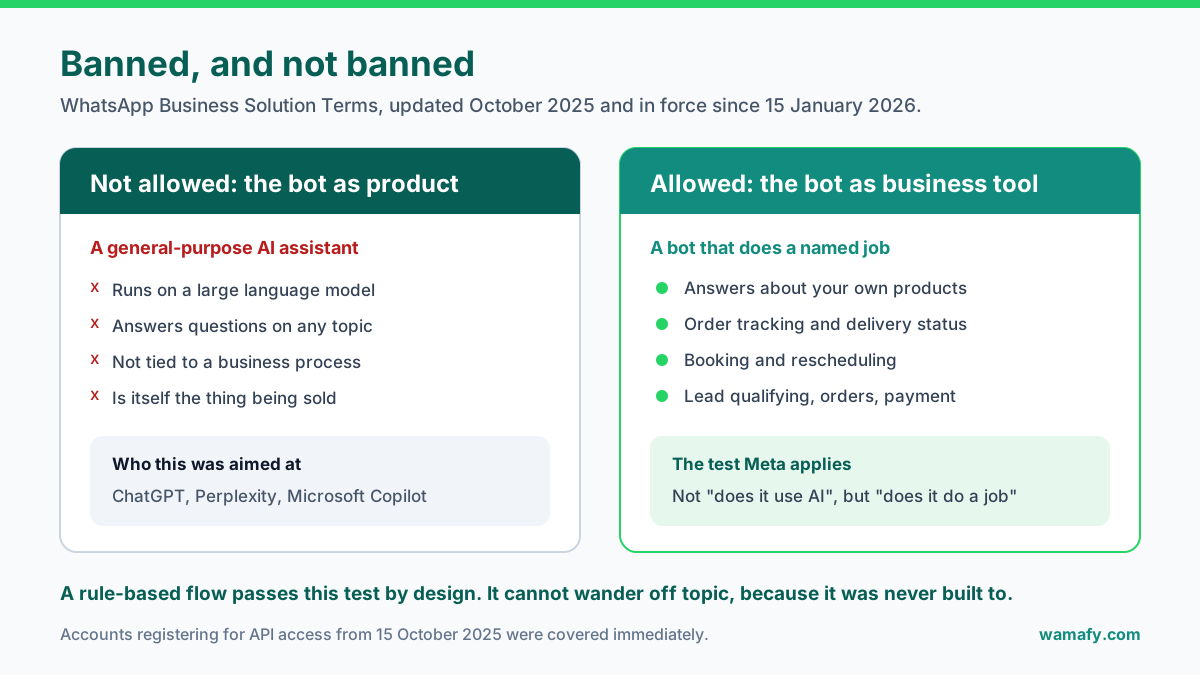
The new wording bars "AI Providers" from using the WhatsApp Business Solution as a distribution channel. In plain terms, that means one thing: you cannot ship a general-purpose AI assistant over WhatsApp.
A general-purpose assistant is a bot that:
- Runs on a large language model.
- Answers questions on any topic at all, from weather to code to poetry.
- Is not tied to a specific business process.
- Is itself the product being sold or distributed.
ChatGPT, Perplexity and Microsoft Copilot are the names in the frame here. They ran assistant bots on WhatsApp, and those are gone. That is the ban, in full.
Who this actually hits
Almost certainly not you.
Meta went after businesses where the chatbot is the product. It did not go after businesses that use a bot to serve customers. Those are still fine, and Meta says so directly.
Still allowed, and openly encouraged:
- Answering questions about your own products and services.
- Order tracking and delivery status.
- Booking, rescheduling and cancelling appointments.
- Qualifying leads and routing them to a person.
- Taking orders and collecting payment.
- Support answers drawn from your own help content.
Notice what these have in common. Each one is a job with a start and an end, tied to your business. That is the test. Not whether the bot uses AI, but whether it does a defined task for you.
A rule-based flow passes this test by design. It cannot wander off topic, because it was never built to. If you run the kind of keyword-and-menu bot covered in the no-code chatbot guide, the January change did not touch you.
Why Meta did it
The stated reasons are about user experience. The real reasons look commercial, and it is worth being straight about that.
Two things were happening. Rival AI firms were using WhatsApp to reach three billion people without paying to be there. And those assistant bots drove enormous message volume that produced no business revenue for Meta.
Meta also sells its own AI layer now, the Meta Business Agent. Clearing competing assistants off the platform while charging for your own is a distribution decision, not a safety one.
Why does the motive matter to you? Because it tells you how the rule will be read. A policy written to protect users gets enforced loosely at the edges. A policy written to protect a distribution channel gets enforced at exactly its stated line. Your product support bot was never the target and is unlikely to become one.
Four questions to audit your bot
You can check your own flows in an afternoon. Ask four questions of each one.
- Does it do a named job? "Books a slot" or "checks an order" passes. "Chats to customers" does not.
- Would it answer a question about something you do not sell? If yes, cap it. An open bot on an open model is the risky shape.
- Can the customer reach a human? Every flow needs an exit. A bot with no way out generates complaints, and complaints hurt your quality rating.
- Does it stop when it cannot help? A bot that keeps replying without resolving anything is the worst outcome. It now costs money too.
That fourth question is the one that has changed the most this year, and it is where the rest of this post goes.
The part that does affect you: 1 October
Here is the change that matters for an Indian SMB in September 2026.
On 1 October the free 24-hour service window closes. Free-text replies sent inside that window become billable. Meta has said the rate matches each country's utility and authentication price, which in India is Rs 0.115. Treat that as a planning number and confirm the final figure before signing off a budget.
That applies to replies from your agents and from your rule-based bot alike. The 30-day plan for service message charges has the full checklist.
Now the detail almost nobody has connected.
The AI exemption is not a saving
Replies generated by Meta's own Business Agent are not billed as service messages. They are billed by token instead. That sounds like an exemption. Run the numbers and it is the opposite.
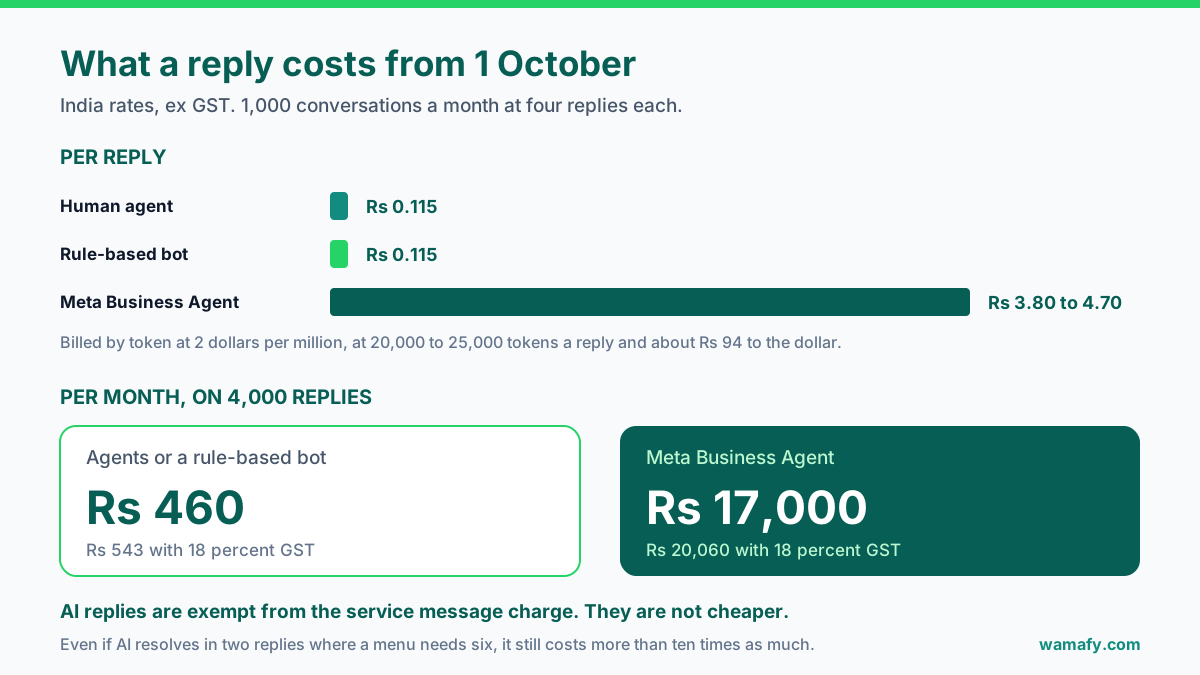
Meta Business Agent moved to token pricing on 1 August 2026. The rate is 2 US dollars per million tokens. A single reply typically consumes 20,000 to 25,000 tokens once context is counted. The rate bundles the AI processing and the message delivery together.
At roughly Rs 94 to the dollar, that works out like this:
| Reply type | Billed as | Cost per reply, ex GST |
|---|---|---|
| Human agent reply | Service message | Rs 0.115 |
| Rule-based bot reply | Service message | Rs 0.115 |
| Meta Business Agent reply | Tokens, at 2 dollars per million | Rs 3.80 to Rs 4.70 |
So an AI reply costs somewhere between 33 and 41 times a service message. The exemption is real. The discount is not.
What that looks like over a month
Take a business handling 1,000 customer conversations a month, at four replies each. That is 4,000 replies.
| Approach | Working | Monthly cost, ex GST |
|---|---|---|
| Agents or a rule-based bot | 4,000 at Rs 0.115 | Rs 460 |
| Meta Business Agent | 4,000 at about Rs 4.25 | Rs 17,000 |
With GST that is Rs 543 against Rs 20,060. On the same volume of conversations.
Two honest caveats. Token counts move with how much context you feed the model, so treat the range as a range. And a good AI agent may close a conversation in fewer messages than a rigid menu tree does.
Steel-man it, though, and the gap holds. Say the AI resolves in two replies where a rule-based flow needs six. That is Rs 8.50 against Rs 0.69. Still more than ten times the cost.
If you were planning to add AI
None of this says do not use AI. It says price it before you build it.
Three questions are worth answering first:
- Which conversations actually need it? Order status, store timings and return policy are the top three questions in most Indian SMB inboxes. None of them need a language model. A menu answers them for about 11 paise.
- What is the value of the conversation? Rs 4 a reply is nothing on a Rs 40,000 order. It is a lot on a Rs 400 one. High-value, low-volume is where AI pays. High-volume, low-value is where it bleeds. That runs opposite to the usual advice on AI support, which says volume drives the cost per ticket down. It does when you pay a fixed platform fee. Meta Business Agent has no fixed fee, only a per-token rate, so volume just multiplies.
- Are you using AI or buying it? A third-party AI assistant behind your own business number is still allowed, so long as it does your business's job. But its replies bill as service messages from October, not by token.
The sensible shape for most Indian SMBs is a rule-based flow that handles the common cases, with a clean exit to a human for everything else. That was true before the pricing change. It is more true now.
Where Wamafy sits on this
Worth stating plainly, because a lot of platform content is vague about it.
Wamafy's chatbot builder is rule-based. It does not use AI. There is no AI writer for template or message copy either. If you specifically want an AI agent answering open questions, Wamafy does not offer that today, and some competitors do.
What a rule-based builder does give you is a bot that was already shaped the way Meta's rules require, and that bills at Rs 0.115 a reply rather than Rs 4. The chatbot builder deep dive covers how the flows are put together.
Frequently Asked Questions
Did Meta ban AI chatbots on WhatsApp?
No. Meta banned general-purpose AI assistants, meaning bots that answer questions on any topic and are themselves the product, such as ChatGPT or Perplexity. Business bots that do defined jobs like bookings, order tracking or support are still allowed and encouraged.
Do I have to remove my chatbot?
Almost certainly not. If your bot answers questions about your own products, books appointments, tracks orders or qualifies leads, it was never covered by the change. Cap it so it cannot answer off-topic questions and you are on the right side of the line.
Is a rule-based chatbot affected by the 2026 rules?
No. A rule-based flow cannot hold an open-domain conversation, so it sits well inside what Meta permits. The rules effectively describe the shape a rule-based bot already has.
When did the WhatsApp AI chatbot rules take effect?
Meta updated the Business Solution Terms in October 2025, and the rules took effect on 15 January 2026. Accounts registering for API access from 15 October 2025 were subject to them immediately.
How much does Meta Business Agent cost in India?
It is billed by token at 2 US dollars per million tokens, bundling AI processing and message delivery. At 20,000 to 25,000 tokens a reply and roughly Rs 94 to the dollar, that is about Rs 3.80 to Rs 4.70 per reply before GST.
Are AI replies exempt from the October service message charge?
Meta Business Agent replies are billed by token instead of as service messages, so they are exempt in that narrow sense. They also cost far more per reply. A third-party AI assistant on your number is billed as a service message like any other reply.
Check the bill, not just the policy
The compliance question here is mostly settled and mostly does not involve you. The cost question is live, arrives on 1 October, and lands during the busiest support weeks of the Indian year.
So the useful work this month is not rewriting your bot for a rule it never broke. It is counting how many replies your bot sends per conversation, and cutting the ones that do not resolve anything.
If you want to build task-shaped flows and see the reply volume behind them in one place, Wamafy is an official Meta Tech Provider with a 14-day free trial. Your card is authorized when the trial starts and charged only on day 15, and you pay Meta's message rates directly with no per-conversation markup added on top.