Wamafy vs DoubleTick: An Honest 2026 Comparison
The short version. DoubleTick is a Mumbai-built WhatsApp sales platform with a strong mobile app and deep bot tools. If your business runs on a field sales team that lives on a phone, it earns its price. If you are a founder or a small team sending campaigns and answering chats, you are paying for a sales CRM you will not open. And as of September 2026, you cannot see that price without booking a demo.
Most posts about DoubleTick alternatives skip the part that matters. They compare feature lists. The feature lists are nearly the same. What actually differs is how each platform charges you, and what happens to that bill as your team and your volume grow. This post walks through both, with real numbers.
What DoubleTick genuinely does well
Start with the fair part. DoubleTick is not a thin wrapper. It is a real product with a clear buyer in mind.
- The mobile app is the point. Most WhatsApp platforms are web dashboards with a phone view bolted on. DoubleTick was built the other way round. A rep can run a broadcast, check a catalogue and close a chat from a phone in a showroom.
- It is built for sales teams, not marketers. Assignment, agent activity and a pipeline view sit at the centre, so if you have eight reps working leads then that is the right shape.
- Bot depth. Welcome bots, order bots and longer journeys are a first-class part of the product, not an afterthought.
- Catalogue and order flows work well for resellers and B2B distributors who send a product list and take an order in the same chat.
- A Shopify app is listed on the Shopify app store, so store owners have a supported path.
If you read that list and thought "that is my business", stop here and go book their demo. The rest of this post will not change your answer.
The pricing page is the real story
Here is something worth knowing before you start comparing. In September 2026, the DoubleTick pricing page does not show a price.
It lists three tiers, Starter, Pro and Enterprise, and it tells you how many agents each includes, how many WhatsApp Business Accounts, and how many custom contact fields. Starter includes 5 agents and Pro includes 10, but there is no rupee figure on any of them. To get one, you book a demo.
Third-party listings still report numbers. The most common figures are around Rs 2,500 a month for Starter and around Rs 3,500 for Pro, billed annually, with extra agents at roughly Rs 500 each. Older listings show lower and higher numbers. Some quote Rs 1,200 and others quote Rs 8,300.
Treat all of it as indicative rather than factual, because that spread is itself the point. When a price is quote-based, the number you end up paying depends entirely on the conversation you had with a salesperson.
So ask for four things in writing before you sign anything:
- The monthly platform fee, and whether a monthly billing option exists at all.
- The cost of one extra agent seat, per month.
- Whether message costs are billed at Meta's published India rates, or with a margin on top.
- Any minimum wallet recharge or unused-credit expiry.
That fourth question catches people out, because a credit wallet that expires is effectively a price increase that never appears on any invoice.
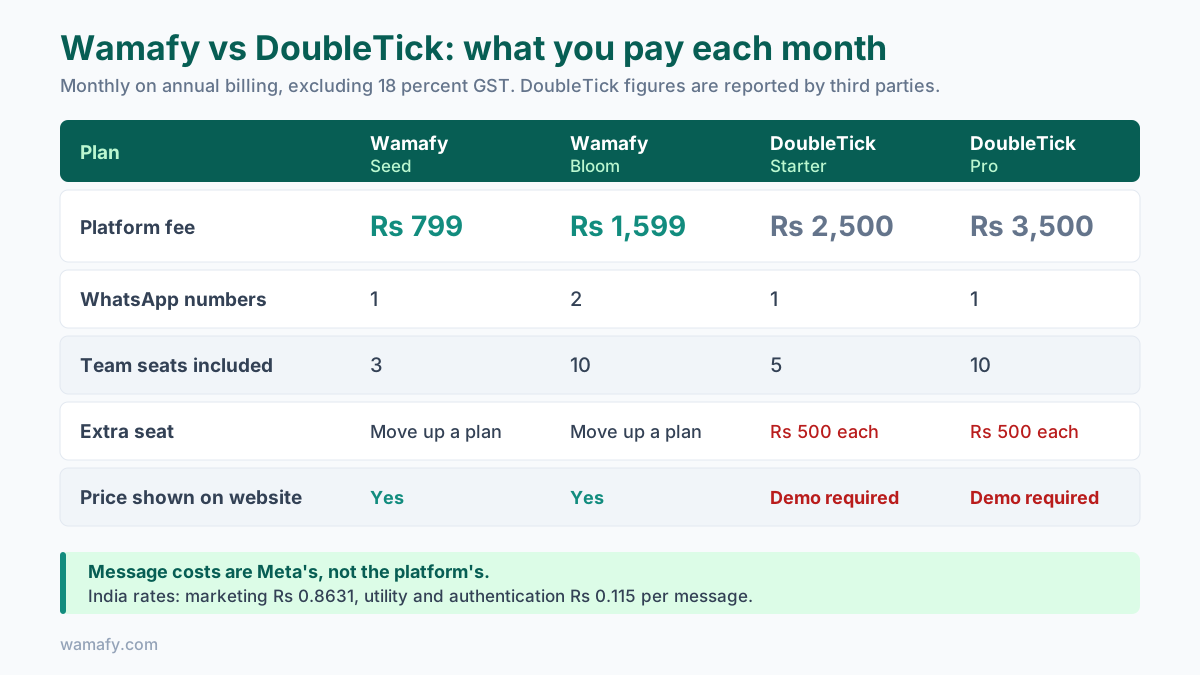
Pricing side by side
All figures below are monthly on annual billing, and exclude 18 percent GST.
| Wamafy Seed | Wamafy Bloom | DoubleTick Starter | DoubleTick Pro | |
|---|---|---|---|---|
| Platform fee | Rs 799 | Rs 1,599 | About Rs 2,500 (reported) | About Rs 3,500 (reported) |
| WhatsApp numbers | 1 | 2 | 1 | 1 |
| Team seats included | 3 | 10 | 5 | 10 |
| Extra seat | Move up a plan | Move up a plan | About Rs 500 each | About Rs 500 each |
| Price published on site | Yes | Yes | No, demo required | No, demo required |
Wamafy Forest is Rs 3,199 for 10 numbers and 20 seats. That is the tier to hold in your head for the team maths later.
What a 10,000-message month actually costs
This is where most comparison posts get sloppy, so here is the honest version.
Meta charges per message, by category. In India the marketing rate is Rs 0.8631 and the utility and authentication rate is Rs 0.115. Those are Meta's rates, not any platform's.
Take a D2C brand sending 10,000 messages in a month. Say 8,000 marketing broadcasts and 2,000 order updates.
| Line | Working | Cost |
|---|---|---|
| Marketing messages | 8,000 at Rs 0.8631 | Rs 6,905 |
| Utility messages | 2,000 at Rs 0.115 | Rs 230 |
| Message bill | Rs 7,135 | |
| Platform fee, Wamafy Bloom | Rs 1,599 | |
| Wamafy total | Rs 8,734 | |
| Platform fee, DoubleTick Pro | reported | Rs 3,500 |
| DoubleTick total | Rs 10,635 |
The gap is Rs 1,901 a month, which works out to Rs 22,812 over a year before GST.
Now read the table again and notice what is identical. The message bill is identical at Rs 7,135 on both, because reports say DoubleTick passes Meta's rates through without a margin. If that holds for your quote, then nobody is saving you money on messages. The messages are Meta's price on every honest platform.
Anyone claiming a big saving on the message line is either adding a markup you are currently paying, or hoping you will not check. Ask for the rate card and compare it to Meta's published India rates yourself. For a fuller breakdown, see the real cost of WhatsApp marketing in India.
One more line lands on both platforms. From 1 October 2026, free service replies inside the 24-hour window become billable at the utility rate. That is a flat Rs 0.115 with no volume discount, and it hits whoever you buy from.
Where Wamafy is honestly weaker
A comparison that only flatters one side is not worth reading. Here are the real gaps.
- No AI copy generation. There is no AI writer for template, campaign or ad copy in Wamafy. Several rivals have one. If you want a tool that drafts your broadcast for you, this is a genuine miss.
- The chatbot is rule-based. It handles menus, forms and routing well. It is not a free-text bot that answers questions it was never taught.
- No ad creation. Click-to-WhatsApp ads are built in Meta Ads Manager. Wamafy captures the lead when it lands and sends conversions back to Meta, but it does not build the ad or write the creative.
- No CRM pipeline. There are no deal stages or sales forecasting. This is DoubleTick's home ground, and it wins it.
If a sales pipeline inside your chat tool is the reason you are buying, then DoubleTick is genuinely the better fit, and that is the straight answer.
At what volume does the difference stop mattering
Here is the part that surprises people, and it runs against what most comparison posts imply.
The platform gap is fixed. Around Rs 1,900 a month at the tiers above. So it shrinks as a share of your spend when volume climbs.
- At 2,000 marketing messages a month, your message bill is about Rs 1,726. The platform gap is larger than the entire message bill. It matters enormously.
- At 100,000 marketing messages, your message bill is about Rs 86,310. The same Rs 1,900 is roughly 2 percent. That is close enough to noise that it should not decide anything.
So the platform fee matters most to small senders, not big ones. If you send a lot, stop optimising the subscription and go optimise your template mix and your opt-in list instead.
There is a second axis, however, and it moves in the opposite direction: the number of seats you need.
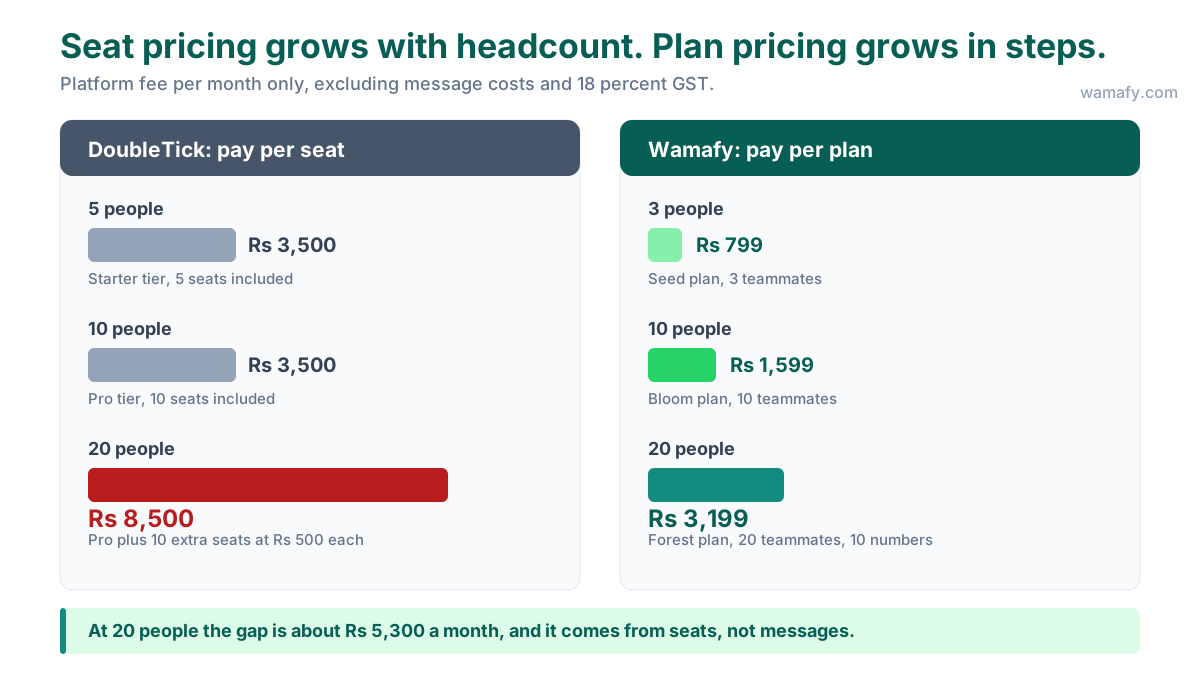
DoubleTick includes 5 agents on Starter and 10 on Pro, with extra seats at roughly Rs 500 each. Put 20 people on it and you are paying Pro plus 10 extra seats, so about Rs 3,500 plus Rs 5,000, or Rs 8,500 a month. Wamafy Forest is Rs 3,199 and includes 20 teammates.
That is the honest summary of the two models. Seat pricing scales with your headcount. Plan pricing scales in steps. A ten-person support desk sending modest volume is the case where the gap is widest.
Add-ons against tiers
The two platforms also unlock features differently, and this changes the real bill more than the headline price does.
On a tier model, a feature sits on a plan. Want one thing from the higher tier, buy the whole tier.
Wamafy sells vertical modules as add-ons instead, and no add-on is locked to a plan. Any add-on works on any plan, including Seed at Rs 799. Most are Rs 499 a month. The Clinics and Restaurant modules are Rs 999 a month billed annually.
So a salon that wants in-chat booking pays Rs 799 for Seed plus Rs 499 for Appointments. Rs 1,298 a month for a real booking system with reminders, rather than climbing a tier to reach the nearest equivalent.
The honest caveat: add-ons stack. Buy three and you have quietly rebuilt a mid tier at mid-tier money. Price the basket you will actually use, not the headline plan.
WABA ownership and what happens when you leave
Ask any provider one question before you sign. Is the WhatsApp Business Account in my Meta Business Manager, or yours?
If the account belongs to them, leaving means a migration you do not control, whereas if it belongs to you then changing platform is about as disruptive as changing courier.
Wamafy is an official Meta Tech Provider and the customer keeps the WABA. Your approved templates live at Meta inside that account, so they travel with you.
What does not travel is your chat history. That sits in the platform's database, not Meta's. Export it before you cancel anything. Both platforms offer CSV export, and this is the one task people remember on the last day.
Worth saying plainly: the biggest lock-in is not technical. It is a twelve-month prepay. Annual billing at Rs 3,500 a month is Rs 42,000 committed before you have sent a single campaign.
Who should pick which
Pick DoubleTick if: you run a field sales team on phones, you want deal stages in the chat tool, you need AI help writing copy, or the mobile app is genuinely your daily driver.
Pick Wamafy if: you are a small team or a solo operator, you run one or two numbers, you want a price you can read without a sales call, you want monthly billing, you need a vertical module like clinics, restaurants, appointments or renewals, or you want to keep your own WABA.
Look wider if: you are a developer wanting an API and nothing else, or you need ad creation and AI copy in one place. Neither platform is your answer. Compare the field properly in the Wamafy vs WATI vs AiSensy comparison or the roundup of the cheapest WhatsApp marketing platforms in India.
Frequently Asked Questions
How much does DoubleTick cost per month in India?
DoubleTick no longer publishes prices on its site, so you have to book a demo to get a quote. Third-party listings commonly report around Rs 2,500 a month for Starter and Rs 3,500 for Pro, billed annually, plus about Rs 500 per extra agent. Treat those as indicative and ask for a written quote.
Does DoubleTick add a markup on WhatsApp message costs?
Reports suggest message costs are passed through at Meta's published rates rather than marked up. Because the rate card is not public, confirm it in writing and compare it line by line against Meta's India rates for marketing, utility and authentication messages.
Can I move my WhatsApp templates to another platform?
Yes, if you own the WhatsApp Business Account. Approved templates are stored in the WABA at Meta, not in the platform, so they stay with you when you switch. If your provider owns the WABA, you will need them to hand it over first.
Will I lose my message history if I switch?
Your chat history sits in the platform's own database, so it does not move with the WABA. Export everything to CSV before you cancel your account. Do this while your login still works, not after the billing period ends.
Which is cheaper for a small business sending low volume?
At low volume the platform fee is the whole story, because the message bill is small on both. Wamafy Seed at Rs 799 against a reported Rs 2,500 for DoubleTick Starter is a difference of about Rs 20,400 a year before GST.
What changes on 1 October 2026?
Free service replies inside the 24-hour customer window become billable at the utility rate, which is Rs 0.115 in India. This applies on every WhatsApp Business Platform provider. Service messages get no volume discount, so trimming a chatty chatbot is the fastest saving available.
Try it before you commit
The fairest test is your own numbers. Take last month's message volume, your real team size, and the one module you actually need, and price both.
Wamafy publishes its prices, so you can do half that maths right now without talking to anyone. Start a 14-day free Wamafy trial and send a real campaign before you decide. Your card is authorised when the trial starts and charged only on day 15, so you can cancel inside the window at no cost.