WhatsApp Marketing for Salons and Spas in India
A salon leaks money in three places, and none of them are marketing.
Empty chairs from no-shows. A receptionist who is on the phone instead of at the counter. And clients who quietly stop coming after two months, without ever complaining.
All three are calendar problems. That is worth saying plainly, because most advice sold to Indian salon owners is about Instagram reels. Reels bring new clients. Your calendar decides whether you keep them.
Why salons have it harder than clinics
Clinics have a booking culture. Patients expect to be given a slot. Salons largely do not, and three things follow from that.
Walk-ins blur the calendar. When half your footfall is unbooked, nobody treats a booked slot as a commitment. The client does not, and often the salon does not either.
The phone rings during every appointment. Your stylist is mid-colour, the phone goes, and someone has to choose between the client in the chair and the client on the line. Whichever you pick, you lose.
Nobody records when a client last came. Most Indian salons can tell you today's bookings and this month's revenue. Very few can tell you which regulars have not been in for ten weeks. That is the most valuable list in the business, and it usually does not exist.
The wider trend does not help. Around two thirds of salon and spa appointments are now booked on a phone. If yours can only be booked by calling one, you are already out of step with how people behave.
The no-show maths
Salons and spas have the highest no-show rate of any appointment business. Without a reminder system, rates sit between 20 and 30 percent, and salons cluster near the top of that band.
Chair time is perishable. An empty 11am slot cannot be sold at 6pm.
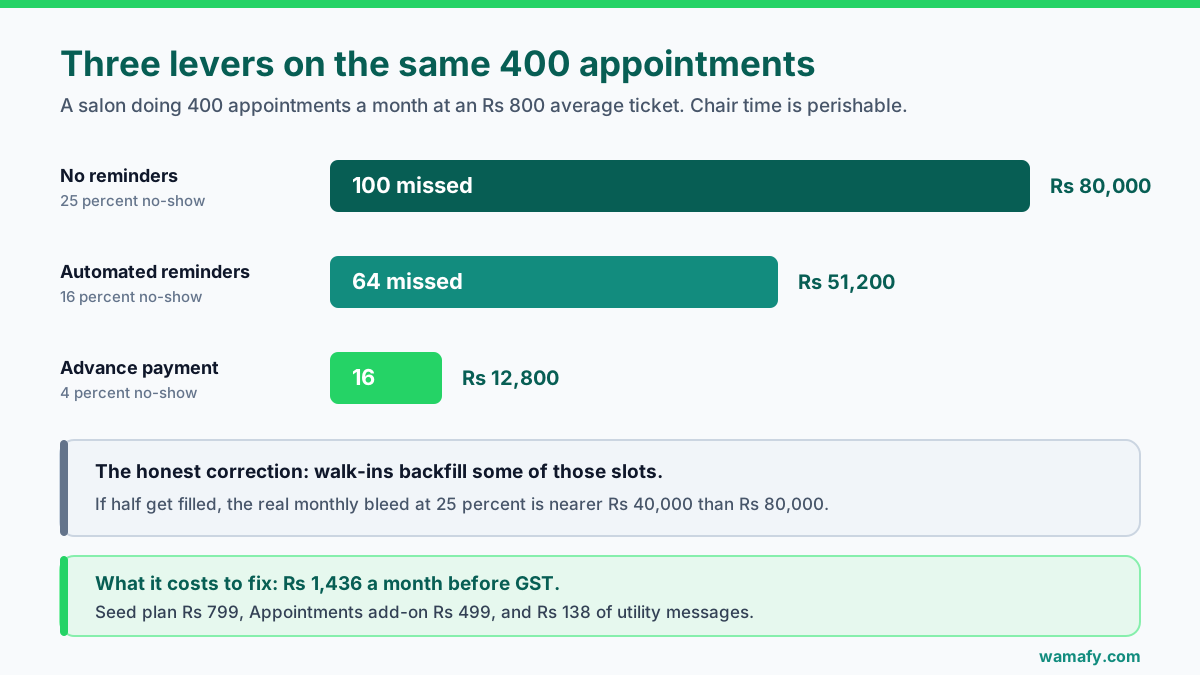
Take a salon doing 400 appointments a month with an average ticket of Rs 800. Substitute your own numbers, the shape holds.
| Scenario | No-show rate | Missed appointments | Value at Rs 800 |
|---|---|---|---|
| No reminders | 25 percent | 100 | Rs 80,000 |
| Automated reminders | 16 percent | 64 | Rs 51,200 |
| Advance payment at booking | 4 percent | 16 | Rs 12,800 |
Now the honest correction, because that table overstates the loss.
Walk-ins backfill some of those empty slots. If half get filled, the real monthly bleed at 25 percent is closer to Rs 40,000 than Rs 80,000. Still a large number for a single-branch salon, and still the cheapest money you will ever recover.
Deposits beat reminders, by a lot
Look at the third row again. Reminders cut no-shows by roughly a third. Asking for payment at booking cuts them to 3 to 5 percent.
That gap is the single biggest finding in this vertical, and most salon content skips it because it is uncomfortable to recommend.
So here is the uncomfortable part. Asking for money up front will cost you some bookings. A first-time client browsing on a Sunday evening may not push through a payment step.
The sensible middle:
- Deposit on high-value services. Colour, keratin, bridal, spa packages, anything over an hour. The no-show hurts most and the client is already committed.
- No deposit on a Rs 300 haircut. The friction costs more than the risk.
- No deposit for known regulars. They have earned it, and they will notice.
Booking in chat
The client messages your salon number and types "book". A form opens inside WhatsApp. They pick a service, a stylist if you offer that, a date and a slot. They confirm. Done, without leaving the chat and without installing anything.
Two things matter more than they sound.
It is your number, not an app. Nobody downloads an app for a haircut. A number they already have in their phone, that they can also use to ask "are you open on Sunday", is a far lower bar.
The phone stops ringing. Every booking that happens in chat is a call your front desk does not take while a client sits in the chair. That is the benefit owners actually feel in week one.
Wamafy handles this through the Appointments add-on, which builds the booking form, holds the schedule and calendar, and takes advance payments where you want them. The appointment booking guide walks through the setup end to end.
The rebooking window, and the trap inside it
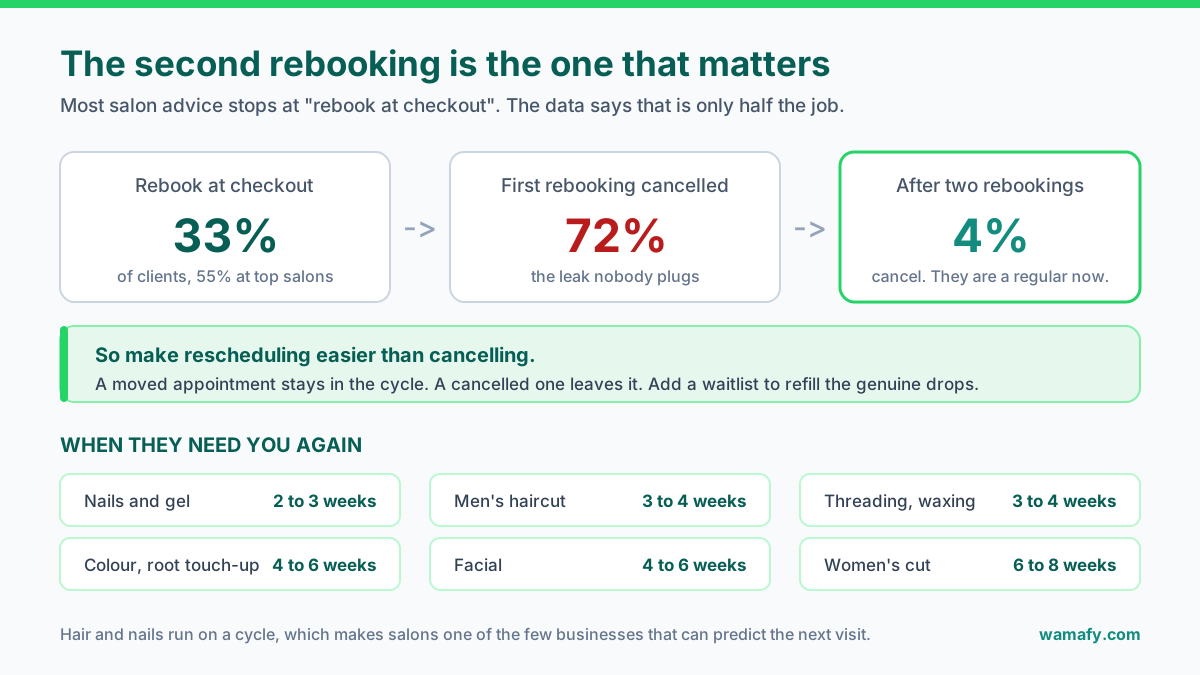
Hair and nails run on a cycle. That makes salons one of the few businesses where you can predict, fairly accurately, when a client next needs you.
| Service | Typical return window |
|---|---|
| Men's haircut | 3 to 4 weeks |
| Nails and gel | 2 to 3 weeks |
| Root touch-up and colour | 4 to 6 weeks |
| Threading and waxing | 3 to 4 weeks |
| Facial | 4 to 6 weeks |
| Women's cut | 6 to 8 weeks |
Standard advice is to rebook the client at checkout. About a third of salon clients do. Top salons push past 55 percent.
But here is the finding that changes what you should automate.
Among salons that rebook well, roughly 72 percent of first-time rebookings are later cancelled. For clients who have been rebooked twice or more, cancellations fall to around 4 percent.
Read that again. The first rebooking is fragile. The second one is where a client becomes a regular.
So the goal is not "get the rebooking". It is "protect the first rebooking until it becomes the second". That changes the automation in one specific way.
Make rescheduling easier than cancelling. A client whose plans change will cancel if that is the easy option and move the appointment if that is easier. One of those outcomes keeps them in the cycle. Self-service reschedule inside the chat is worth more here than any reminder.
Pair it with a waitlist so a genuine cancellation refills the slot rather than leaving a hole.
Reminders that do not annoy
Two messages. That is the whole pattern.
- The day before, in the evening. Long enough ahead that the client can move it if they need to, which is the entire point.
- The morning of, for afternoon and evening slots. Skip this one for a 10am appointment. Nobody wants a 7am message about a 10am haircut.
Both should carry a one-tap way to confirm, reschedule or cancel. A reminder with no action attached is just a notification.
Three things not to do. Do not send a third reminder. Do not send at 9pm. And do not put an offer inside a reminder, because a reminder is a utility message and stuffing a promotion into it changes what it is.
That last point has a cost angle too. Utility messages run at Rs 0.115 in India against Rs 0.8631 for marketing. Keeping reminders clean keeps them cheap.
Winning back the client who drifted
This is the list nobody has. Build it, because these people have not left. They just have not been reminded.
Two nudges, spaced, and then stop:
- At eight weeks since the last visit. No discount. A simple, warm message noting it has been a while and offering a slot. Plenty of people are just busy.
- At twelve weeks. Now a reason to return. A small offer, a new service, or their usual stylist's availability.
Then leave them alone. A client who has ignored two win-back messages is not going to respond to a fourth, and continuing to send costs you money and your quality rating.
Honest expectations: a win-back sequence typically recovers a modest slice of a lapsed list, not most of it. The reason it is still worth doing is that the cost per message is measured in paise and the value of a recovered regular is measured in thousands of rupees a year.
Festive and wedding season is now
September to November is the peak, and it is a different problem from the rest of the year. You are not chasing bookings. You are running out of slots.
Three things to do before the rush:
- Open bookings early for the named dates. Karva Chauth, Dhanteras, Diwali on 8 November, and every wedding date your regulars mention. These sell out first.
- Run a waitlist rather than saying no. A full Saturday is not a lost client if they are queued for the next cancellation.
- Ask for deposits during peak weeks specifically. A no-show on Diwali week costs far more than a no-show in July, because the slot could have been sold three times over.
Bridal and party bookings are also where the advance payment argument gets easy. Nobody is surprised to be asked for a deposit on a bridal package.
What it costs
For the 400-appointment salon above, running on the entry plan:
| Line | Monthly, ex GST |
|---|---|
| Seed plan | Rs 799 |
| Appointments add-on | Rs 499 |
| Messages: 400 bookings at 3 utility messages, Rs 0.115 each | Rs 138 |
| Total | Rs 1,436 |
| With 18 percent GST | Rs 1,694 |
Set that against roughly Rs 40,000 a month of no-show losses after walk-in backfill, of which reminders and deposits recover a large share.
Two notes on the plan. Add-ons in Wamafy are not tier-gated, so the Appointments module works on the Rs 799 Seed plan exactly as it does on higher tiers. And if you sell prepaid packages or memberships, which many salons do, the Membership Renewals add-on handles expiry reminders on the same number.
The gyms and fitness studios playbook covers that renewal pattern in more depth, and the clinics playbook covers the same booking mechanics for a higher-value appointment.
Frequently Asked Questions
Do clients actually book a salon appointment on WhatsApp?
Yes, and the behaviour is already there. Around two thirds of salon and spa appointments are booked on a mobile device, and WhatsApp removes the app download that kills most booking funnels. The client uses a number already saved in their phone.
What happens to walk-ins?
Nothing changes. Booking in chat runs alongside walk-ins rather than replacing them. What it does is stop bookable slots sitting empty because nobody answered the phone, so your walk-in capacity fills genuine gaps instead of covering for no-shows.
How much do reminders reduce salon no-shows?
Automated reminders typically cut no-shows by around a third, taking a 25 percent rate to roughly 16 percent. Asking for advance payment at booking is far stronger, pulling no-shows down to 3 to 5 percent.
Should I ask salon clients for a deposit?
On high-value services, yes. Colour, keratin, bridal and spa packages justify it, and clients expect it. Skip it on a quick haircut and for known regulars, where the friction costs more than the no-show risk.
How often should I message a client who stopped coming?
Twice. A warm nudge at eight weeks with no offer, and a reason to return at twelve weeks. After that, stop. Repeated win-back messages damage your quality rating and rarely convert.
What does WhatsApp appointment booking cost for a salon in India?
On the Rs 799 Seed plan plus the Rs 499 Appointments add-on, a salon doing 400 appointments a month lands around Rs 1,436 before GST, including message costs. Add-ons are not tier-gated, so the entry plan is enough.
Fix the calendar first
New clients are expensive and slow. The chair that sat empty at 11am this morning was already paid for.
So the order of work is: stop the no-shows, then protect the first rebooking until it becomes the second, then go back for the clients who drifted. Marketing comes after that, and it works better when it does.
If you want booking, reminders, rescheduling and deposits running on your salon's own WhatsApp number, Wamafy is an official Meta Tech Provider with a 14-day free trial. Your card is authorized when the trial starts and charged only on day 15, and you pay Meta's message rates directly with no per-conversation markup added on top.