WhatsApp for Dental Clinics: Recall Reminders That Fill the Chair
Look at the patients who came in for a cleaning last year. How many have been back? In many dental clinics, the honest answer is "fewer than expected." Most of them are not unhappy. They simply forgot, and no one reminded them. Good dental clinic patient reminders fix that. They bring back patients who already trust you, at almost no cost, and they keep the chair full on the quiet weekdays.
This guide shows how to run recalls, treatment follow-ups and appointment reminders on WhatsApp. It covers timing, multi-sitting treatments, consent and tone for health messages, and what it all costs for a two-chair clinic in India.
The recall gap: patients forget, they do not leave
Most dental revenue comes back on a cycle. A cleaning and checkup every few months. The next sitting of a root canal. An aligner check every few weeks. A crown review after a year.
Each of those visits depends on the patient remembering. Life gets in the way, so a patient who meant to come back in six months comes back in fourteen, or goes to a new clinic near their new office.
Think of three groups of patients:
- Due soon. Their next checkup is in the next two weeks. A friendly nudge is all they need.
- Overdue. They are past the date you set. They need a reminder and an easy way to book.
- Lapsed. They have not visited in over a year. They need a personal call from the front desk, not another automated message.
Most clinics only track the third group, if at all, and only when the chairs are empty. Reminders work best on the first two.
Set the recall date per patient, not for everyone
Many clinics send every patient a "six months since your last visit" message. That is simple to set up, but it is not how dentists decide when a patient should return. The UK's NICE guideline on dental recall, for example, says the gap between checkups should be set for each patient by their risk. For adults it ranges from 3 months to 24 months.
So let the dentist set the next date at the end of each visit:
- A patient with gum disease might come back in 3 months.
- A healthy adult with low risk might come back in 12 months.
- A child or a patient in active treatment comes back sooner.
Then the reminder goes out against that date, not a blanket one. Patients notice the difference. "Dr. Priya asked to see you again in March" feels like care. "It has been six months!" feels like a sales message.
In the Wamafy Clinics and Hospitals add-on, this happens when you log the visit. Set the next-visit date and tick the follow-up box, and a care reminder is created for that patient with that due date. No separate list to keep.
The three kinds of dental clinic patient reminders
Dental reminders fall into three types. Each one has a different job and a different tone.
| Reminder | When it goes | Its job | Example |
|---|---|---|---|
| Recall | Before the due date the dentist set | Bring a patient back for a checkup | "Your checkup with Dr. Priya is due in March. Reply BOOK to pick a time." |
| Treatment next step | Between sittings of a planned treatment | Keep a treatment on track | "Your next sitting is due this week. Reply BOOK to choose a slot." |
| Appointment | Before a booked visit | Cut no-shows and late arrivals | "See you tomorrow at 10:30 am at Smile Care, Anna Nagar." |
All three are utility messages on WhatsApp, because they are about a patient's own care. They are not promotions. Keep offers, such as a whitening discount, out of them. An offer turns the message into marketing, which costs more and annoys patients.
Timing your dental clinic patient reminders
Timing matters more than wording. Send too early and patients forget again, but send too late and they cannot fit you in.
For recalls
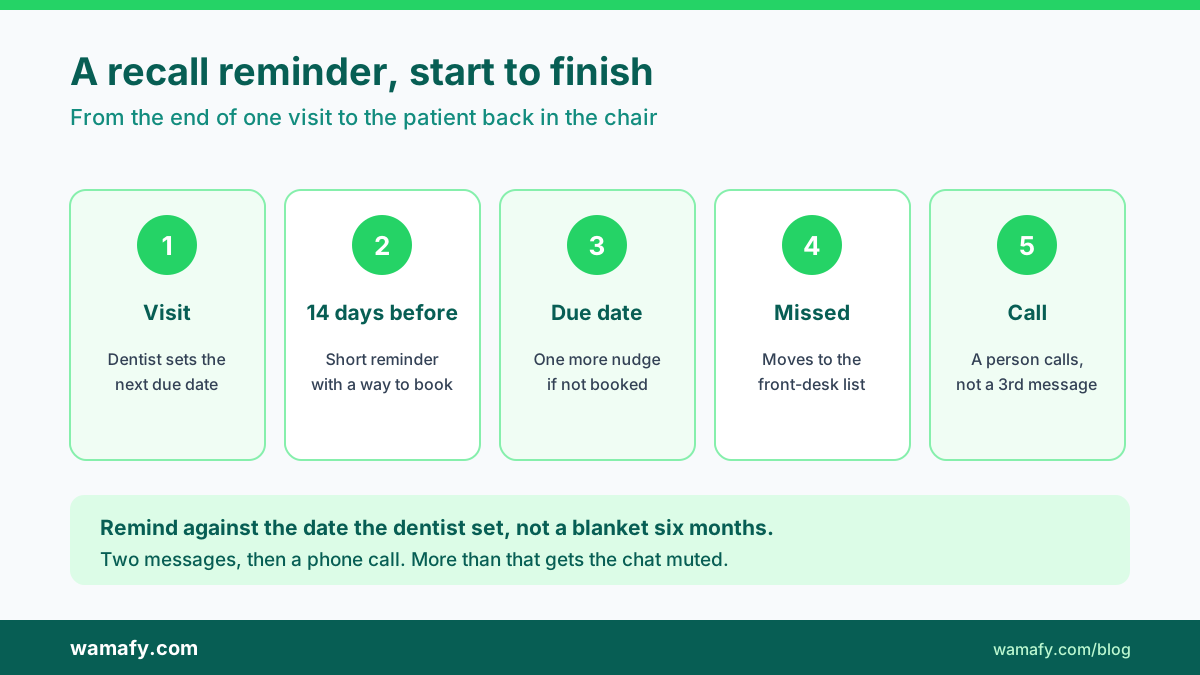
- Two weeks before the due date. A short note with a way to book. Most patients who will book, book here.
- On the due date, if they have not booked. One more gentle nudge.
- About a month after, if still nothing. Move them to the front desk's call list. A call works better than a third message.
For booked appointments
- The day before, in the evening. Time, doctor, address and a way to change the slot.
- The morning of, for early slots only. A 9 am patient benefits from a morning nudge. A 6 pm patient does not need two messages.
Two or three messages per visit is enough. More than that, and patients mute the chat.
Wamafy's Care Reminders let you set this as stages. Each stage has its own template, its own number of days before the due date and its own send hour. If the due date passes and the grace period ends with no visit, the reminder moves to "missed". That missed list is your call list for the front desk.
Multi-sitting treatments: where clinics lose the most
A missed checkup is a lost visit. A missed sitting in a root canal or an implant plan is worse. The treatment stalls, the patient may end up in pain, and the clinic loses the rest of the plan.
Here is how to handle the common ones:
- Root canal treatment. Book the next sitting before the patient leaves the chair. Send the appointment reminder the day before. If they cancel, the front desk calls the same day.
- Aligners. Reminders for each review visit, and a short "time to switch to your next set" note if your dentist wants one. Keep it plain. No medical advice in the message.
- Implants. Long gaps between stages mean patients drift. A reminder a week before each stage helps, plus a call if they do not confirm.
- Braces. Monthly adjustment visits suit a fixed reminder pattern.
The rule is simple: the longer the gap between sittings, the more each reminder matters to the outcome.
No-shows: what reminders can and cannot do
Appointment reminders do cut no-shows. As an industry benchmark, reminders typically reduce no-shows by a third to a half. These are typical figures from healthcare clinics in general, not results from any one clinic or from Wamafy customers.
Two things make reminders work better:
- Make it easy to change the slot. A patient who cannot come should be able to say so in one tap. A cancelled slot can be refilled. A no-show cannot.
- Keep a short waitlist. When a slot opens the day before, message the next patient who asked for an earlier time.
With the Appointments feature in the Clinics add-on, patients can book by sending "book" to your WhatsApp number. They pick a service, a doctor, a day and a free slot, and the slot is held so two people cannot take it.
Reminders will not fix everything. Some patients skip because of cost or fear of pain. For them, a call from someone they know at the clinic does more than any message.
Consent and tone for health messages
Health messages need more care than shop messages, because a phone can be seen by family members, and some patients do not want others to know about their treatment.
Get consent at registration
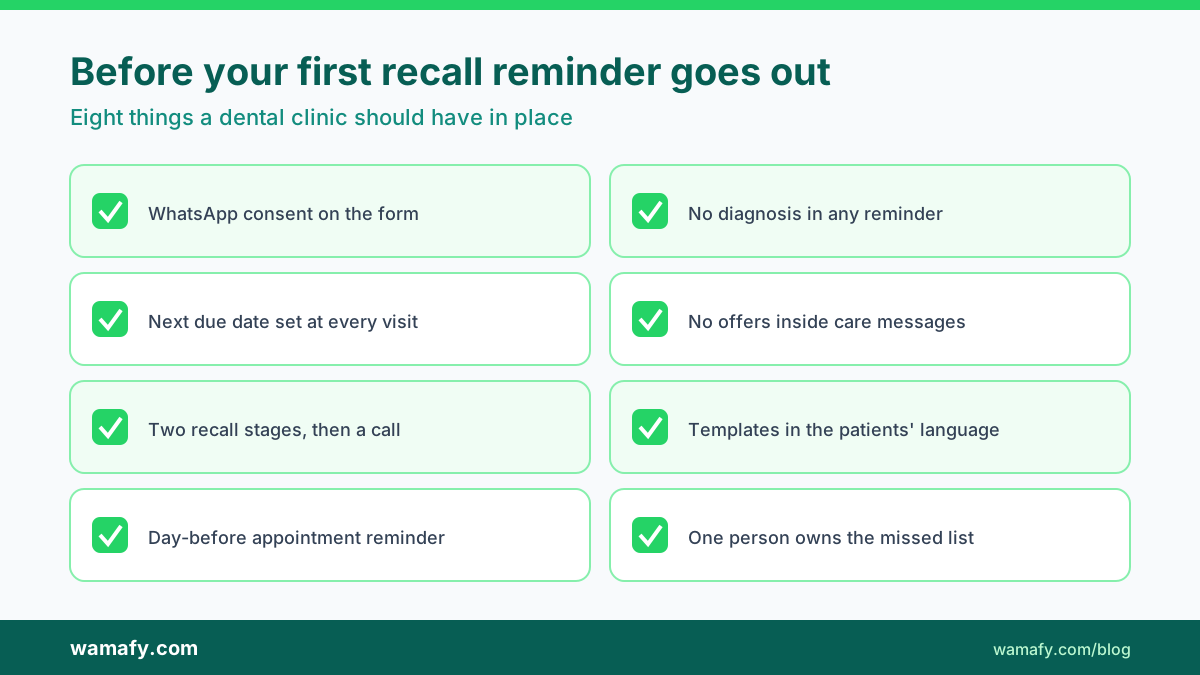
Add one line to your registration form or front-desk script. For example: "Smile Care Dental Clinic will send appointment and checkup reminders to this number on WhatsApp." Meta requires an opt-in that names your business. India's data protection law also expects you to collect patient data for a clear purpose and use it only for that purpose.
Keep clinical details out of reminders
- Say "your next sitting", not the name of the procedure.
- Say "your checkup", not the condition you are watching.
- Never put test results or diagnoses in a reminder.
Sound like the clinic, not a call centre
Use the dentist's name, and sign off with the clinic name. Write in the language your patients speak at the front desk. In Chennai, that may mean a Tamil version of each reminder template. And reply to patients who answer with a question. A reminder that cannot be answered feels like spam.
Prescriptions and invoices are different. Patients often want them on WhatsApp. In the Clinics add-on, they go as PDFs on the clinic letterhead, sent straight to the patient's chat, never as a public link anyone could open.
What it costs for a two-chair dental clinic
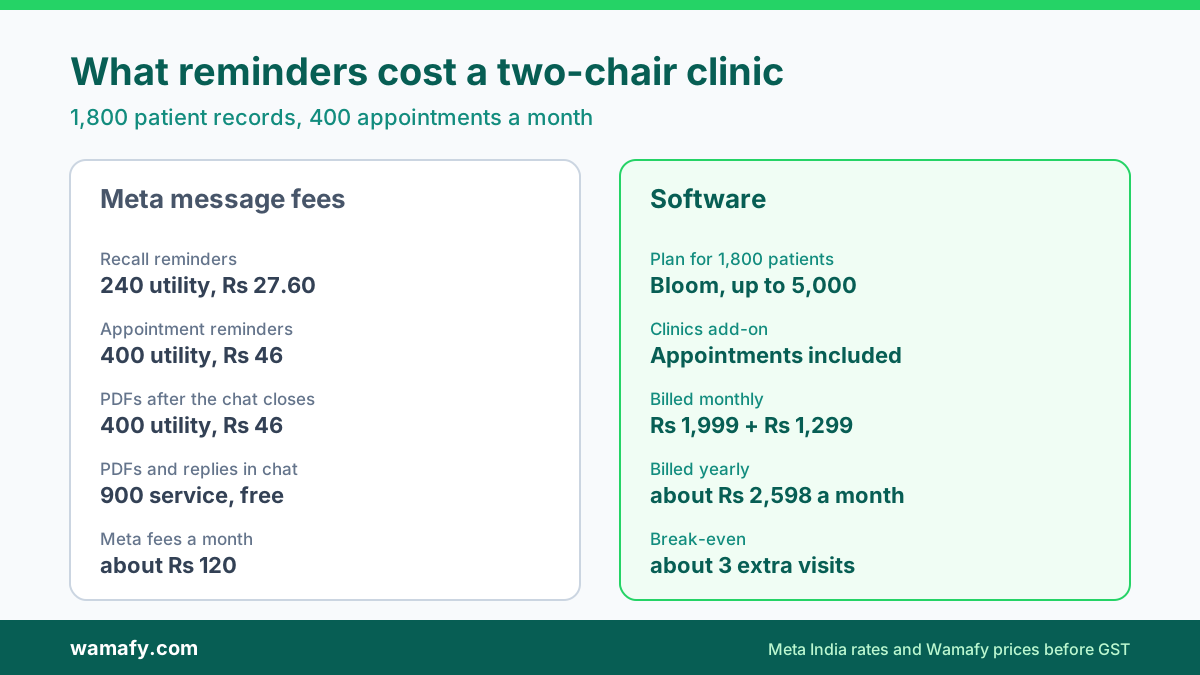
Here is a worked example. A two-chair clinic in Anna Nagar, Chennai, has about 1,800 patient records and sees about 400 appointments a month. Rates are Meta's India rates before GST.
| Messages in a month | Type | Count | Meta fee |
|---|---|---|---|
| Recall reminders, two stages | Utility | 240 | 240 x Rs 0.115 = Rs 27.60 |
| Appointment reminders, day before | Utility | 400 | 400 x Rs 0.115 = Rs 46 |
| Prescriptions and invoices sent after the chat has closed | Utility | 400 | 400 x Rs 0.115 = Rs 46 |
| Prescriptions and invoices sent while the chat is open | Service | 400 | Free (inside the 1,000 free) |
| Replies to patient questions and rescheduling | Service | 500 | Free (inside the 1,000 free) |
| Total | 1,940 | about Rs 120 |
Meta gives every business number 1,000 free service messages a month. After that, each one costs Rs 0.115. Utility messages always cost Rs 0.115, even inside an open chat, since 1 October 2026.
Then add the software. With 1,800 patient records, this clinic needs the Bloom plan, which holds up to 5,000 patient records. The Seed plan holds up to 500, so it suits a new clinic.
- Bloom plus the Clinics and Hospitals add-on, billed monthly: Rs 1,999 + Rs 1,299 = Rs 3,298 a month.
- The same, billed yearly: Rs 19,190 + Rs 11,988 = Rs 31,178 a year, about Rs 2,598 a month.
- A new clinic on Seed with the Clinics add-on, billed monthly: Rs 999 + Rs 1,299 = Rs 2,298 a month.
All prices are before GST. Wamafy adds no markup on Meta's message rates.
Is it worth it? Do the sum with your own fees. If a cleaning and checkup costs Rs 1,000 at your clinic, about three extra returning patients a month cover the yearly-billed cost. Anything above that is revenue you were losing to forgetting.
For a wider view of WhatsApp in healthcare, see the guide to WhatsApp for clinics in India and the clinics and hospitals resource.
Common mistakes with dental recall reminders
- One date for everyone. A blanket six-month blast ignores what the dentist decided. Set the date per patient.
- Too many messages. Four reminders for one checkup gets the chat muted. Two, then a call.
- Offers inside reminders. A discount line makes it a marketing message. Keep care and promotions apart.
- No reply from the clinic. If a patient answers "Can I come Saturday?", someone must reply that day.
- Nobody owns the missed list. The overdue patients are the most valuable list in the clinic. Give one person a weekly slot to call them.
Frequently Asked Questions
Is it allowed to send health reminders on WhatsApp in India?
Yes, if the patient has agreed to get messages from your clinic on WhatsApp. Collect that consent at registration and name the clinic in it. Keep diagnoses and test results out of reminders.
Can patients reschedule themselves on WhatsApp?
Yes, if your booking setup allows it. With the Appointments feature in the Wamafy Clinics add-on, patients book by sending "book" and pick a free slot. Staff can also reschedule from the schedule screen with a live slot picker.
How often should a dental clinic send recall reminders?
Base it on the recall date the dentist sets for each patient. A good pattern is one reminder two weeks before, one on the due date if they have not booked, then a phone call after about a month.
Are dental appointment reminders free on WhatsApp?
No. A reminder template is a utility message and costs Rs 0.115 per delivered message in India, before GST. Only service replies inside an open chat are free, and only for the first 1,000 each month per number.
Do I need a separate appointment booking tool for my dental clinic?
Not with Wamafy. The Clinics and Hospitals add-on includes Appointments, so booking, reminders, patient records and invoices sit in one place. It is a paid add-on and works on any plan.
Fill the chair with patients you already have
The cheapest new patient is an old one who forgot to come back. Set a recall date per patient, send two well-timed reminders, and give the missed list to someone who will call. That routine keeps the chair full long before you spend on ads.
To see it working, send democlinics to Wamafy on WhatsApp and try the demo as a patient would. Or start a 14-day free Wamafy trial. Your card is authorised when the trial starts and charged only on day 15.