Inside the Clinics & Hospitals Add-On: Patients, Queue, Prescriptions
Most clinic software is built for the doctor's desk. Your patients, though, live on WhatsApp. They message to ask if the doctor is in. They forward a photo of last month's prescription because the paper copy is lost. They forget the follow-up visit you asked them to book. The front desk ends up running the clinic from a personal phone.
The Clinics & Hospitals add-on in Wamafy is built for that gap. It is clinic management software for the WhatsApp side of your practice: patient records with an ID, bookings, a walk-in token queue, prescriptions and invoices sent as PDFs, and after-care reminders. This post walks through each part, what it costs to run, and who it does not suit.
The short version: one add-on turns your clinic's WhatsApp number into its front desk. It costs Rs 999 a month billed annually (Rs 1,299 billed monthly), plus GST, on any Wamafy plan. It includes the Appointments module, so you never buy both. It is a patient engagement tool, not a full medical records system.
What the Clinics & Hospitals add-on is (and is not)
Think of it as the layer between your clinic and your patients' phones. Everything sits in one sidebar section with seven parts:
- Overview - the day at a glance: patients, reminders due, today's bookings and the queue.
- Patients - a register with an auto patient ID (UHID) for every person.
- Appointments - in-chat booking, bundled in.
- Queue - walk-in tokens over WhatsApp.
- Care Reminders - follow-ups, vaccinations, checkups and refills.
- Invoices - bills, receipts and paid revenue.
- Setup - your clinic details, branches, doctors and services.
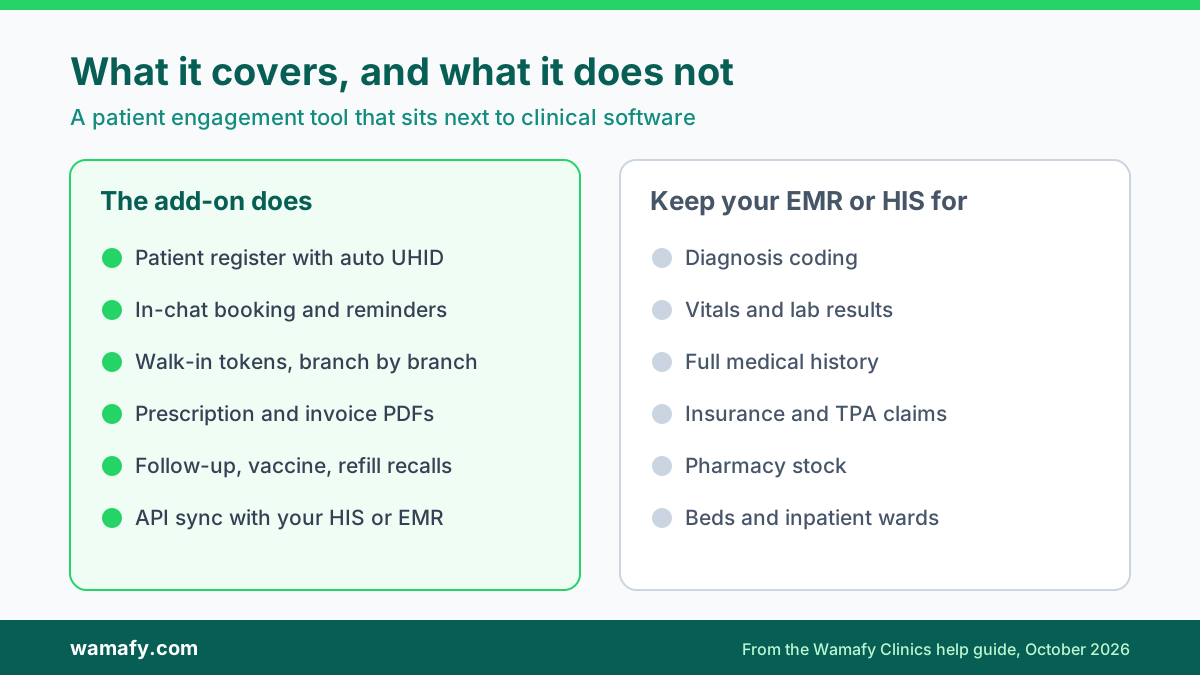
Here is the honest line. It does not do diagnosis coding, vitals, lab results or a full medical history. A doctor's note is free text, nothing more. If you need an EMR or a hospital information system (HIS), keep yours. This add-on can sit next to it, and your HIS can push patients and reminders into it through the Wamafy API.
Why build it this way? For most small clinics, the bigger leak is not the records. It is the edges: a missed follow-up, a long wait at the counter, a prescription nobody can find. Those edges all happen on the patient's phone.
Patient records and the UHID
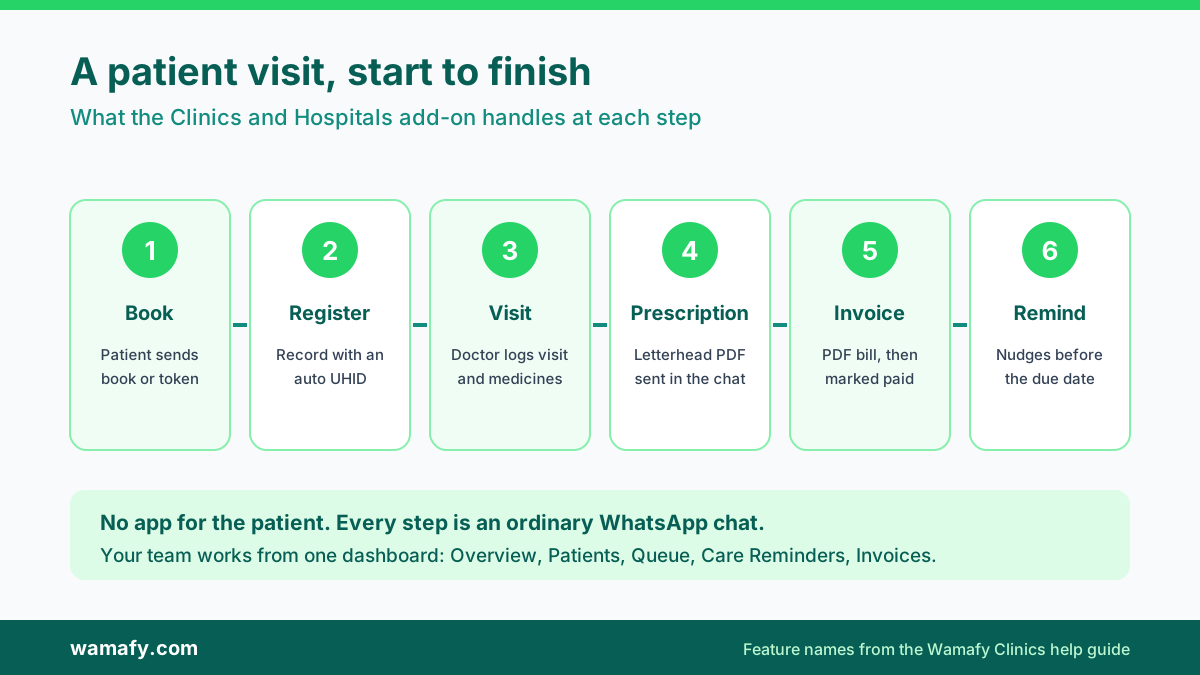
Every patient you add gets a unique hospital ID, such as SUN-1004. You set the prefix and the number width once, in Setup. The ID never repeats, and it shows on every prescription and invoice.
A record holds name and phone (both required), plus date of birth, sex, blood group, allergies, chronic conditions and notes. If the patient has already messaged your number, the record links to that chat on its own. That link is what lets you send them a document later. No duplicate contact is made.
Moving your existing list across
Most clinics already have patients in an Excel sheet or an old system. You can import a CSV and map your columns. Only the columns you map come in. Rows with a phone number already on file are skipped, not doubled. Each new row gets its own UHID.
One tip: clean the phone column first. Ten-digit mobiles import most cleanly. Landlines, spaces and extra leading zeros are common reasons a row fails.
Who sees the records
Your logged-in team sees them, under the roles you give them. The patient sees only what you send to their chat. Two doctors in the same clinic share one register, so a patient seen by one doctor on Monday shows up for the other on Friday with the full visit history.
Booking and the walk-in token queue
Booked visits
Patients type book (or "appointment") on WhatsApp. A form opens inside the chat. They pick a service, a day and a free slot. Only times that are really open are shown, based on your clinic hours, holidays and each doctor's own schedule.
A visiting consultant who comes in only on Tuesday evenings is offered only on Tuesday evenings. Reminders go out before each visit, up to five of them, at times you choose: two days before, two hours before, and so on. If you want, the clinic can approve each booking by hand, or ask for payment at booking through your own Razorpay account.
The booking side is the same engine as the standalone Appointments add-on. The Appointments deep dive covers it in full. The key point here: Clinics & Hospitals includes it. Do not buy both.
Walk-ins
Walk-ins are where Indian OPDs get crowded. With the queue switched on, a patient sends token, queue or register to your number. They pick a department and get a token, say C-23, with the number of people ahead of them.
Your staff open a live Queue board. Each department has its own card: who is being seen now, how many are waiting, how many are done. One tap on Call next moves the next patient up and messages them that it is their turn. So a parent can wait in the car or the pharmacy instead of the packed waiting area.
Run more than one branch? Each branch keeps its own daily token numbers. The bot asks the patient which branch they are at first, so two people at two branches never hold the same token.
Prescriptions and invoices as private PDFs
This is the part doctors notice first. You log a visit: doctor, department, reason and a note. Then you add medicines line by line, with dosage, a Morning, Afternoon and Night picker, duration, and before or after food. One Advice box holds general guidance.
Wamafy turns it into a PDF on your clinic letterhead. It carries your name, address, phone and GST number, plus the patient's UHID, age, sex and the next visit date. You can send it as you save the visit, or later with one tap. The front desk can also print a paper copy.
Why "private" matters
Many tools send a document as a link. Anyone who gets that link can open it. Here the PDF goes from Wamafy to WhatsApp server to server, as a media file. It is never posted to a public or shareable link. When your staff open it again later, it loads through a logged-in channel that browsers are told not to save. The PDF is not stored either. It is rebuilt from the saved prescription each time.
For a patient, the result is simple. Their prescription sits in their own chat, where they can find it at the chemist next month.
What a prescription message costs
There are two routes, and the add-on picks the right one:
- The patient messaged you in the last 24 hours - the PDF goes as a normal WhatsApp document. Since 1 October 2026, Meta bills these replies as service messages.
- Outside that window - it goes inside an approved utility template that carries the PDF. You generate both templates (prescription and invoice) in one click on the Documents tab, and Meta usually approves them within minutes to a few hours.
In India both routes cost the same: Rs 0.115 per message before GST on Meta's current rate card, which Wamafy passes on with no markup. So you do not need to plan around the window. The in-chat route can even be free: Meta gives each business number 1,000 free service messages a month, and charges only from the 1,001st. The India rate card post explains what changed on 1 October.
Invoices work the same way. Add line items and a discount, mark how it was paid (cash, UPI, card or bank transfer), and send the PDF. Two cards at the top show paid revenue this month and last month. Once an invoice is paid it locks, because its receipt records money received. To fix a mistake, you raise a new one.
After-care and follow-up reminders
This is where the money is, even though it looks like the boring part.
When you log a visit, you can set a next-visit date and a type: Follow-up, Vaccination, Checkup, Refill or Other. A care reminder is created for that date on its own. You can also add one by hand from any patient's file.
Then you build a schedule of up to ten stages. A common setup is three nudges: seven days, three days and one day before the due date. Each stage can use its own approved template, so the first message can be gentle and the last one direct. A background job checks every minute and sends each stage once, in your clinic's time zone.
Three details that save you trouble:
- No bursts. If you add a reminder late, after some stages have passed, the patient gets one nudge (the most urgent), not three at once.
- Dead numbers are skipped. A number that WhatsApp has refused before (not on WhatsApp, or the patient blocked you) is left out. Retrying it would only hurt your number's quality rating.
- Missed means missed. You set a grace period. After it, an un-actioned reminder is marked missed, so the front desk can call the patients who did not respond.
Template fields include the patient's name, the care type, the due date and the clinic name. Keep the wording plain and useful: what is due, when, and how to book. A reminder that reads like an offer may be classed as marketing by Meta, which costs more and gets blocked more often.
Setting it up in an afternoon
Setup is one page with tabs, in the order you should fill them: clinic details, clinic schedule, locations, departments, doctors, services, configuration, new patient questions, documents and publish.
For a single-doctor clinic this takes under an hour. For a chain with five branches and twenty doctors, filling forms gets slow. Use Import from Excel instead. You download a template with one sheet each for branches, doctors, schedules, services, prices and departments. You see every change before it saves, and an import never deletes anything.
The one step people forget: after changing services, doctors, branches or hours, rebuild the booking form on the Publish tab. Until you do, the WhatsApp bot keeps showing the old version.
What it costs a two-doctor clinic
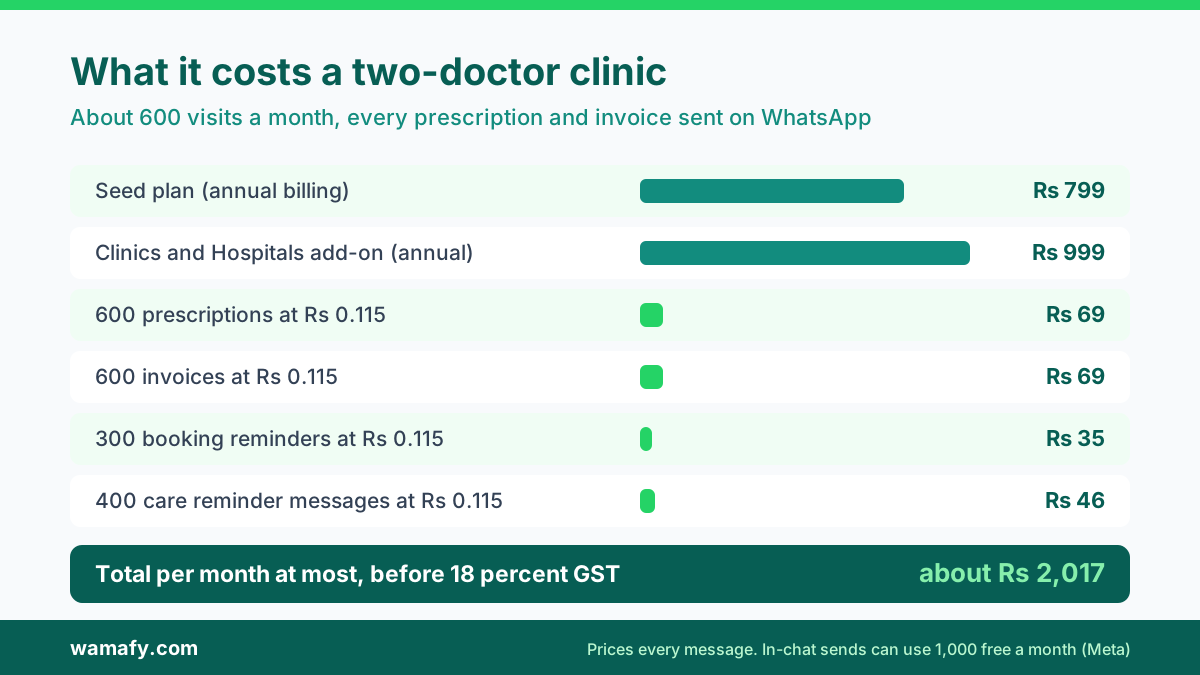
The add-on price is Rs 999 a month billed annually, or Rs 1,299 billed monthly, plus 18 percent GST. It works on every plan, including Seed. Seed is Rs 799 a month billed annually (Rs 999 monthly).
Take a two-doctor clinic in Chennai with about 600 visits a month. Assume every patient gets a prescription and an invoice on WhatsApp, 300 booked visits get one reminder each, and 200 patients get a two-stage care reminder.
| Item | Per month (before GST) |
|---|---|
| Seed plan (annual billing) | Rs 799 |
| Clinics & Hospitals add-on (annual billing) | Rs 999 |
| 600 prescriptions at Rs 0.115 | Rs 69 |
| 600 invoices at Rs 0.115 | Rs 69 |
| 300 booking reminders at Rs 0.115 | Rs 35 |
| 400 care reminder messages at Rs 0.115 | Rs 46 |
| Total, at most | about Rs 2,017 |
Message charges are Meta's India rates as of October 2026. They can change, so check the rate card before you budget. Messages a patient sends you cost nothing.
Correction, 1 November 2026: The table above prices every message. Prescriptions and invoices sent while a patient's chat is open are service messages, and Meta's pricing page gives each business number 1,000 free service messages a month. If most of them go out in an open chat, the message bill drops by up to Rs 115, to about Rs 1,902 a month before GST. See 1,000 free WhatsApp service messages explained.
Now the other side. If that clinic charges Rs 500 a consultation and reminders bring back just five follow-up visits a month that would otherwise be missed, that is Rs 2,500. The tool has paid for itself. That figure is an example, not a promised result. How many patients come back depends on your specialty and your patients.
Who it fits, and who it does not
It fits well if you are:
- A single-doctor or small group practice that runs on a paper register and the receptionist's phone.
- A dental, skin, eye, physio or paediatric clinic with repeat visits on a cycle.
- A diagnostics centre or vaccination clinic that needs reminders more than records.
- A polyclinic or small hospital with an HIS that does records well but does not reach patients on WhatsApp.
- A chain with several branches that wants one patient register and branch-wise tokens.
It is the wrong tool if you need:
- A full EMR with structured clinical data, vitals and lab results.
- Insurance claims, TPA billing or pharmacy stock.
- Bed management or inpatient wards.
For those, buy a hospital system and connect it. The add-on then handles the WhatsApp side.
Want the wider view of WhatsApp for healthcare first? Read the WhatsApp playbook for clinics and hospitals, or the shorter guide to WhatsApp for clinics.
Frequently Asked Questions
Is patient data safe in the Clinics add-on?
Records are visible only to your logged-in team. Prescriptions and invoices go to WhatsApp server to server and are never posted to a public link. The PDF is rebuilt on demand, not stored as a file.
Can two doctors share the same patient records?
Yes. All doctors in a workspace share one patient register with one UHID per patient. Each visit records which doctor and department saw the patient.
Do patients need to install an app?
No. Booking, tokens, prescriptions, invoices and reminders all happen in the patient's normal WhatsApp chat. The patient only needs to message your number.
Is it allowed to send prescriptions and health reminders on WhatsApp?
Sending a patient their own prescription or a reminder for a visit they need is a normal service use. The patient should have opted in to hear from you. Keep reminders factual, since a reminder that reads like an offer may be classed as marketing.
Does it replace my hospital software?
Not if you need clinical records. It has no vitals, lab results or diagnosis coding. It works next to your HIS or EMR, which can sync patients and reminders through the Wamafy API.
Do I need to buy Appointments as well?
No. Clinics & Hospitals includes the full Appointments booking module. Buying both would mean paying twice for the same thing.
See it on your own phone
The fastest way to judge this is to be the patient. Message democlinics to Wamafy's demo number and you will book a visit in a form, get a token, receive a reminder and get a prescription PDF in the chat.
When you are ready, see the Clinics & Hospitals add-on or start a 14-day free Wamafy trial. Add-ons are free during the trial. Your card is authorized when the trial starts and charged only on day 15.