WhatsApp Marketing for Jewellery Stores: The Dhanteras Season
Most of your best customers walk in only a few times a year. They come for Dhanteras, for a wedding in the family, for an anniversary gift. The rest of the year, they are quiet. That is why WhatsApp marketing for jewellery shops is not about sending more messages. It is about being in the right chat on the few days that matter, with something the customer actually wants.
This guide is for owners of one to five jewellery stores in India. It covers Dhanteras pre-booking, gold savings scheme reminders, occasion reminders, showing designs, and the daily gold rate question. It ends with what all of it costs for a store with 3,000 customers, using Meta's October 2026 rates for India.
Why WhatsApp marketing for jewellery shops works differently
A clothing brand can send a new offer every week. A jeweller cannot. Your buying cycle is slow and your ticket size is high. Four things set you apart:
- Trust comes first. A customer hands you lakhs of rupees for something they cannot fully test at the counter. They buy from a name they know. A WhatsApp chat from your verified business number keeps that name in front of them.
- The family buys, not one person. A bridal set is chosen by the bride, her mother and often an aunt. A photo shared in a family group does more selling than any ad.
- The dates are known in advance. Dhanteras, Akshaya Tritiya, wedding season, birthdays and anniversaries. You can plan for most of your revenue months ahead.
- Customers come back for years. The same family buys a chain for a naming ceremony, then bangles for a wedding twenty years later. The phone number is often the only record you have of them.
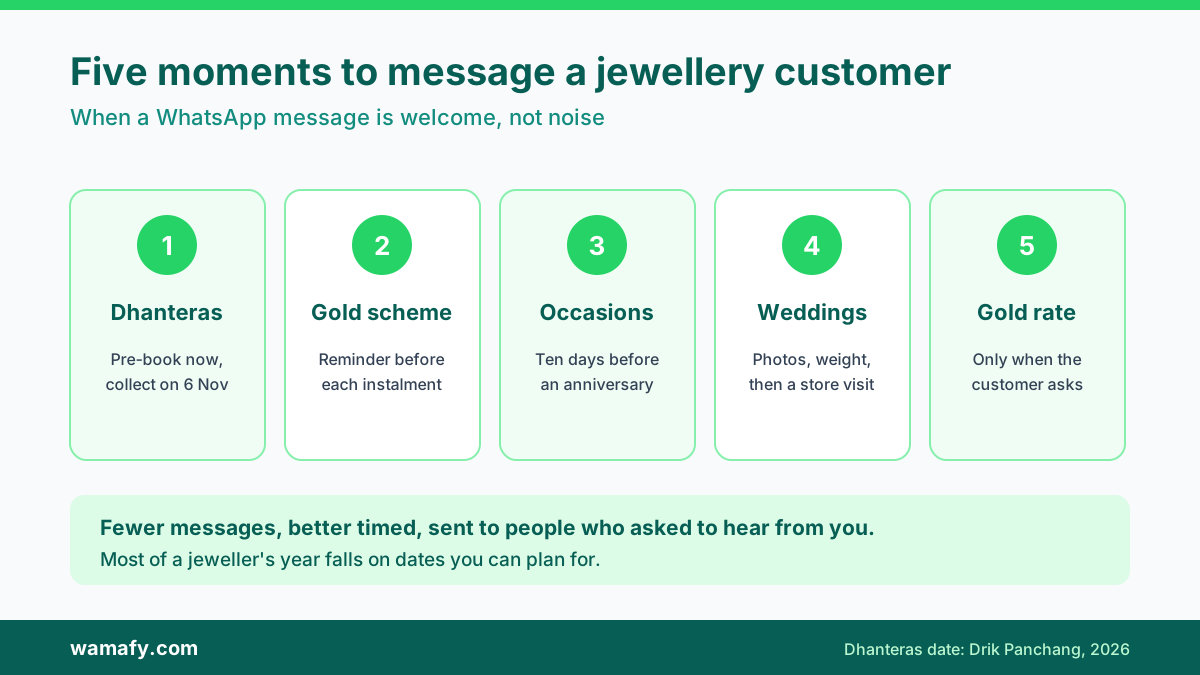
So the goal is simple. Fewer messages, better timed, sent to people who asked to hear from you.
Dhanteras pre-booking: book now, collect on the day
Dhanteras falls on Friday, 6 November 2026 (Drik Panchang). For many families it is the one day of the year they must buy gold or silver. That creates a problem for you. Everyone wants to come on the same evening, and your counter cannot serve them all.
Pre-booking fixes this. The customer chooses and pays for the piece now. They collect it on Dhanteras, so the purchase still counts on the right day. Here is a simple plan:
- Two to three weeks before: send one message to past buyers. Say that Dhanteras pre-booking is open, show three or four pieces, and ask them to reply "book".
- When they reply: your team answers in the chat. Share more photos, the weight and the making charge. Agree on a collection time.
- Visit slots: if they want to see the piece first, book a time to visit the store. A slot on a quiet weekday morning is far better than a crowd on the evening of 6 November.
- A day before collection: send a reminder with the time slot and the store address.
Two things to get right. First, be clear on the price. Gold moves every day. Say whether the price is locked at booking or set on the day of collection, and write it in the chat. Second, keep a token amount small and receipted. A customer who pays a large sum to a chat with no paper trail will worry, and they should.
In Wamafy, the Appointments add-on handles the visit slots. Customers book inside WhatsApp, get an automatic reminder, and can cancel or move the slot themselves. For a wider festive plan, see the Diwali WhatsApp marketing playbook.
Gold savings scheme reminders on WhatsApp
Most jewellers run a monthly savings scheme. The customer pays a fixed amount each month, often for 10 or 11 months. At the end, they buy jewellery with the total, often with a bonus month or a waiver on making charges.
The weak point is the reminder. A member who misses two instalments often drops out. Your staff then spend the first week of every month calling people. That is slow, and many calls go unanswered.
A WhatsApp reminder works better because the customer can act on it right away. A good scheme reminder has:
- The member's name and scheme number
- The instalment amount and due date
- How many instalments are paid and how many are left
- A "Pay now" button, so they do not have to visit the store
Send it three days before the due date and again on the day. Stop there. A third or fourth nudge in the same week feels like a debt collector, not a family jeweller.
Wamafy has no module named "gold scheme". The Contract Renewals add-on does the same job once you relabel it. You rename the fields (Member, Scheme, Scheme number, Instalment, Due date), set the cycle to one month, and pick your reminder days. Connect Razorpay and each reminder carries a "Renew now" pay button. When a member pays, mark it paid and the due date moves forward one month on its own. A paid instalment also gets a receipt with your GSTIN and logo. The founder's view on why renewals belong in WhatsApp is in this post.
A note on scheme rules: savings schemes are usually closed within a year because money held longer can be treated as a deposit under Indian law. Check your scheme terms with your CA. WhatsApp reminders do not change those rules.
Anniversary and birthday reminders, with consent
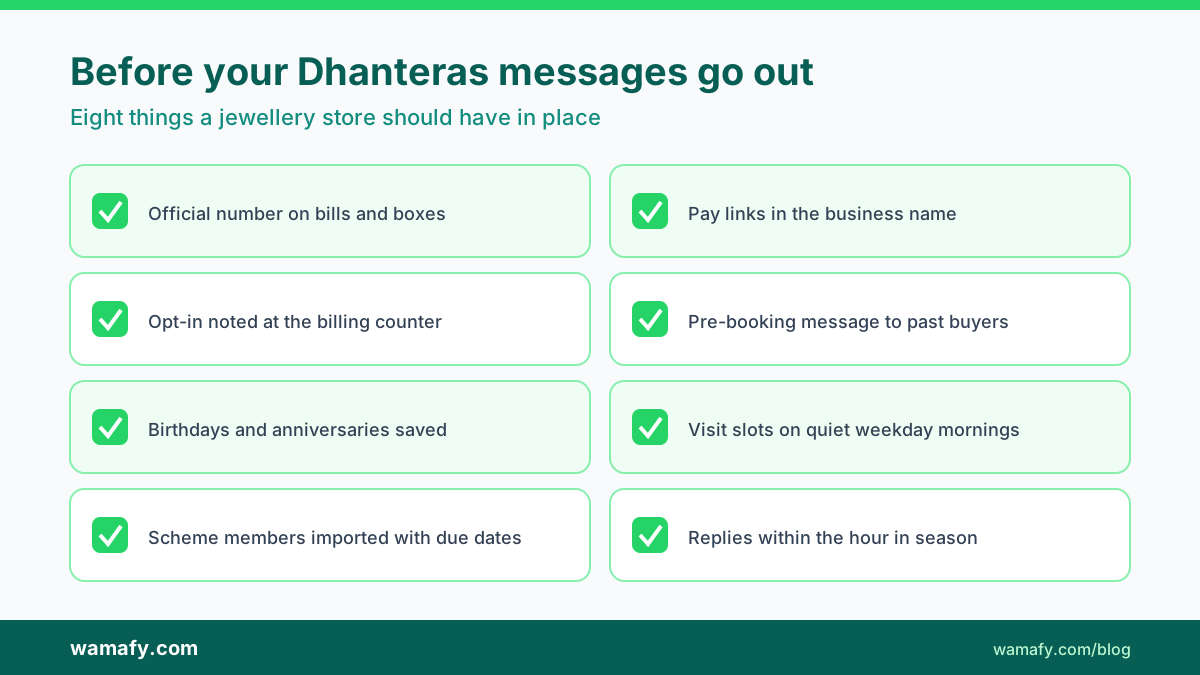
This is where a jeweller can win the most and annoy the least. Ask for two dates at billing: the customer's birthday and their wedding anniversary. Ask, do not assume, and note that they agreed to hear from you on WhatsApp.
Then send one message, about ten days before the date. Ten days gives a husband or a son enough time to visit. Keep it short and personal:
"Hi Priya, your anniversary is coming up on the 24th. We have kept aside a few new diamond pendants in your budget. Reply PHOTOS to see them, or VISIT to book a time."
Store the dates as Date fields on the contact (Wamafy calls these Contact Attributes). If you want the reminder to fire on its own every year, the same Contract Renewals setup works with a 12-month cycle and the payment button switched off.
Two mistakes to avoid:
- Sending on the day itself. A "happy anniversary" message with an offer on the day is too late to buy anything. Send the warm wish on the day if you like, but sell ten days before.
- Using a list you did not collect. If a contact never agreed to hear from you, do not message them. One blocked chat at a time adds up and can hurt your number's quality rating.
Showing designs: photos, catalogue and visits
Jewellery sells on detail. A customer wants to see the clasp, the back of the pendant, and how a necklace sits on a person. WhatsApp handles this well because they can zoom, forward and ask questions in the same chat.
What works:
- Three to five photos, not thirty. Pick pieces in the customer's budget. A flood of photos makes it harder to choose.
- Weight and purity with every photo. Grams, karat and hallmark details answer the first three questions before they are asked.
- A short video for heavy pieces. Ten seconds of a necklace turning under store lights beats any studio photo.
- A visit slot for big purchases. Bridal sets and diamonds still close in the store. Use the chat to get the family in the door.
Should you put your full range in a WhatsApp catalogue with prices? For silver articles, coins and fixed-price fashion pieces, yes. For gold jewellery, it is harder, because the price changes with the gold rate every day. A catalogue price that was right on Monday is wrong by Thursday. Many jewellers show the piece and weight in the catalogue and quote the price in the chat on the day.
Daily gold rate messages: when they help and when they annoy
Many jewellers want to send the day's gold rate to every customer each morning. It feels useful. It is usually a mistake, for two reasons.
First, it is expensive. A daily rate message is promotional, so Meta reviews it as a marketing template. In India that costs Rs 0.8631 per message. Sent to 3,000 customers every day for 30 days, that is about Rs 77,679 a month, just for the rate.
Second, people stop reading. A customer who buys twice a year does not need the rate 365 times. After a few weeks they mute the chat. Some block it, and blocks lower your number's quality rating. Meta also limits how many marketing messages one person receives, so a daily broadcast may not even arrive.
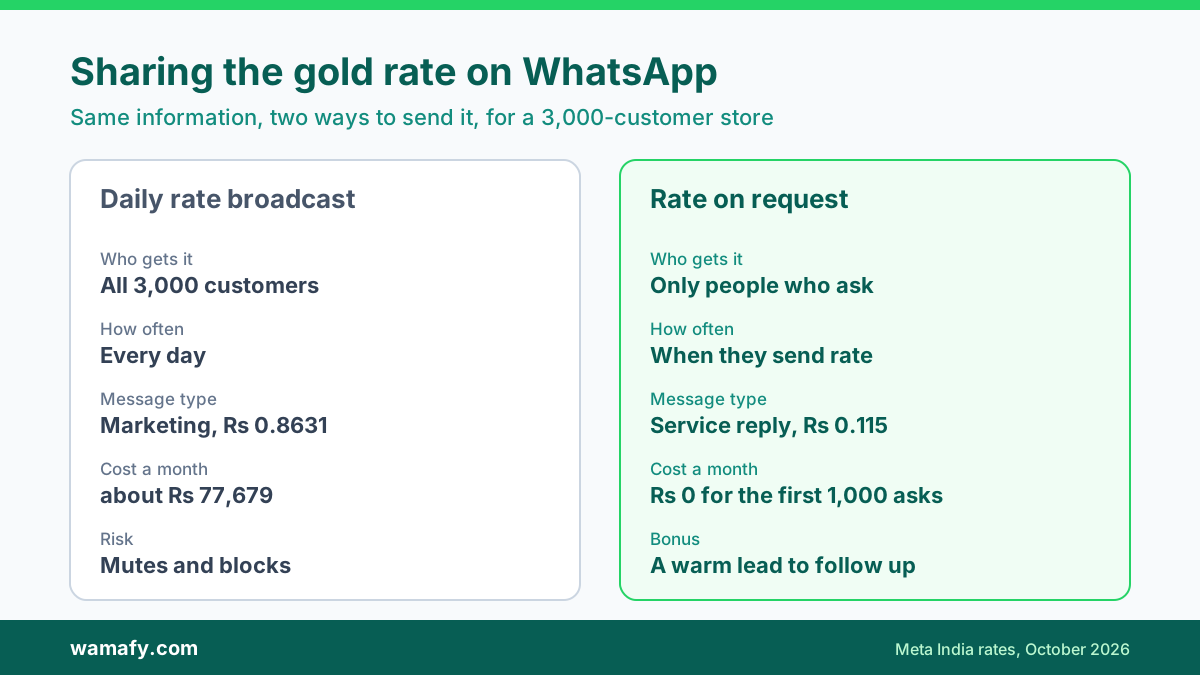
A better way is rate on request. Tell customers to send the word "rate" any time. A chatbot replies with today's 22K and 24K rate and a button to book a visit. You only pay for people who asked, and the first 1,000 replies a month on each number are free. After that, each reply costs the service rate of Rs 0.115. And a customer who asks for the rate is often close to buying, so your team can follow up in the same chat.
When does a rate broadcast make sense? When the price moves a lot. If gold drops sharply in a week, one message to your scheme members and recent enquiries saying "rates are down, a good week to book" is useful news. Send it to a small group, not your whole list.
Is it safe to share prices and take payments on WhatsApp?
Jewellery fraud on WhatsApp is common. Fake accounts copy a known store's name and photos, then ask for advance payments. Your customers know this, so make your real number easy to trust:
- Use the WhatsApp Business API on your store's official number, with your logo and display name approved by Meta.
- Print that number on bills, boxes and the shop board, so customers can check it.
- Take payments through a payment link in your business name, never a staff member's personal UPI ID.
- Send a receipt for every payment in the same chat.
- Tell customers once a year that you never ask for full payment for an unseen piece over WhatsApp. It costs nothing and builds trust.
Sharing prices is fine. Sharing a customer's purchase history, scheme balance or address with anyone else is not. Give only trusted staff access to the inbox.
What WhatsApp marketing costs for a jewellery store
Take a store with 3,000 customers on its list, 400 gold scheme members, about 250 birthday and anniversary reminders a month, and 150 store visits booked through WhatsApp. Rates below are Meta's India rates for October 2026, with no markup added by Wamafy. Since 1 October 2026, Meta also charges for service replies inside the 24-hour window, at the same Rs 0.115 as utility, after 1,000 free service messages a month per number.
Correction, 1 November 2026: An earlier version billed all 1,500 customer replies. Meta's pricing page gives each business number 1,000 free service messages a month, so only 500 are billed. The table now reflects that. See 1,000 free WhatsApp service messages explained.
| Item | Normal month | Festive month |
|---|---|---|
| Bloom plan (billed annually) | Rs 1,599 | Rs 1,599 |
| Contract Renewals add-on, for schemes and occasions (annual) | Rs 399 | Rs 399 |
| Appointments add-on, for visit slots (annual) | Rs 399 | Rs 399 |
| Scheme reminders: 800 utility messages at Rs 0.115 | Rs 92 | Rs 92 |
| Occasion reminders: 250 marketing messages at Rs 0.8631 | Rs 216 | Rs 216 |
| Visit confirmations and reminders: 300 utility messages | Rs 35 | Rs 35 |
| Replies to customers: 1,500 service messages (first 1,000 free) | Rs 58 | Rs 58 |
| Broadcasts to all 3,000 customers (marketing) | 1 send: Rs 2,589 | 2 sends: Rs 5,179 |
| Total, before 18% GST | about Rs 5,390 | about Rs 7,980 |
Why Bloom and not the cheaper Seed plan? Seed holds up to 1,000 contacts and 5 campaigns a month. A store with 3,000 customers outgrows it. A single store with under 1,000 customers can start on Seed at Rs 799 a month billed annually and add the same add-ons, since every add-on works on every plan.
Look at where the money goes. The plan and add-ons are fixed. Scheme and visit messages are cheap because they are utility. Broadcasts are the big cost. So the lever you control is how often you broadcast and to whom. Sending the Dhanteras message to 1,200 recent buyers instead of all 3,000 saves about Rs 1,550 per send. The full rate card is in WhatsApp API pricing in India after 1 October.
Five mistakes jewellers make on WhatsApp
- Broadcasting to everyone, every time. Split your list. Scheme members, bridal enquiries, recent buyers and lapsed customers want different messages.
- Sending "Happy Diwali" as a free greeting. A festive greeting from a business is a marketing template and is billed like one. If you send it, make it worth reading.
- Posting the gold rate daily to the whole list. See the costs above.
- Leaving replies for hours. A bride's family asking about a set on a Sunday evening is a hot lead. Have someone answer within the hour in season.
- Forgetting to ask for a review. A happy customer collecting a bridal set is your best moment to ask. Here is how to collect reviews on WhatsApp.
Timing matters too. For when to send so your message is read, see the best time to send a WhatsApp broadcast in India.
Frequently Asked Questions
Can I send the gold rate on WhatsApp every day?
You can, but it is usually not worth it. A daily rate message is a marketing template at Rs 0.8631 per message in India, so 3,000 customers for a month costs about Rs 77,679. Letting customers send "rate" to get a reply costs nothing for the first 1,000 replies a month, then Rs 0.115 per reply, and reaches only people who want it.
Is it safe to share jewellery prices on WhatsApp?
Yes, from your store's verified business number. The risk is fake accounts copying your name, so print your official number on bills and boxes, take payments only through links in your business name, and send a receipt for every payment.
How do I send gold savings scheme reminders on WhatsApp?
Keep one record per member with the instalment amount and due date, then send a reminder a few days before and on the due date. In Wamafy, the Contract Renewals add-on does this with a one-month cycle and a pay button on each reminder.
Do I need the customer's permission to message them?
Yes. Meta requires opt-in before a business sends template messages. Ask at the billing counter and note the date they agreed. A customer who messages you first can be replied to, but that does not mean they agreed to marketing.
How much does WhatsApp marketing cost a jewellery store?
For a store with 3,000 customers, about Rs 5,500 in a normal month and about Rs 8,090 in a festive month, before GST, on Wamafy's Bloom plan with two add-ons. Most of the cost is broadcasts, so sending to the right group matters more than the plan price.
When should I start Dhanteras messages?
Dhanteras is on 6 November 2026. Open pre-booking two to three weeks before, so customers can choose and pay early and collect on the day. A reminder a day before collection cuts no-shows.
Start with the dates you already know
You do not need a big campaign. Start with three lists: scheme members, customers with an anniversary or birthday on file, and everyone who bought in the last two Dhanteras seasons. Set up reminders for the first two and one pre-booking message for the third. That alone covers most of a jeweller's year.
Start a 14-day free Wamafy trial to set up your scheme reminders and Dhanteras slots. Your card is authorised when the trial starts and charged only on day 15. Wamafy passes Meta's message rates through with no markup.