Diwali Corporate Gifting Orders on WhatsApp: A Playbook for B2B Sellers
An HR manager has 140 people to thank before Diwali. She asks three gift sellers for options on the same afternoon. One sends a price list the next morning. One sends it a week later. One sends a short catalogue, a quote and a simple way to share addresses within the hour. The third seller usually wins. Price is often not the reason. With Diwali corporate gifting orders, speed and ease win the deal. She is busy, and that seller made her job easy before anyone else did.
Diwali falls on Sunday, 8 November 2026, with Dhanteras on Friday, 6 November. So the next two weeks are when most companies lock their gift orders. This playbook is for hamper makers, sweet shops, dry fruit sellers and gift box studios who sell to companies. It shows how to run the whole order on WhatsApp: the catalogue, the quote, the address list, payment and delivery updates. It also shows what each step costs in Meta's message fees.
Who buys Diwali corporate gifts, and when
The buyer is rarely the boss. It is usually someone in HR, admin or the founder's office. Their job is simple to describe and hard to do: a gift for every employee or client, within budget, delivered on time, with no complaints.
Here is what that person cares about, in order:
- A clear price per person. They start with a budget, such as Rs 500 or Rs 1,500 per head, and work back from it.
- One approval. Their manager or finance team signs off once. They do not want a second round.
- No address chasing. Collecting 140 addresses is the worst part of the job.
- Proof of delivery. When someone says "my gift never came", they need an answer fast.
- A proper invoice. Finance will not pay without one.
If your WhatsApp process solves those five things, you win orders even when you are not the cheapest. If it solves none of them, a lower price rarely saves you.
Step 1: The catalogue message, built around budget
Most gift sellers send a 40-page PDF with every product they make. That slows the buyer down, because a busy HR manager wants three clear choices, each priced per person.
Build your catalogue in budget tiers:
| Tier | Price per person | What goes in it |
|---|---|---|
| Simple | Rs 400 to Rs 700 | Sweets or dry fruit box, branded sleeve, greeting card |
| Classic | Rs 800 to Rs 1,500 | Hamper with sweets, dry fruit, a diya set or candle |
| Premium | Rs 2,000 and up | Hamper with a keepsake item and the company's logo |
These ranges are only an example, so set your own from your costs. The point is the shape: three tiers, one photo each, a price per person and a minimum order.
Send this as a WhatsApp marketing template to past corporate buyers who have agreed to hear from you. One photo, three lines of text and a button such as "Get a quote" works better than a PDF. In India, Meta charges Rs 0.8631 for each delivered marketing message, before GST. Sending it to 80 past buyers costs about Rs 69.
Never send it to people you have not spoken to, because a list of HR emails or LinkedIn profiles is not permission. More on that in the FAQ.
Step 2: One quote, one thread, one approver
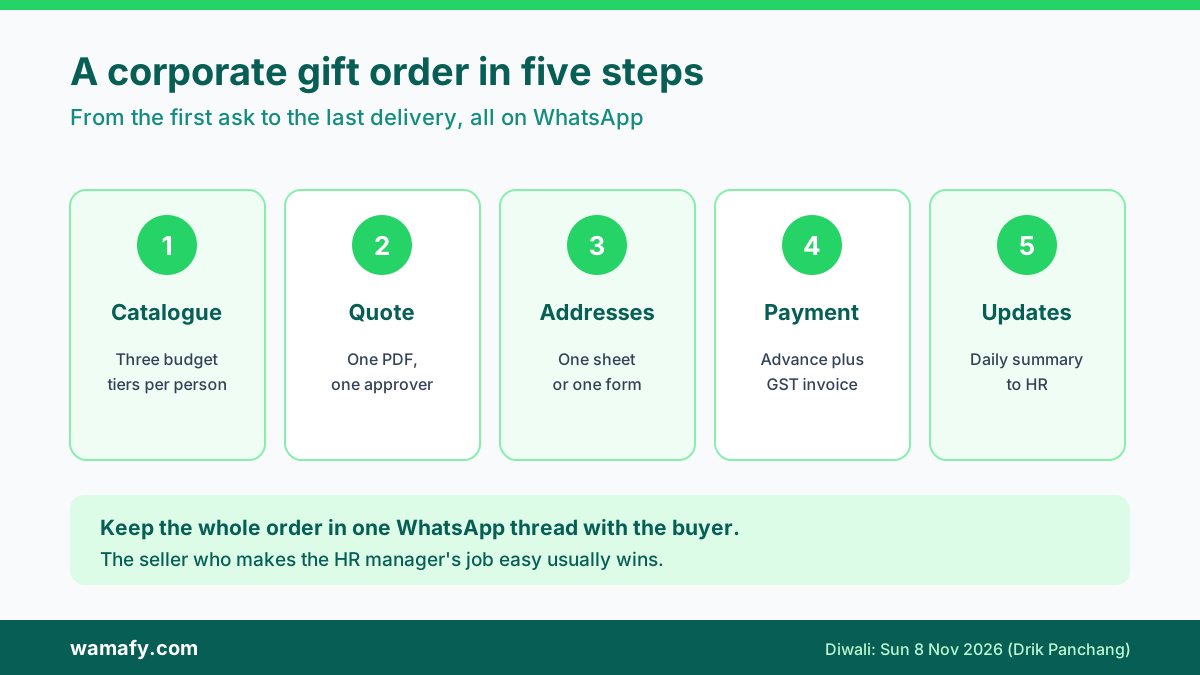
Once a buyer replies, the deal moves into a normal chat. Keep the whole deal in that one thread. Do not split it across email, calls and two staff phones.
Here is a simple order of play:
- Ask four questions. How many gifts? Budget per person? Delivery to one office or many addresses? Last date for delivery?
- Send one PDF quote. Show the tier, unit price, quantity, delivery charges, GST and total. Add your payment terms and the last date you can accept the order.
- Ask who approves. If finance signs off, ask the buyer to add them or forward the PDF. Your quote should be readable without your explanation.
- Confirm in writing. When the buyer says yes, reply with the final quantity, tier and delivery date in one message. That message is your order record.
A shared inbox helps a lot here. In Wamafy, every corporate chat can be assigned to one person on your team, tagged and snoozed until the buyer is due to reply. You can send the quote PDF from the same chat. If your sales person is out, someone else can pick up the thread and see the whole history.
These replies are service messages, because the buyer messaged you first. Meta gives every business number 1,000 free service messages a month. After that, each one costs Rs 0.115. A season of quote chats with 20 companies often fits inside the free 1,000.
Step 3: Getting the delivery list without chasing
This is where most corporate orders go wrong. Some gifts go to one office. Others go to employees' homes across cities. Typos in pin codes and phone numbers cause most failed deliveries.
You have two good routes.
Route A: HR sends one sheet
Send the buyer a blank sheet with fixed columns: name, phone, full address, pin code, city and gift tier. Ask them to fill it and send it back in the chat, then check it once before you pack.
This is the cheapest route. It also keeps you from messaging employees you have never spoken to. The downside is that HR still has to collect the addresses.
Route B: Employees fill in their own address
HR shares a WhatsApp link with a keyword, such as "gift acme", in their staff group or email. Each employee taps it and messages you. A chatbot asks for their name, address, pin code and gift choice, then saves the answers.
With Wamafy's chatbot, a Google Sheet node writes each answer into a row of your sheet the moment it arrives. The guide to sending WhatsApp leads to Google Sheets shows the setup. On Bloom and Forest, you can use a WhatsApp Flow instead, which is a short form that opens inside the chat. A form means fewer messages back and forth and fewer typing mistakes.
Route B costs more, because each employee's chat uses several service messages. It also saves HR a day of work, and some buyers will gladly pay a little more for that, so offer it as an option.
There is one rule for Route B. Message employees only after they message you first. HR's staff list is not consent from each employee.
Step 4: Payment and the invoice
Corporate buyers usually pay against an invoice, not on the spot. Agree the terms up front and put them in the quote.
- Take an advance. For a custom or branded order, 50% before you start packing is common. Branded sleeves and printed cards cannot be resold if the order is cancelled.
- Send a payment link or bank details. Send a payment link from your own gateway, or your bank details, in the same chat. If you sell smaller repeat orders, Wamafy's Sell on WhatsApp add-on can create a Razorpay link for each order. The money goes straight to your account.
- Send a GST invoice. Make it in your billing software, with the buyer's company name and GSTIN, then send the PDF in the chat. Ask the buyer's finance team what they need on it before you raise it.
Many companies cannot claim GST input credit on gifts they give away. So some buyers will ask for the invoice to show items in a certain way. Do not guess here. Ask your CA what you can and cannot show on an invoice for gifts.
Step 5: Delivery updates that stop "where is my gift?"
The last week before Diwali is the busiest time of year for couriers, so some boxes will be late. What matters is that the buyer hears it from you first.
Pick the update style that fits the route:
- For Route A, send one daily summary to HR. "Delivered: 112. Out for delivery: 21. Problem: 7, with reasons." If HR messaged you in the last 24 hours, this is a service message. If not, use a short utility template, which costs Rs 0.115 each in India.
- For Route B, send one update to each employee. These employees started the chat, so they have opted in. Send a utility template such as "Your Diwali gift from Acme is out for delivery" with the courier link. At Rs 0.115 each, 2,400 updates cost Rs 276.
Since 1 October 2026, Meta also charges for utility messages sent inside an open chat. So treat every update as paid. That is another reason one daily summary to HR is often the better choice.
What Diwali corporate gifting orders cost on WhatsApp
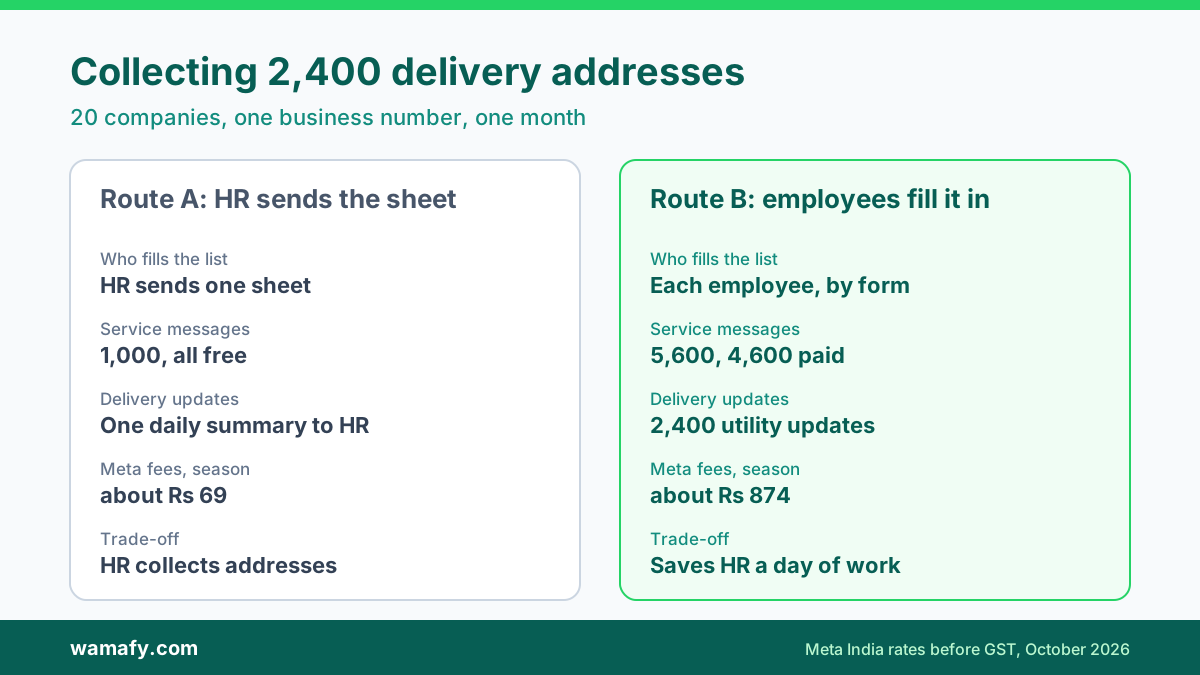
Here is a worked example. A hamper maker in Chennai takes Diwali orders from 20 companies, 2,400 gift boxes in total. Rates are Meta's India rates before GST.
| Messages | Route A: HR sends the sheet | Route B: employees fill it in |
|---|---|---|
| Catalogue to 80 past buyers (marketing) | 80 x Rs 0.8631 = Rs 69 | 80 x Rs 0.8631 = Rs 69 |
| Quote and approval chats with HR (service) | 800 messages | 800 messages |
| Daily delivery summary to HR (service) | 200 messages | None |
| Address chats with employees (service) | None | 2,400 x 2 = 4,800 messages |
| Service messages in total | 1,000, all inside the free 1,000 | 5,600, so 4,600 paid x Rs 0.115 = Rs 529 |
| Delivery update per employee (utility) | None | 2,400 x Rs 0.115 = Rs 276 |
| Meta fees for the season | about Rs 69 | about Rs 874 |
Route B assumes a WhatsApp Flow form, so each employee needs about two messages. A step-by-step chatbot uses more, about five or six each. Both routes assume every service chat happens on one number in one month.
Either way, the message fees are small next to the value of the order. 2,400 boxes at Rs 800 is Rs 19.2 lakh in sales. What decides your margin is how many hours your team spends chasing addresses and answering "where is my gift". On top of Meta's fees, you pay for your WhatsApp software. With Wamafy, that is a flat plan and Meta's rate with no markup on any message. The Seed plan is Rs 999 a month billed monthly, or Rs 799 a month billed yearly. Bloom, which includes WhatsApp Flows, is Rs 1,999 a month billed monthly. All prices are before GST.
Step 6: Win next Diwali before this one ends
Most corporate gift sellers lose next year's order because they disappear for eleven months. The buyer forgets their name, or moves to another company, and the new HR manager starts from scratch.
Do three things before the season closes:
- Tag every corporate buyer. Save them in a segment such as "corporate Diwali 2026", with the tier and quantity they bought.
- Ask one question after delivery. "Anything to change for next year?" The answer tells you what to fix. The question also keeps the chat warm.
- Note the date they first asked. If a company asked on 20 October this year, message them in early October next year. Send one message with this year's tiers and their past order, so reordering takes one reply.
The same list works for other gifting moments, such as New Year, Pongal or work anniversaries. Send only when you have something useful to offer, not every week. Each marketing message costs money, and too many lead to blocks.
If you also sell to businesses year-round, the B2B WhatsApp playbook covers longer sales cycles in more depth.
Common mistakes that lose Diwali corporate gifting orders
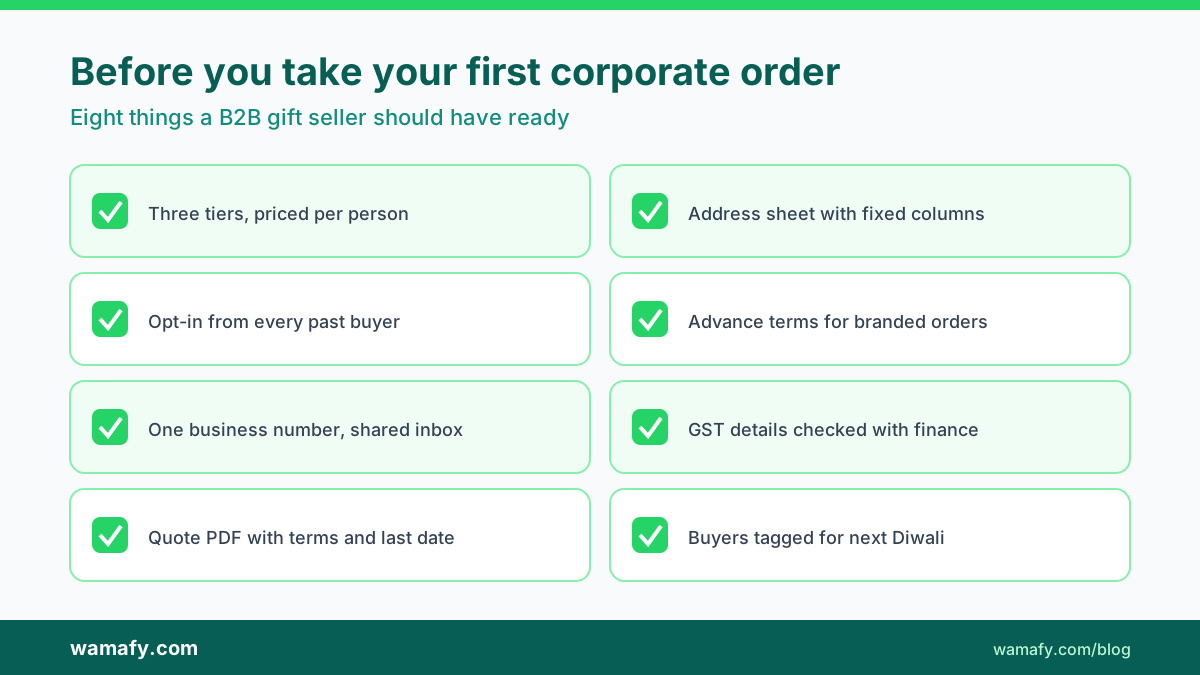
- Sending a full product PDF first. Lead with three budget tiers. Send the full range only if they ask.
- Quoting from a personal phone. When that phone is busy or that person is on leave, the deal stalls. Use one business number with a shared inbox.
- Taking addresses in loose messages. Twenty chats with addresses typed in different ways is how parcels go to the wrong city. Use one sheet or one form.
- Messaging staff from HR's list. They never agreed to hear from you. That can lead to blocks and a lower quality rating on your number.
- Going silent about delays. A late gift with a warning is forgiven. A late gift with no warning loses next year's order.
Frequently Asked Questions
Can I message HR contacts I found on LinkedIn about Diwali gifts?
No. Meta requires a person to opt in to messages from your business, naming your business, before you message them. A LinkedIn profile or a purchased list is not an opt-in. Reach out by email or call first, and move to WhatsApp once they agree.
How early should I send my Diwali corporate gifting catalogue?
Early October works for most sellers, because companies need time for approvals and branded packing. With Diwali on 8 November 2026, late October is the last call for most custom orders. A seller who replies the same day can still win late orders.
Is a WhatsApp delivery update free?
No. A utility template costs Rs 0.115 per delivered message in India, before GST. Since 1 October 2026, utility messages inside an open chat are also charged. Only service replies are free, and only for the first 1,000 each month per number.
Should I send a quote as a PDF or as text?
Send a PDF for the formal quote, because finance teams forward and file it. Then confirm the final quantity, tier and date in a short text message. That message becomes your order record in the chat.
Do I need the WhatsApp Business API for corporate orders?
For a few orders, the WhatsApp Business app can work. Once several staff handle buyers, or you need templates for updates, the API gives you a shared inbox, templates and delivery tracking on one number. The API also lets you send updates to hundreds of recipients without typing each one.
Make this Diwali's orders easy to say yes to
Corporate buyers pick the seller who saves them time. Three tiers, one quote, one address sheet and clear delivery updates do more than a discount. Set it up once this season and reuse it every year.
If you want a shared inbox, a chatbot that writes addresses into a Google Sheet, and Meta's message rates with no markup, start a 14-day free Wamafy trial. Your card is authorised when the trial starts and charged only on day 15. You can compare plans on the pricing page.