How to Read Your WhatsApp Platform Invoice (and Spot a Markup)
Your WhatsApp bill went up in October. Some of that is Meta. Since 1 October 2026, Meta charges for replies to customers and for utility messages sent inside an open chat. But some of it may be your platform. If you cannot say which part is which, you cannot tell whether you are paying a fair price. This guide shows you how to read your bill line by line, so WhatsApp API charges explained stops being a mystery and becomes a ten-minute check.
You need three things: last month's invoice or wallet statement, the number of messages you sent by type, and Meta's rate card for India. Everything in this guide uses Meta's India rates, before 18% GST.
Your WhatsApp bill has two parts
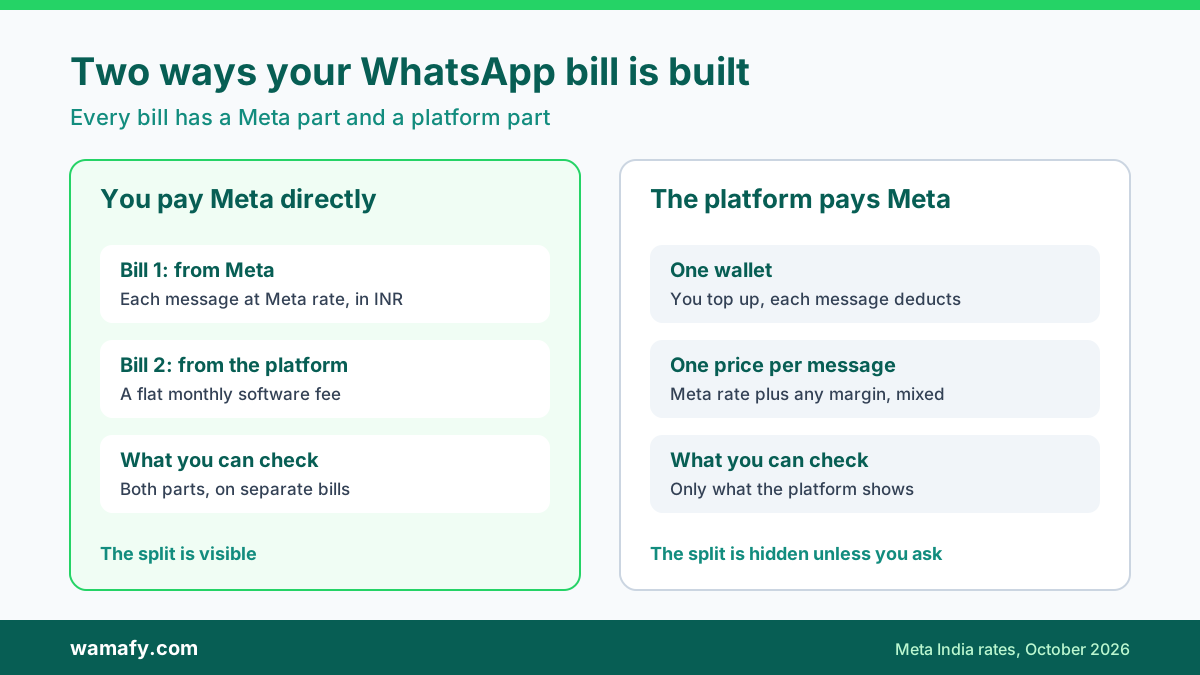
Every WhatsApp Business API bill is made of two parts, even when it shows up as one number.
- Meta's charge. Meta charges for each delivered message. The price depends on the message type and the country of the person you message.
- Your platform's charge. This is what the software company charges you. It can be a monthly plan, a per-message fee, a markup on Meta's rate, or a mix.
A monthly plan fee is easy to see. You know what you agreed to pay. A markup is harder. It sits inside the price of each message, so it grows every time you send more.
Here is Meta's India rate card as it stands now. These are the numbers you will test your bill against.
| Message type | What it is for | Meta's rate (India) |
|---|---|---|
| Marketing | Offers, launches, cart reminders, festive greetings | Rs 0.8631 |
| Utility | Order updates, payment reminders, booking alerts | Rs 0.115 |
| Authentication | One-time passcodes to Indian numbers | Rs 0.115 |
| Service | Your replies inside the 24-hour window | First 1,000 a month free per number, then Rs 0.115 |
Two rules from Meta's pricing page matter for the checks below. Meta only charges for messages that are delivered, not ones that failed. And each business phone number gets 1,000 free service messages every month. Meta starts charging from the 1,001st reply. Unused free replies do not carry over to the next month.
Where Meta's charges show up
How you see Meta's charges depends on who pays Meta.
You pay Meta directly
Your own card or payment method sits on your WhatsApp account in Meta's Billing Hub. Meta sends you its own invoice. Your platform sends a separate bill for its software. This is the easiest setup to check, because the two parts arrive on two separate bills.
Meta's invoice for Indian businesses is now in rupees. Meta asks every eligible Indian account to move to INR billing by 31 December 2026. Accounts still on dollar billing stop delivering messages from 1 January 2027. If your bill is still in dollars, read our guide on moving WhatsApp billing to INR.
Your platform pays Meta and bills you
Here, your platform pays Meta and charges you back, often through a prepaid wallet. You top up the wallet. Each message takes a small amount out. You never see Meta's invoice, only the platform's statement.
This setup is not wrong. It saves you from adding a card on Meta's side. But it is where a markup can hide, because the platform sets the price per message that comes out of your wallet. Accounts billed this way often cannot see Meta's charges in WhatsApp Manager either, so you have to ask the platform for them.
The per-message test: ten minutes, one calculator
This test works for any platform. It tells you what you really paid per message, by type, and compares it with Meta's rate.
- Get last month's total charge for messages. Use the wallet statement or the invoice. Leave out the monthly plan fee and GST for now.
- Split it by message type if the statement allows. Most wallets show marketing, utility, authentication and service separately.
- Get the delivered count for each type from your platform's reports. Use delivered, not sent.
- Divide. Charge for marketing divided by marketing messages delivered gives your real price per marketing message. Do the same for each type.
- Compare with Meta's rate. The gap is your platform's markup on that type.
Remember the free replies. If you sent 3,000 service replies from one number, only 2,000 should be charged. Divide the service charge by 2,000, not 3,000. If the result looks right only when you divide by 3,000, your platform may be charging for replies Meta gave you free.
What if your platform does not split the charge by type? That is a finding in itself. You are paying for something you are not allowed to measure. Ask for the split in writing.
Wallet top-ups and blended rates: how a markup hides
A markup rarely appears as a line called "markup". It usually looks like one of these:
Correction, 11 November 2026: An earlier version said the free window after a click-to-WhatsApp ad lasts 72 hours. Meta's pricing page now says the free entry point window opens when a customer messages you from a click-to-WhatsApp ad on the WhatsApp Android or iOS app and you reply within 24 hours, and that it may stay open for up to 7 days (checked 11 November 2026). For the full rate card, see our guide to WhatsApp API pricing in India.
- A rounder price. Meta charges Rs 0.8631 for a marketing message. A wallet price of Rs 0.99 or Rs 1.05 looks tidy, but the difference is margin.
- One price for all types. A single "per message" price across marketing and utility means you overpay on every utility message. Utility is about one-seventh the price of marketing at Meta.
- Charging on sent, not delivered. Meta does not charge for failed messages. If your wallet goes down for every message sent, you pay for messages that never arrived.
- No free replies. If every service reply comes out of your wallet from the first one, the first 1,000 a month per number are being charged when Meta does not charge them.
- Charging inside the free ad window. When a customer messages you from a click-to-WhatsApp ad and you reply within 24 hours, Meta opens a free entry point window that can stay open for up to 7 days. A wallet that charges for those messages is charging for something Meta does not bill.
- A currency spread. If the platform pays Meta in dollars and bills you in rupees at its own exchange rate, the rate can carry a margin too.
- GST on the wrong base. GST should apply to what you actually pay. Check that GST is not added twice, once on the top-up and again on each message.
None of these is illegal. A platform is free to set its prices. The problem is when the price is not shown, so you cannot compare one vendor with another.
What changed in October: a markup now applies to every reply
Before 1 October 2026, your replies to customers were free at Meta. A per-message markup only touched templates. Now service replies have a price, Rs 0.115 after the first 1,000 a month. So if your platform adds a markup on every message, it now adds one to every reply your support team sends.
This matters most for businesses that chat a lot. A store that sends 2,000 broadcasts a month but answers 8,000 customer messages now has more billable replies than templates. A 20% markup on those replies is small per message, but it adds up over a year. For the full list of what changed, see WhatsApp API pricing in India after 1 October.
A worked example: one month, one number
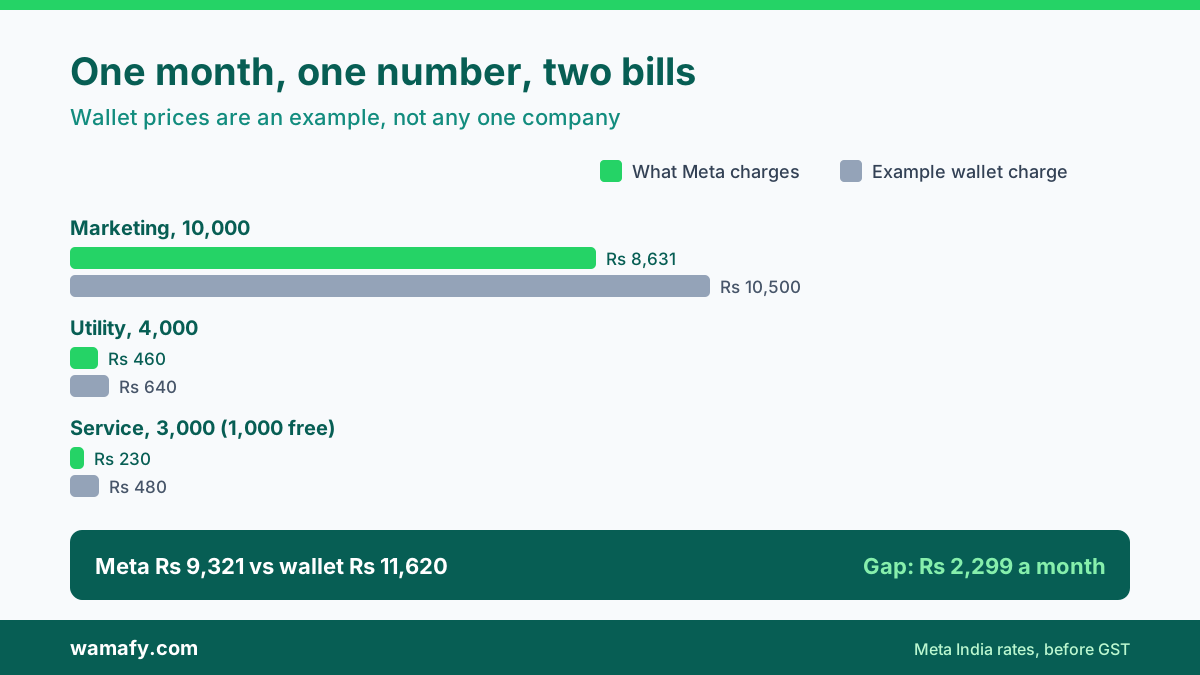
Take a D2C brand with one WhatsApp number. Last month it delivered 10,000 marketing messages, 4,000 utility messages and 3,000 service replies.
| Message type | Delivered | What Meta charges | Example wallet price | Wallet charge |
|---|---|---|---|---|
| Marketing | 10,000 | Rs 8,631 | Rs 1.05 each | Rs 10,500 |
| Utility | 4,000 | Rs 460 | Rs 0.16 each | Rs 640 |
| Service | 3,000 (1,000 free) | Rs 230 | Rs 0.16 each, no free replies | Rs 480 |
| Total | 17,000 | Rs 9,321 | Rs 11,620 |
The wallet prices here are an example, not any one company's rates. But the pattern is common. The brand pays Rs 2,299 more than Meta's charges in one month. That is a markup of about 25%, or close to Rs 27,600 a year, before GST. And it does not show anywhere on the statement as a markup.
Now run the test. Rs 10,500 divided by 10,000 marketing messages is Rs 1.05 each, against Meta's Rs 0.8631. Rs 480 divided by 2,000 charged replies is Rs 0.24 each, against Meta's Rs 0.115. The service line is the one that gives it away. The wallet charged for all 3,000 replies.
Questions to ask your WhatsApp provider
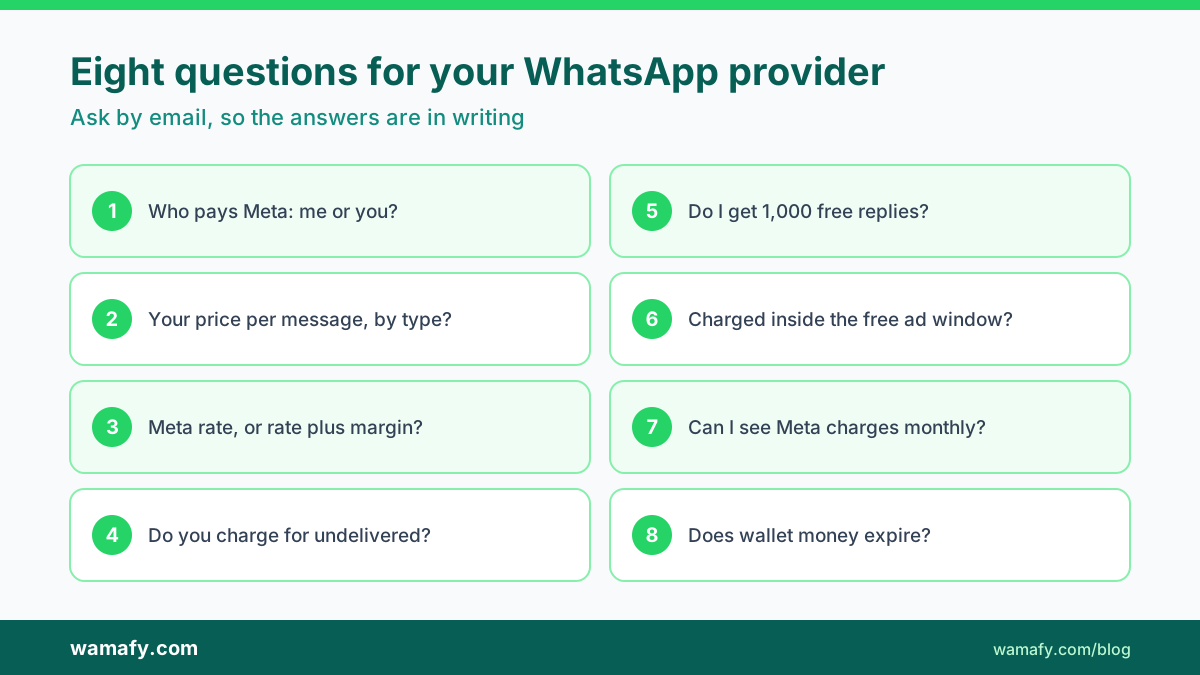
Send these by email, so you have the answers in writing.
- Who pays Meta for my messages: me, or you?
- What do you charge per message for marketing, utility, authentication and service in India?
- Is that Meta's rate, or Meta's rate plus a margin? If a margin, how much?
- Do you charge for messages that were sent but not delivered?
- Do you pass on the 1,000 free service replies per number each month?
- Do you charge for messages inside the free entry point window after a click-to-WhatsApp ad?
- Can I see Meta's charges for my account each month?
- Does wallet money expire? Can I get unused balance back if I leave?
A good provider answers all eight in one email. If the answers are vague, or you are told the split is "internal", that is your answer too.
How Wamafy bills
Wamafy is built the first way. You pay Meta directly, with your own payment method on your WhatsApp account. Meta bills you at its own rate. Wamafy charges a flat monthly plan, from Rs 799 a month billed annually on Seed, and adds nothing per message. The founder's reasons for building it this way are in why Wamafy has no per-message markup.
That does not mean a flat plan is always cheaper. A business that sends very few messages may pay less on a pay-per-message platform with no monthly fee, even with a markup. Run the numbers for your own volume. The point is to know what you are paying for.
Frequently Asked Questions
Is a markup on WhatsApp messages illegal?
No. A platform can charge what it likes for its service, including a margin on each message. The issue is whether it tells you. You should be able to see Meta's rate and the platform's price side by side.
Can I pay Meta directly for WhatsApp messages?
Yes. You can add your own payment method to your WhatsApp account in Meta's Billing Hub, and Meta will bill you directly. Some platforms require you to pay through their wallet instead, so ask before you sign up.
Are the first 1,000 WhatsApp replies free?
Yes. Meta's pricing page says each business phone number gets 1,000 free service messages a month, and charging starts from the 1,001st. Unused free messages do not roll over.
Why does my WhatsApp bill not match WhatsApp Manager?
The numbers in WhatsApp Manager are estimates and can differ a little from the final invoice. If a platform bills you, the bigger reason is usually the platform's own price per message, which WhatsApp Manager does not show.
Do I pay GST on WhatsApp charges?
Yes. 18% GST applies to Meta's charges and to your platform's fees. With INR billing, Meta issues an Indian invoice, which makes it easier to claim input credit where you are eligible.
What is a normal price per marketing message in India?
Meta's own rate is Rs 0.8631 per marketing message, before GST. Anything above that is the platform's margin. Compare that margin across providers rather than the headline price.
Check one bill this week
Pick last month's statement and run the per-message test. It takes ten minutes. If the numbers match Meta's rates, you can stop worrying. If they do not, you now know exactly how much the gap is and can ask about it.
If you want a bill where Meta's charges and the software fee are separate, start a 14-day free Wamafy trial. Your card is authorised when the trial starts and charged only on day 15. You can also compare plans on the pricing page.