WhatsApp Business API Pricing in India: Meta Rates, Free Tier and Real Bills
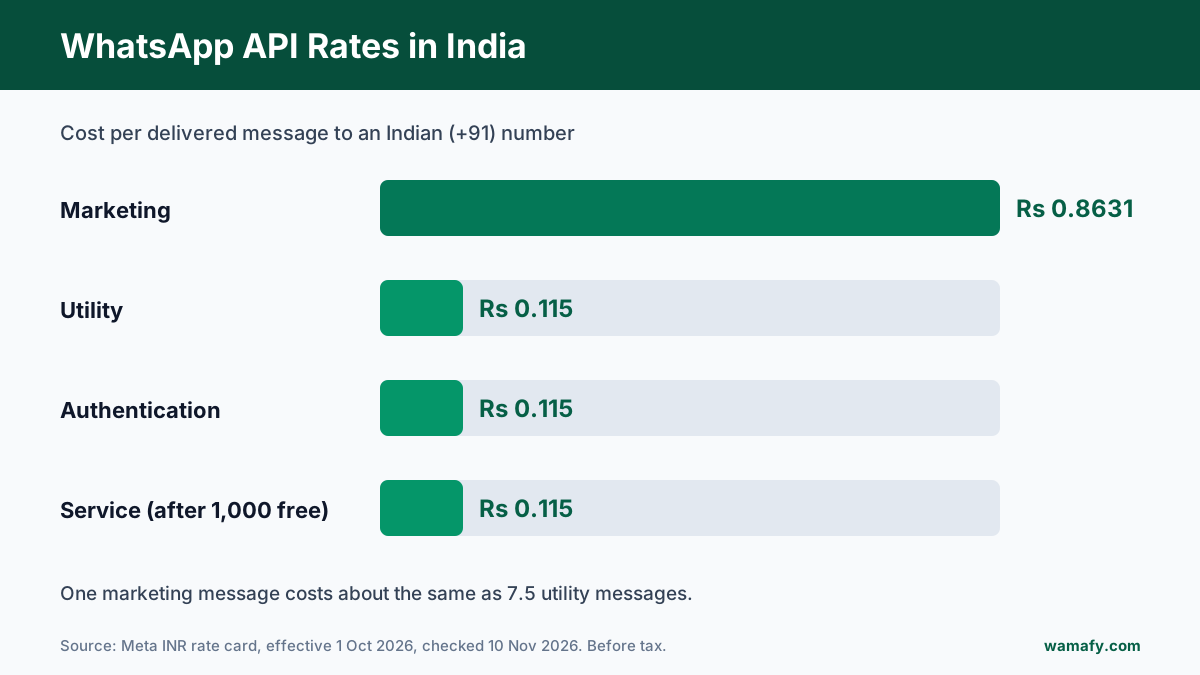
WhatsApp Business API pricing in India, as of 10 November 2026: Meta charges per delivered message. A marketing message costs Rs 0.8631. A utility, authentication or service message costs Rs 0.115. The first 1,000 service messages per number each month are free. These are Meta's own INR rates, before tax. Your platform's fee comes on top, and some platforms also add a markup to every message.
That is the whole price list in one paragraph. The rest of this guide shows you how those rates turn into a real monthly bill. It covers what is free, what a platform adds, three worked bills for Indian businesses, and how to keep the total low. Every Meta rate and date below comes from Meta's own pricing page and INR rate card, checked on 10 November 2026.
Quick estimate: if you already know roughly how many messages you send, put the numbers into the free WhatsApp message cost calculator and you will have your Meta bill in under a minute.
What this guide covers
- WhatsApp Business API pricing in India, in one table
- What is free on the WhatsApp API
- How Meta decides which rate a message pays
- What a platform adds: flat fee or per-message markup
- Three worked monthly bills: a salon, a D2C store and a clinic
- How WhatsApp API pricing changed in 2024 to 2026
- What Wamafy costs
- How to cut your WhatsApp API bill
- Common pricing mistakes
- Frequently Asked Questions
WhatsApp Business API pricing in India, in one table
Meta sets one rate for each message category in each market. India is its own market on the rate card, so every message you deliver to a +91 number pays the India rate. Meta charges only when a message is delivered, not when it is sent, and never for messages your customers send to you.
| Message category | What it is for | Meta rate per delivered message (India, INR) |
|---|---|---|
| Marketing | Offers, sale alerts, new arrivals, abandoned-cart nudges, festive greetings | Rs 0.8631 |
| Utility | Order confirmations, shipping updates, appointment reminders, payment receipts | Rs 0.115 |
| Authentication | One-time passwords (OTPs) and login codes | Rs 0.115 |
| Authentication-international | OTPs sent by businesses that Meta treats as international senders in India | Rs 2.4971 |
| Service | Free-form replies inside the 24-hour customer service window | First 1,000 per number per month free, then Rs 0.115 |
Source: Meta, "Pricing on the WhatsApp Business Platform" and the INR list rates file "Cost per message in INR on the WhatsApp Business Platform, effective October 1, 2026", developers.facebook.com/documentation/business-messaging/whatsapp/pricing, checked 10 November 2026. Rates are before tax.
Three things in this table matter more than the rest.
- Marketing is the expensive line. One marketing message costs about the same as seven and a half utility messages. In the three worked bills below, marketing is 86 to 96 percent of Meta's charges.
- Utility, authentication and service share one low rate. Rs 0.115 per message, or Rs 115 for every thousand.
- Volume discounts will not reach you. Meta gives tier rates on utility and authentication messages only, and in India the first discount starts above 2.5 crore utility messages a month (7.5 lakh for authentication). A small or mid-sized business pays the list rate.
A sixth category exists. Meta Business Agent messages are replies written by Meta's own AI agent product, launched on 1 July 2026. They are billed by tokens, at USD 2.00 per million tokens, which Meta puts at roughly 4 to 5 US cents a message. Most Indian SMBs do not use it, so it is left out of the worked bills below.
What is free on the WhatsApp API
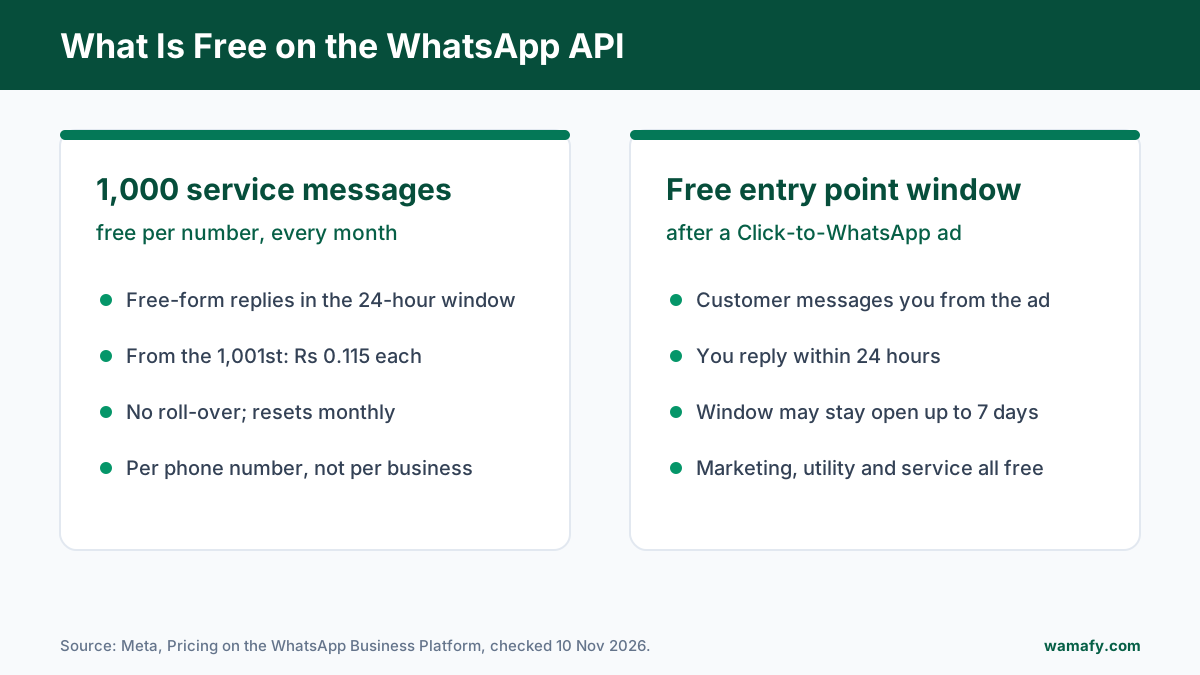
Meta lists exactly two cases where it does not charge for a message you deliver. Everything else is billed.
1. The first 1,000 service messages per number, every month
Since 1 October 2026, Meta gives each business phone number 1,000 free service messages a month. A service message is a normal reply you type (or your chatbot sends) inside the 24-hour customer service window, without a template. From the 1,001st service message that month, each one costs Rs 0.115.
- The 1,000 are per phone number, not per business. Two numbers get 1,000 each.
- Unused free service messages do not roll over. The count resets at midnight on the 1st, in your Messaging account's time zone.
- Without a payment method on your Meta account, service messages stop being delivered once the 1,000 are used up.
For a deeper look at how the free tier works in practice, read WhatsApp service message pricing in 2026.
2. Everything inside a free entry point window
When a customer taps a Click-to-WhatsApp ad on Facebook or Instagram and messages you from the WhatsApp phone app, Meta opens a free entry point window when you reply within 24 hours. Meta says this window "may remain open for up to 7 days". While it is open, marketing, utility, authentication and service messages to that customer are all free. Only Meta Business Agent messages are still charged.
Two limits are easy to miss. The customer has to message you from the Android or iOS app, not WhatsApp Web or desktop. And you have to reply inside the 24-hour customer service window to open the free window at all.
What is no longer free
Two things that were free until 30 September 2026 are now charged:
- Service messages above 1,000 a month per number. They were fully free from 1 November 2024 to 30 September 2026.
- Utility templates sent inside an open customer service window. From 1 July 2025 these were free. From 1 October 2026 each one costs Rs 0.115 again.
So if an older article tells you "replies are free" or "utility messages inside 24 hours are free", it describes the old rules.
How Meta decides which rate a message pays
Every template you send is approved by Meta into one of three categories: marketing, utility or authentication. The category decides the rate, and Meta, not you, has the final say.
- Utility is for a message about something the customer already did or asked for: an order, a booking, a payment, a delivery. "Your order #4821 has shipped" is utility.
- Marketing is anything that tries to sell, promote or bring the customer back. "20 percent off this weekend" is marketing. So is "You left something in your cart".
- Authentication is a one-time code and nothing else.
The trap is mixing. A shipping update that ends with "Use code SAVE10 on your next order" becomes a marketing message, and its price goes from Rs 0.115 to Rs 0.8631. Meta can also re-check an approved template and move it into marketing if its content looks promotional. Keep transactional templates purely transactional, and keep the offer in a separate marketing template that you send on purpose.
Free-form replies are different. They do not use a template, so they are always service messages, and you can only send them while the customer service window is open: 24 hours from the customer's last message, reset each time they write to you.
If you send marketing through Meta's Marketing Messages API instead of the regular Cloud API, the same India marketing rate applies. That API also has an optional maximum price setting, so a marketing message can cost less per send if you choose to cap it.
What a platform adds: flat fee or per-message markup
You can connect to Meta's Cloud API directly, but then you build the inbox, campaigns and reports yourself. Most businesses use a platform instead (Meta calls them Solution Providers) that gives you all of that ready-made. That platform charges you in one of two ways, and the difference shows up on every message.
| Flat platform fee, no markup | Per-message markup | |
|---|---|---|
| How it works | A fixed monthly fee for the software. Meta's rates are passed through unchanged or paid to Meta directly. | The platform adds its own margin to each message, on top of or folded into Meta's rate. |
| What grows when you send more | Only Meta's charges | Meta's charges plus the markup |
| How to spot it | The per-message rate on your invoice matches Meta's rate card | The per-message rate is higher than Meta's, or there is a "conversation" or "credits" charge you cannot match to Meta's card |
| Who it suits | Anyone who sends regular campaigns | Very low volume senders, if the platform fee is lower |
Here is what a markup costs at a normal sending level. The numbers are illustrative, not any named platform's price. Take a store that sends 10,800 marketing messages a month. At Meta's rate that is Rs 9,321.48. With a 20 percent markup on each message it becomes Rs 11,185.78, an extra Rs 1,864.30 a month, or about Rs 22,372 a year, for the same messages.
Some platforms sell "credits" or a prepaid wallet instead of quoting a rate. That is fine if you can convert a credit into rupees per message and compare it with the table above. If you cannot, ask the platform for its per-message rate for marketing and utility in India, in writing. Our guide on how to read a WhatsApp platform invoice walks through a real-looking invoice line by line.
On tax: Meta's rate card prices are before tax, and platform plans in India are usually quoted before 18 percent GST. Check both invoices so that GST is added once on each, not twice.
Three worked monthly bills: a salon, a D2C store and a clinic
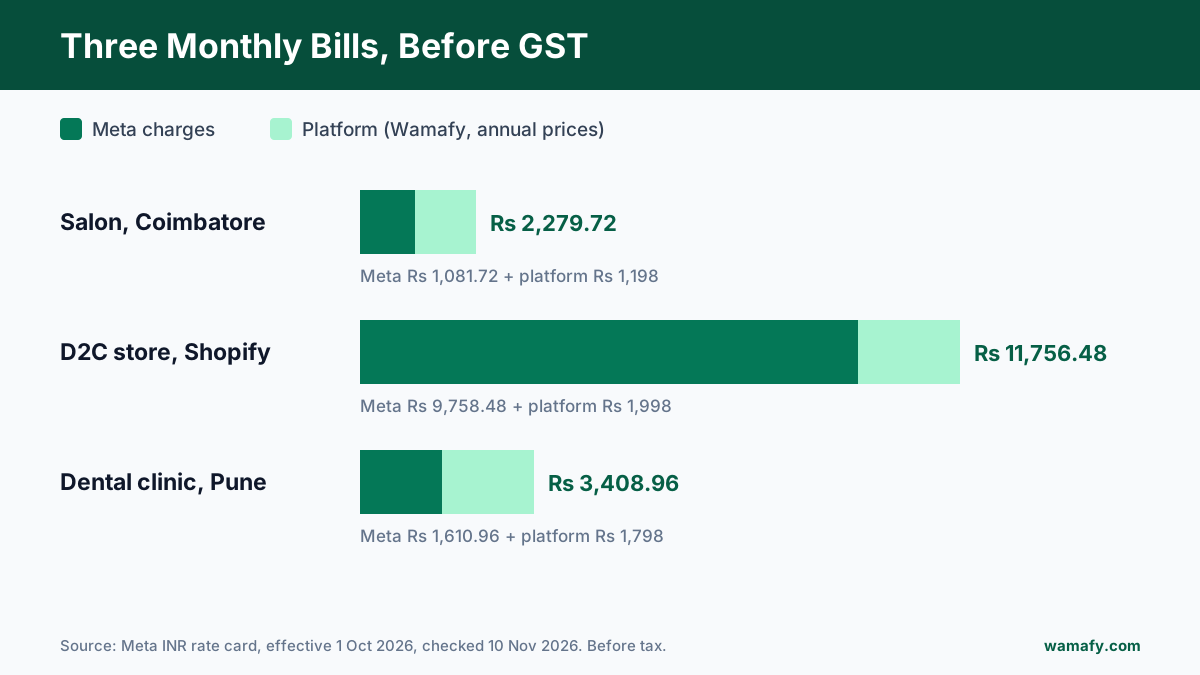
Rates are easy. Bills are where people get surprised. Here are three typical Indian businesses, each on one WhatsApp number, at Meta's India rates from the table above. All amounts are before GST, assume no free entry point windows, and use Wamafy's annual-billing prices as the platform line so you can see a complete total. Swap in your own platform's fee if you use another one.
Bill 1: a two-chair salon in Coimbatore
The salon has about 600 regular customers. It sends a reminder before every appointment, two offer messages a month to its whole list, and answers questions on WhatsApp.
| Line | Messages | Rate | Cost |
|---|---|---|---|
| Appointment reminders (utility) | 400 | Rs 0.115 | Rs 46.00 |
| Two offers to 600 customers (marketing) | 1,200 | Rs 0.8631 | Rs 1,035.72 |
| Replies to customer questions (service) | 900 | Free (under 1,000) | Rs 0.00 |
| Meta total | Rs 1,081.72 | ||
| Platform: Wamafy Seed plus the Appointments add-on, billed annually | Rs 1,198.00 | ||
| Monthly total before GST | Rs 2,279.72 |
What to notice: the 400 reminders cost Rs 46. The two offers cost more than 20 times that. If the salon cut to one offer a month, its Meta bill would fall to about Rs 564.
Bill 2: a D2C skincare store on Shopify
The store gets about 3,000 orders a month and has 2,500 opted-in customers. It sends order and shipping updates, abandoned-cart reminders and four campaigns a month.
| Line | Messages | Rate | Cost |
|---|---|---|---|
| Order and shipping updates (utility) | 3,000 | Rs 0.115 | Rs 345.00 |
| Abandoned-cart reminders (marketing) | 800 | Rs 0.8631 | Rs 690.48 |
| Four campaigns to 2,500 customers (marketing) | 10,000 | Rs 0.8631 | Rs 8,631.00 |
| Replies to customers (service), 1,800 sent | 800 charged | Rs 0.115 after 1,000 free | Rs 92.00 |
| Meta total | Rs 9,758.48 | ||
| Platform: Wamafy Bloom plus the Shopify add-on (billed through Shopify), annual prices | Rs 1,998.00 | ||
| Monthly total before GST | Rs 11,756.48 |
What to notice: campaigns are 88 percent of Meta's charges. The abandoned-cart line looks expensive per message but is usually the best-paid line on the bill: if just 40 of those 800 carts are recovered at an average order of Rs 900, that is Rs 36,000 of sales for Rs 690.48. Also note the plan: this store sends about 15,600 messages a month in total, which is over the Seed plan's 15,000 outbound messages, so Bloom is the right fit. If you want to model cart recovery for your own store, use the abandoned-cart ROI calculator.
Bill 3: a dental clinic in Pune
The clinic sees about 1,500 appointments a month. It sends a reminder for each, follow-up care messages, two health camp announcements and answers a lot of patient questions.
| Line | Messages | Rate | Cost |
|---|---|---|---|
| Appointment reminders (utility) | 1,500 | Rs 0.115 | Rs 172.50 |
| Follow-up care messages after a visit (utility) | 300 | Rs 0.115 | Rs 34.50 |
| Two health camp announcements to 800 patients (marketing) | 1,600 | Rs 0.8631 | Rs 1,380.96 |
| Replies to patients (service), 1,200 sent | 200 charged | Rs 0.115 after 1,000 free | Rs 23.00 |
| Meta total | Rs 1,610.96 | ||
| Platform: Wamafy Seed plus the Clinics and Hospitals add-on, billed annually | Rs 1,798.00 | ||
| Monthly total before GST | Rs 3,408.96 |
What to notice: 1,800 reminders and follow-ups cost Rs 207 together. One missed appointment usually costs a clinic more than that. The reminders pay for themselves if they save even one or two no-shows a month. You can test that with the clinic no-show cost calculator.
Your own numbers: the message cost calculator uses the same Meta India rates. Enter your monthly volume for each category and compare the result with your current invoice. If your invoice is much higher, the gap is your platform's markup.
How WhatsApp API pricing changed in 2024 to 2026
WhatsApp API pricing has changed several times in two years, which is why so many pages online disagree. Here is the sequence, with dates from Meta's pricing page.
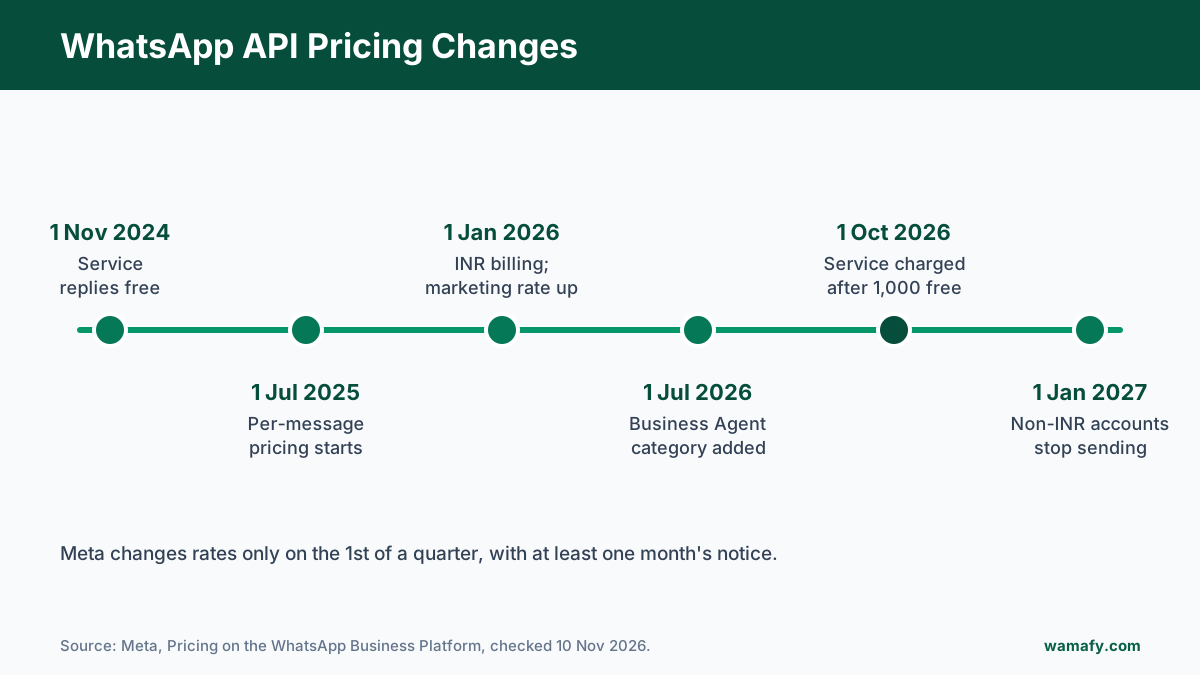
| Date | What changed |
|---|---|
| 1 November 2024 | Service messages (free-form replies) became free. |
| 1 July 2025 | Meta moved from charging per 24-hour conversation to charging per delivered message. Utility templates sent inside an open customer service window became free. |
| 1 January 2026 | India's marketing rate went up. INR billing launched for eligible Indian businesses and Solution Providers. |
| 1 April 2026 | India's authentication-international rate went up. |
| 1 July 2026 | Meta Business Agent became a fifth message category, billed by tokens. |
| 1 October 2026 | Service messages became chargeable again, with 1,000 free per number per month. Utility templates inside the customer service window became chargeable again. Meta stopped delivering service messages for accounts with no payment method once the free tier is used. |
| 31 December 2026 | Deadline for eligible Indian businesses to move all their Messaging accounts to INR billing. From 1 January 2027, Meta will no longer deliver messages from their non-INR accounts. |
Two rules help you plan around future changes. Meta changes rates only on the first day of a quarter (1 January, 1 April, 1 July or 1 October). And it gives at least one month's notice for a rate change, and six months for a change to the pricing model itself. So you will always know before your bill moves, as long as you or your platform watch Meta's pricing page.
If your WhatsApp account is still billed in US dollars and you are an Indian business, check the INR deadline with your platform now. A dollar-billed account that is not moved in time will stop sending on 1 January 2027.
What Wamafy costs
Wamafy is a flat-price WhatsApp marketing platform. You pay Meta's message charges to Meta directly, at Meta's own rates, and Wamafy adds no markup to any message. The plan price is the software: inbox, campaigns, chatbot, contacts and reports.
| Plan | Billed monthly | Billed annually (per month) | Numbers | Teammates | Contacts | Outbound messages a month |
|---|---|---|---|---|---|---|
| Seed | Rs 999 | Rs 799 | 1 | 3 | 1,000 | 15,000 |
| Bloom | Rs 1,999 | Rs 1,599 | 2 | 10 | 10,000 | No cap |
| Forest | Rs 3,999 | Rs 3,199 | 10 | 20 | 1,00,000 | No cap, plus A/B testing |
Prices from wamafy.com/pricing on 10 November 2026, before 18 percent GST. Annual plans are billed once a year (Seed Rs 9,590, Bloom Rs 19,190, Forest Rs 38,390).
Add-ons work on every plan, including Seed. Most cost Rs 499 a month, or Rs 399 a month billed annually: Appointments, Sell on WhatsApp, Shopify integration, Insurance Renewals, Membership Renewals, Contract Renewals and Seat Booking. Clinics and Hospitals and Restaurant and Delivery cost Rs 999 a month billed annually. See the full list on the pricing page.
Every plan starts with a 14-day free trial. Your card is authorised at signup and charged only on day 15.
The honest trade-off: a flat fee means you pay the plan price even in a quiet month. If you send only a few hundred messages a year, a pay-per-message tool with no monthly fee can work out cheaper. Once you send campaigns every month, the flat fee with no markup usually wins, because the markup grows with every message and the plan price does not.
How to cut your WhatsApp API bill
You cannot change Meta's rates. You can change what you send, to whom and in which category. These are the levers that move a real bill, in order of impact.
- Send fewer, better marketing messages. Marketing is most of the bill. Send offers to the customers likely to act (recent buyers, people who clicked last time) instead of the whole list. Cutting a 10,000-message blast to the 4,000 most active customers saves Rs 5,178.60.
- Keep utility templates purely transactional. One promotional line turns a Rs 0.115 message into a Rs 0.8631 message. Move the offer into its own template.
- Answer inside the 24-hour window with free-form replies. A typed reply is a service message: free for the first 1,000 a month per number, Rs 0.115 after that. Do not send a utility template to answer a question the customer just asked.
- Use Click-to-WhatsApp ads for new customers. Reply within 24 hours and the free entry point window covers every message to that customer for up to 7 days, including your follow-up offer.
- Combine messages. One order message that says "confirmed and packed" costs half as much as two separate ones.
- Clean your list. Meta charges only for delivered messages, but numbers that never read or reply drag your quality rating down and waste marketing sends. Remove contacts who have not opened anything in six months.
- Check for a markup. Compare your per-message rate with Meta's table. If it is higher, that difference is a cost you can remove by switching platforms.
For a deeper version of this checklist with a full before-and-after bill, read how to reduce your WhatsApp marketing costs in India.
Common pricing mistakes
- Budgeting from an old article. Pages written before October 2026 often say replies are free, or quote conversation-based prices that ended in July 2025. Always check the date of the rate you are using.
- Forgetting the 1,000 free service messages are per number. A business on two numbers gets 2,000 free a month. A business that answers everything from one number may run out sooner than it expects.
- No payment method on the Meta account. Once the 1,000 free service messages are used, Meta stops delivering replies until a payment method is added. Your customers see silence.
- Comparing platform fees without comparing per-message rates. A cheaper plan with a markup can cost more than a higher plan without one, as soon as you send a few thousand marketing messages.
- Treating every message as marketing, or every message as utility. Both lead to wrong budgets. Count each type separately, the way the worked bills above do.
- Leaving the account in US dollars. Eligible Indian accounts that are not moved to INR billing by 31 December 2026 stop sending on 1 January 2027.
Frequently Asked Questions
How much does the WhatsApp Business API cost per message in India?
Meta's India rates, effective 1 October 2026, are Rs 0.8631 for a marketing message and Rs 0.115 for a utility, authentication or service message. The first 1,000 service messages per number each month are free. These rates are before tax, and your platform's fee is extra.
Is the WhatsApp Business API free in India?
No. Meta charges per delivered message. Two things are free: the first 1,000 service messages per business phone number each month, and all messages inside a free entry point window, which opens when a customer messages you from a Click-to-WhatsApp ad and you reply within 24 hours.
Are WhatsApp service messages free?
Partly. Since 1 October 2026, each business phone number gets 1,000 free service messages a month. From the 1,001st, each service message costs Rs 0.115 in India. Unused free service messages do not carry over to the next month.
What is the difference between the WhatsApp Business app and the API on price?
The WhatsApp Business app is free to use but is built for typing chats by hand on a few devices, with no bulk campaigns, automation or integrations. The API charges per message and needs a platform, but supports a team inbox, automation, chatbots and campaigns to thousands of customers. Our guide to the WhatsApp Business API vs the Business app covers when to switch.
Does Meta charge GST on WhatsApp messages in India?
Meta's published rates are before tax. Taxes are added on Meta's invoice according to your billing setup. Your platform's plan is usually quoted before 18 percent GST too. Check that GST appears once on each invoice.
Do I pay for messages that are not delivered?
No. Meta charges only for delivered messages, not for messages sent. Messages that fail because a number is not on WhatsApp, or is blocked, are not charged by Meta.
Why is my platform's per-message price higher than Meta's?
Because it includes a markup. Some platforms add a margin to each message or sell credits worth less than Meta's rate. Ask your platform for its India rate per marketing and utility message and compare it with Meta's rate card.
How often does Meta change WhatsApp API prices?
Meta changes rates only on the first day of a quarter, so at most four times a year, and gives at least one month's notice for a rate change. Changes to the pricing model itself get six months' notice.
Do I need to move my WhatsApp billing to INR?
If you are an eligible Indian business or Solution Provider, yes. Meta asks for all Messaging accounts to be on INR billing by 31 December 2026. From 1 January 2027, it will stop delivering messages from non-INR accounts of eligible customers.
What is the cheapest way to run WhatsApp marketing in India?
Pay Meta's rates with no markup, send marketing only to customers likely to act, keep transactional messages in the utility category, and use free-form replies inside the 24-hour window. Then compare platforms on total monthly cost at your real volume, not on the plan price alone.
Your next step
Start with your own numbers. Put your monthly volumes into the WhatsApp message cost calculator and compare the result with what you pay today. If the gap is large, Wamafy's flat plans with no markup start at Rs 799 a month billed annually, with a 14-day free trial.
Now wire it up →
Step-by-step Help guides for the moves above.