Why We Have Not Built an AI Copywriter
The short version: many WhatsApp platforms in India now sell AI marketing tools. They write your templates, draft your ad creatives and run AI agents that chat with your customers. Wamafy does none of that. This post explains why, what it costs us in deals, and the conditions that would make us change our minds.
Wamafy is built and run by our team at kCube Consultancy Services. We also handle sales and support, so we hear it when a missing feature loses us a buyer. AI copy is the gap we hear about most. It deserves a straight answer, not a roadmap slide.
What we do not have, stated plainly
If you are comparing AI WhatsApp marketing tools in India, here is the list you should check against Wamafy:
- No AI copywriter. Wamafy does not write your templates, broadcasts or replies for you.
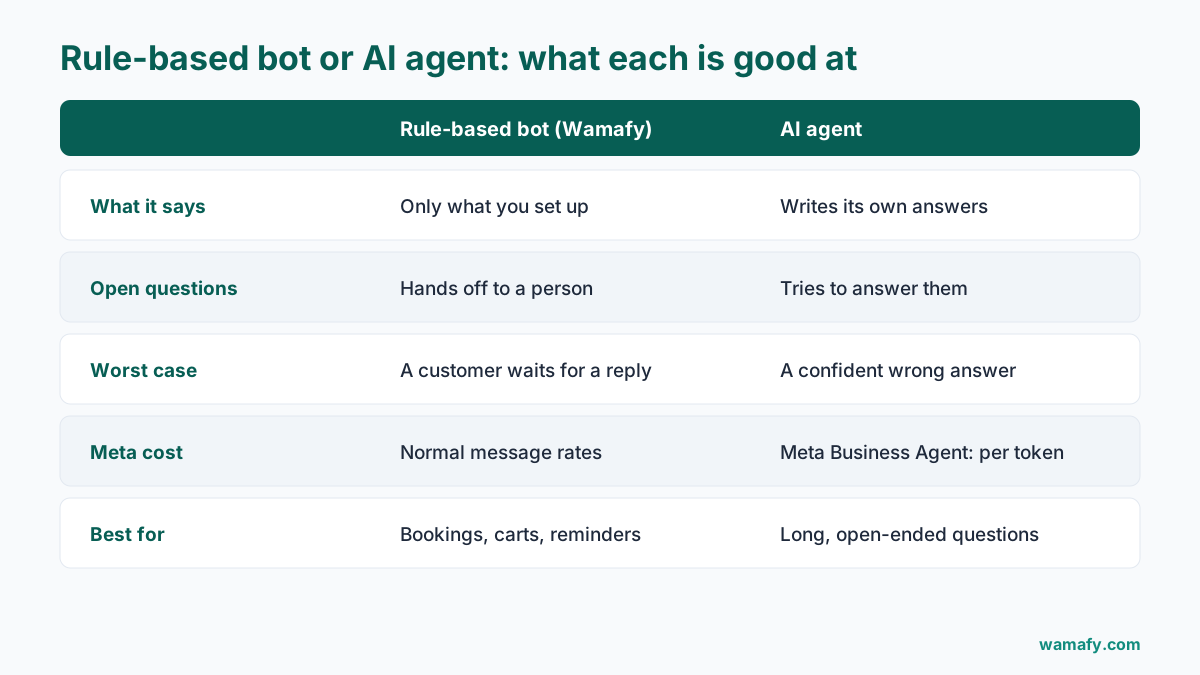
- No AI flow builder. Our chatbot and Flow Builder are rule-based. You draw the steps. The bot follows them exactly.
- No AI agent that answers customers in open conversation.
- No in-house ad creation. You build click-to-WhatsApp ads in Meta Ads Manager. Wamafy catches the lead when it lands in WhatsApp and sends the conversion back to Meta.
Some competitors list all of these on their own sites. AiSensy, for example, advertises an AI template generator, an AI ad creative generator and a paid AI agent. If those tools are what you need, they are real, and you should weigh them.
Where this genuinely loses us business
We would rather tell you who should not pick us than have you find out in week two.
Teams with nobody to write
A two-person D2C brand where the founder packs orders by day and answers WhatsApp at night has no time to write copy. For them, a tool that drafts ten templates in a minute is a real saving. A blank template box is not.
Buyers who want ads and messages in one place
If you want to build the ad, write the ad and run the WhatsApp follow-up in one screen, we are not that tool. You will use Meta Ads Manager next to Wamafy.
Businesses with long, open-ended questions
A travel agency answering "what can we do in Coorg with two kids in December" gets more from an AI agent than from a menu. A rule-based bot can route that question to a person. It cannot answer it.
If you are one of these buyers, a platform with AI built in may be the better fit today. Our honest Wamafy vs AiSensy comparison lays out the trade-offs side by side.
Why AI copy is harder on WhatsApp than it looks
AI writing tools are good at email and social posts. WhatsApp adds three problems that most demos skip.
1. Every template goes through Meta review
You cannot send a marketing message on the WhatsApp Business Platform unless Meta has approved the template. Generated copy has to pass the same review as copy you write by hand. Drafting fast does not help much if the draft comes back rejected and you rewrite it anyway.
2. The wording decides the price
This is the problem we think matters most, and almost nobody talks about it.
Every template has a category, and Meta can change it when it reviews the wording. The category sets the price. In India, a utility message costs Rs 0.115 and a marketing message costs Rs 0.8631, before GST. That is about seven and a half times more.
Utility means an update the customer expects: an order shipped, an appointment tomorrow, a payment due. The moment the wording starts selling, with an offer, a "don't miss out" or a nudge to buy more, the template can be filed as marketing instead.
AI writing tools are trained to be persuasive. Ask one for a friendlier shipping update and it will often add a line like "Shop our new arrivals while you wait." That one line can move the whole template into marketing.
Here is what that means for a store sending 5,000 order updates a month:
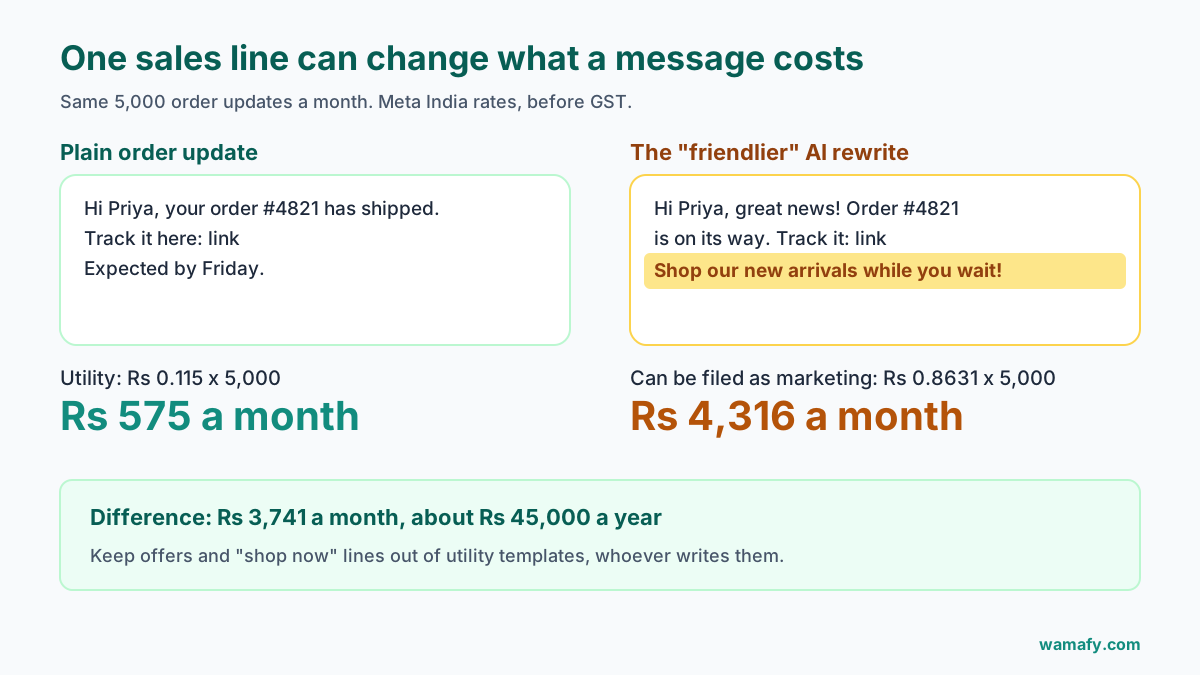
| Same 5,000 order updates | Rate (India) | Monthly cost before GST |
|---|---|---|
| Filed as utility | Rs 0.115 | Rs 575 |
| Filed as marketing | Rs 0.8631 | Rs 4,316 |
That is Rs 3,741 a month, or about Rs 45,000 a year, for one extra sentence. A copy tool that does not understand categories can quietly cost more than it saves. Our WhatsApp template message examples show what clean utility wording looks like.
3. The message goes out on your own number
An email that reads oddly goes to a spam folder. A WhatsApp message that reads oddly arrives on your customer's phone, from your business number, next to messages from their family. If they block or report it, your quality rating drops. A low rating can limit how many people you can message at all.
That makes a wrong or pushy message more expensive on WhatsApp than almost anywhere else.
Meta's rules have moved against open-ended AI chat
Meta's current terms for the WhatsApp Business Platform, last updated on 23 September 2026, prohibit AI providers whose main product is a general-purpose AI assistant from using the platform. The line Meta has drawn is between a business using a bot to do a clear job, and a chatbot whose job is simply to chat.
Bots that handle support, bookings, order tracking and sales for one business are still allowed. We explained the details in our post on Meta's AI chatbot rules for WhatsApp.
Meta has also launched its own AI option. Since 1 July 2026, Meta charges businesses for Meta Business Agent messages by the token. Meta's developer docs put a typical message at about 4 to 5 US cents. That is several rupees a message, well above even a marketing template in India.
Correction, 11 November 2026: An earlier version gave 1 August 2026 as the start of Meta Business Agent billing. Meta's pricing page says the category was introduced on 1 July 2026 (checked 11 November 2026).
We read both moves the same way. AI on WhatsApp is allowed when it does a specific job for the business. It has a price per message, and Meta does not want it used as an open chat room.
The failure we did not want to ship
The risk that worries us most is not a boring message. It is a confident wrong one.
Picture a clinic's bot telling a patient that a doctor is in on Sunday when she is not. Or a store's bot promising a refund policy the owner never wrote. The customer does not blame the software. They blame the clinic or the store, on the clinic's or store's own number.
A rule-based bot cannot do that. It can only say what you told it to say. When a question falls outside the flow, it hands the chat to a person. That is less impressive in a demo. But you always know what your number will say.
What we built instead
We put the time into tools that do one job each, and do it the same way every time:
- A rule-based chatbot with a clear hand-off to a person. See the chatbot builder deep dive.
- A visual Flow Builder for in-chat forms, so customers book, order or sign up without typing free text.
- Add-ons for one job each, such as appointments with reminders, Shopify cart recovery, and renewal reminders for policies, gym memberships and AMCs.
- No markup on any message. You pay Meta's rate directly, so the category of each template is the cost you actually pay.
Our argument is simple. For most Indian small businesses, the money on WhatsApp is in a few repeated jobs. A cart reminder. A booking. A renewal. A bot that does those well beats a bot that can do anything, but not reliably.
What would change our minds
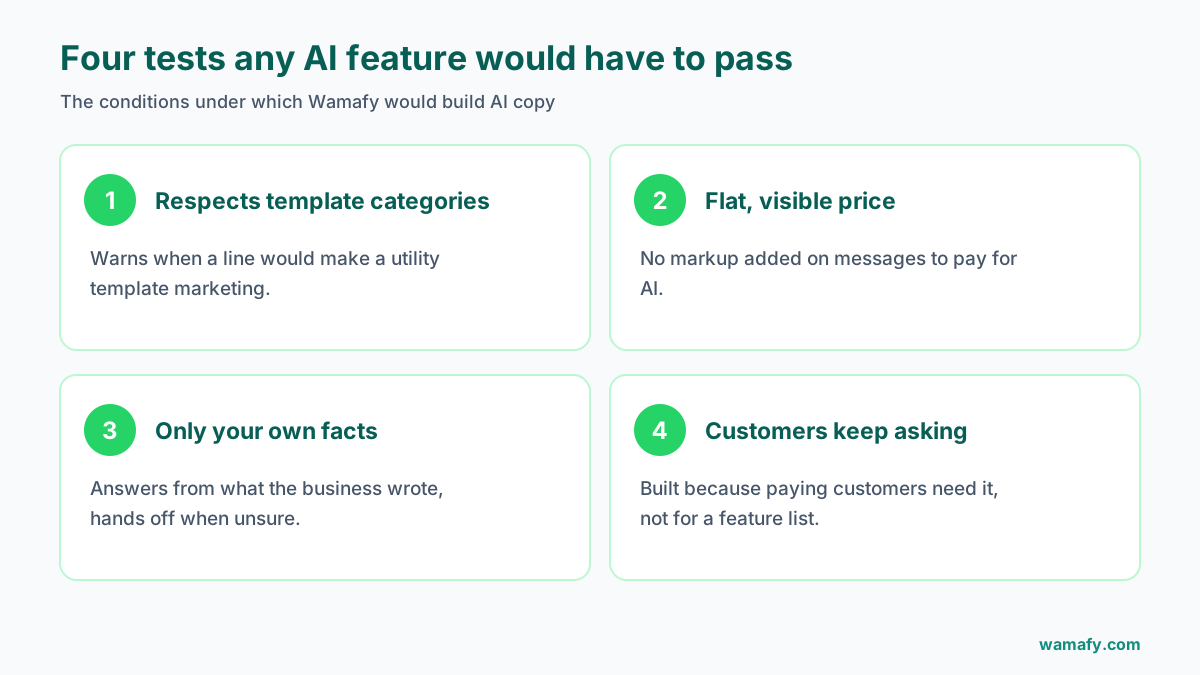
This is a position for today, not a promise to never build AI. Here are the conditions that would change it:
- If AI drafting can respect template categories. A writer that warns you "this line will likely make this a marketing template" would save money instead of costing it. That is the version worth building.
- If it can be priced without a hidden per-message charge. We will not add a markup on messages to pay for AI. It would need a clear, flat price.
- If the answers can be kept to your own facts. Any AI reply would need to use only what the business has written down, and hand off to a person when unsure.
- If our customers keep asking. We will build what paying customers need, not what a feature list needs.
If all four line up, we will build it and tell you plainly what it does and does not do.
Frequently Asked Questions
Does Wamafy have AI features?
No. Wamafy has no AI copywriter, no AI agent and no AI flow builder. The chatbot and Flow Builder are rule-based, so they only send what you set up.
Is AI allowed on the WhatsApp Business Platform?
Yes, for bots that do a specific job for one business, such as support, bookings or order tracking. Meta's terms prohibit AI providers whose main product is a general-purpose AI assistant.
Can AI-written templates cost more?
They can. If the wording starts to sell, Meta can file the template as marketing instead of utility. In India that is Rs 0.8631 per message instead of Rs 0.115, before GST.
Should I choose a platform with AI copy?
Choose one if you have nobody to write copy, or you need open-ended answers. If your WhatsApp work is a few repeated jobs, like reminders, bookings and cart recovery, a rule-based tool is usually enough and more predictable.
Can I use ChatGPT to write my WhatsApp templates?
You can draft with any tool and paste the text into Wamafy. Before submitting, remove anything that sells from utility templates, such as offers or "shop now" lines, so they stay in the cheaper category.
Where kCube stands
Build what we can support. Price it flat. Say what is missing.
That is how we run Wamafy, and this post is part of that. If the tools we have are the tools you need, start a 14-day free Wamafy trial. Your card is authorized when the trial starts and charged only on day 15. If you need AI copy today, pick a tool that has it, and check your template categories before you hit send.