WhatsApp Marketing Software Pricing Plans: Why Every Wamafy Add-On Works on Every Plan
The short version: most WhatsApp marketing software pricing plans lock the one feature you need behind a bigger plan. You want Shopify alerts or a booking form, and the pricing page tells you to pay for more seats, more numbers and more tools you will never open. Wamafy does it the other way. Every add-on works on every plan, including Seed. This post explains why we chose that, what it costs us, and where it is the wrong fit.
Wamafy is built and run by our team at kCube Consultancy Services. We also handle sales and support, so we see the moment a buyer stops on a pricing page and closes the tab, and most of the time the problem is not the plan price but the jump to the next plan.
The tier-upgrade trap in WhatsApp marketing software pricing plans
Here is how the trap works: a plan ladder has three or four steps, and each step adds a long list of features. The one feature a small business really needs sits on step two or three, packed with features built for a much bigger team.
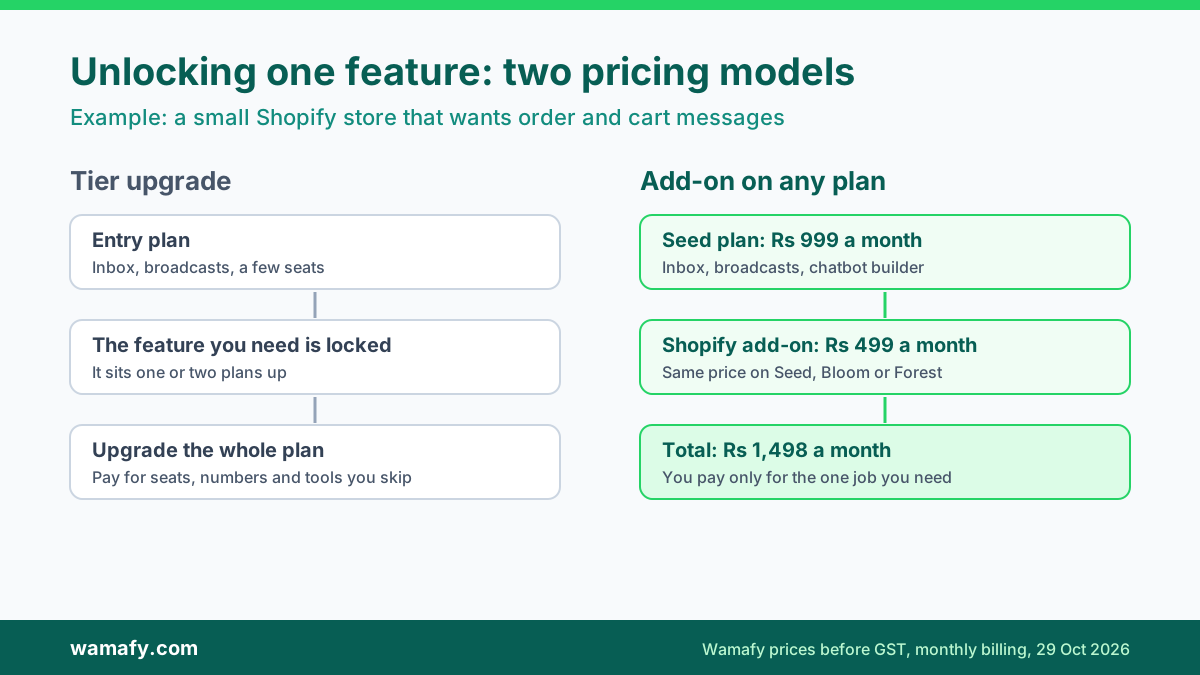
Take a small D2C store on Shopify. It wants three things on WhatsApp and nothing else: order confirmations, shipping updates and abandoned cart reminders.
On the WATI pricing page for India, checked on 29 October 2026, the Growth plan is listed at Rs 2,699 a month, billed quarterly. Shopify buyer-data campaigns are listed from the Pro plan, at Rs 5,799 a month, and webhooks and extra integrations also start at Pro, so the store pays for the whole Pro bundle to get one Shopify feature.
That is not a WATI problem alone. It is how most SaaS pricing works, and it often makes sense for the seller. A bigger plan lifts average revenue per customer. The trouble is who pays for that lift: the small business that wanted one thing.
Feature gating also hides the real price. A founder compares the entry prices of five tools and picks the cheapest, and two weeks later the feature they needed turns out to live two steps up, so the entry price was never the real price.
What an add-on is at Wamafy
An add-on at Wamafy is one job with one price that sits on top of any plan. You buy it under Settings, Add-ons, and nothing else about your account changes.
The plan covers the shared base: the inbox, broadcasts, templates, the chatbot builder, contacts, teammates and WhatsApp numbers. The add-on covers one particular business task, such as booking, selling, renewals or running a clinic.
Three rules hold for every add-on:
- Any plan. Seed, Bloom or Forest, with no add-on held back for a bigger plan.
- Its own price. The price is identical whichever plan you are on, so a Seed customer and a Forest customer pay the same for Appointments.
- Fair billing. Bought during the 14-day trial, it is free until the trial ends, and then it is charged with the plan. Bought in the middle of a paid month, you pay only for the remaining days, and after that it renews on the same day as your plan.
So the Shopify store above would pay for Seed plus the Shopify add-on. That is Rs 999 plus Rs 499, or Rs 1,498 a month before GST, and on annual billing it works out to Rs 799 plus Rs 399 a month. Our guide to the Shopify add-on on every plan walks through the setup.
Where this costs us
This choice is not free for us, and it would be odd to pretend it is.
Lower revenue per customer
A gated feature pushes people up the ladder, while an add-on lets them stay put. A clinic that would have moved from Seed to Forest to get a clinic module now stays on Seed and pays for the Clinics add-on. On monthly billing, that is Rs 2,298 a month with us, before GST. Under a gated model, it would have paid for the bigger plan as well.
We give up that difference on purpose, because we would rather keep a small customer for three years than squeeze them for three months.
More pricing to explain
A ladder is easy to read, while plan plus add-ons is a small sum that every new customer has to work out. Some ask us on chat which add-on they need, and a few are unsure whether they need one at all, which takes our team real time.
Plan limits still exist
Here is the honest catch: the add-on is never gated, but plans still set limits on volume. Clinics works on Seed, for example, but Seed holds up to 500 patient records, Bloom holds 5,000 and Forest has no cap, and renewals and leads follow the same pattern.
So a busy clinic with 3,000 patients will need Bloom. That is a size limit, not a feature lock: the clinic gets the complete clinic module on every plan and only pays more when it grows past what the smaller plan can hold.
| Plan limit | Seed | Bloom | Forest |
|---|---|---|---|
| Price per month (monthly billing) | Rs 999 | Rs 1,999 | Rs 3,999 |
| Price per month (annual billing) | Rs 799 | Rs 1,599 | Rs 3,199 |
| Leads | 1,000 | 10,000 | 100,000 |
| Patient records (Clinics) | 500 | 5,000 | No limit |
| Renewal records | 500 | 5,000 | No limit |
| Seat booking venues | 1 | 3 | 10 |
| Can buy any add-on | Yes | Yes | Yes |
Prices are before 18% GST, read from the live Wamafy plans page on 29 October 2026.
Where it does not fit
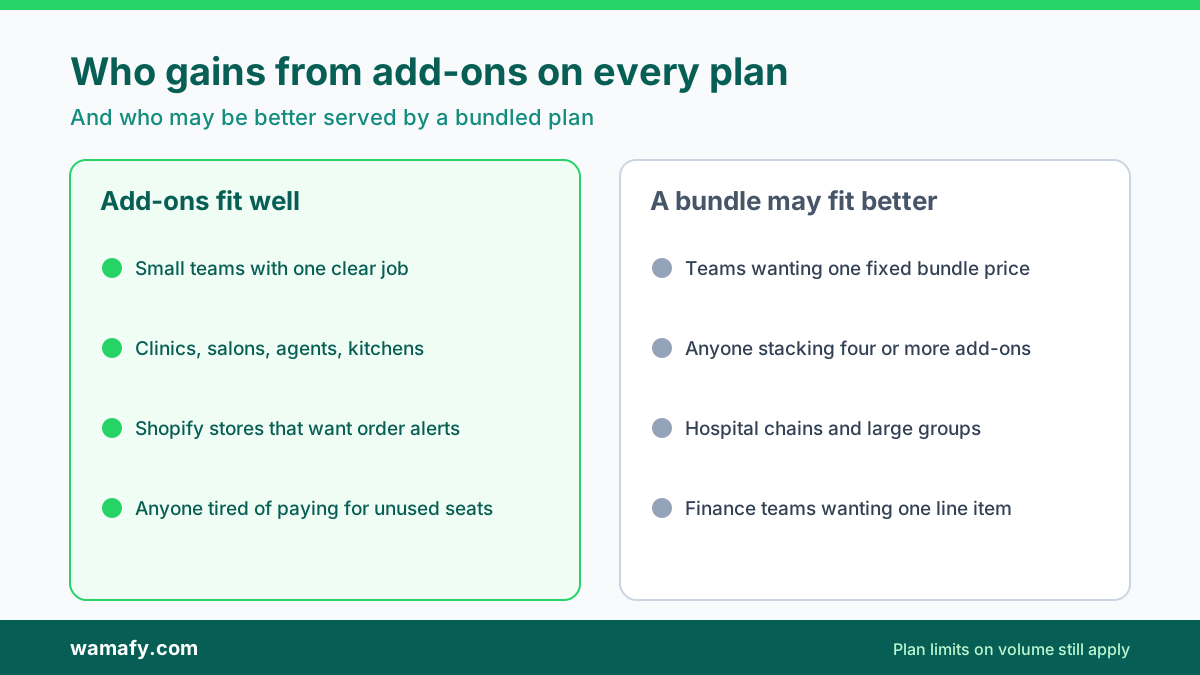
Add-ons suit a business that knows the one or two jobs it needs done, and they suit a large team less well.
- Teams that want everything in one bundle. Forest does not include add-ons. A team that wants booking, selling and renewals on Forest pays for each one. Some finance teams would rather have one fixed bundle price on one line.
- Businesses that stack many add-ons. Each Rs 499 add-on is small on its own, but four of them on Seed add Rs 1,996 a month. If you need four, do the sum and compare it with a bundled plan elsewhere, because sometimes the bundle genuinely wins.
- Large groups. A hospital chain with ten branches is better served by a custom Enterprise deal than by plan plus add-ons.
AiSensy, for what it is worth, also sells its chatbot builder as an add-on that works on top of any plan. So the add-on idea is not ours alone; what is different is that we apply it to every module, with no exceptions.
The add-ons today, with prices
These are the nine add-ons on sale now, with prices read from the live Wamafy add-ons page on 29 October 2026. All prices are before 18% GST.
| Add-on | What it does | Monthly billing | Annual billing |
|---|---|---|---|
| Appointments | Customers book slots in chat, with reminders and self-serve reschedule | Rs 499 | Rs 4,788 a year |
| Sell on WhatsApp | Product catalogue, order form and checkout in chat | Rs 499 | Rs 4,788 a year |
| Shopify | Order, shipping and abandoned cart messages from Shopify | Rs 499 | Rs 4,788 a year |
| Insurance Renewals | Reminders before each policy expiry, with the renewal link | Rs 499 | Rs 4,788 a year |
| Membership Renewals | Gym, studio and club renewal reminders with your pay link | Rs 499 | Rs 4,788 a year |
| Contract Renewals | AMCs, leases, rentals and warranties in one module | Rs 499 | Rs 4,788 a year |
| Seat Booking | Book seats by the hour for gaming lounges, turfs and halls | Rs 499 | Rs 4,788 a year |
| Clinics and Hospitals | Patient records, booking, prescriptions, invoices and care reminders | Rs 1,299 | Rs 11,988 a year |
| Restaurant and Delivery | Food orders in chat by branch, with delivery or pickup | Rs 1,299 | Rs 11,988 a year |
Two notes are worth adding. First, Clinics already includes booking, so a clinic does not need to buy Appointments as well. Our Clinics and Hospitals add-on deep dive covers what is inside. Second, prices can change, so check the add-ons page before you buy and treat this table as a snapshot.
Three real sums for a small business
- A salon in Coimbatore on Seed with Appointments: Rs 999 plus Rs 499, so Rs 1,498 a month.
- An insurance agent in Pune on Seed with Insurance Renewals: also Rs 1,498 a month, for up to 500 policies.
- A cloud kitchen in Bengaluru on Seed with Restaurant and Delivery: Rs 999 plus Rs 1,299, so Rs 2,298 a month.
All three are monthly prices before GST, and Meta's own message fees come on top, paid straight to Meta with no markup from us. Our post on why there is no per-message markup explains that choice.
How to compare WhatsApp marketing software pricing plans
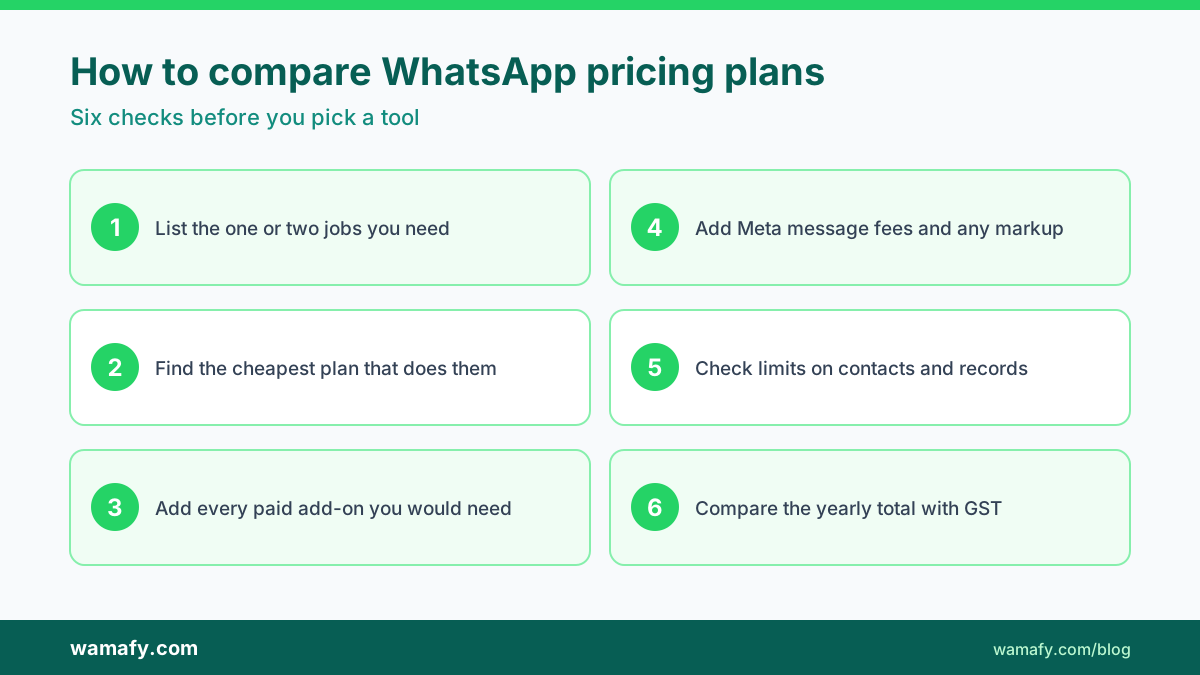
Whatever tool you pick, a few checks will save you from the tier-upgrade trap:
- Write down the one or two jobs you need. Be specific: booking, Shopify alerts, renewals or a catalogue.
- Find the cheapest plan that does those jobs. Ignore the cheapest plan on the page and search the plan table for each job by name.
- Add every paid add-on you would need. Chatbot builders, AI agents and integrations are often sold on top.
- Add the message fees. Ask whether the tool adds a markup to Meta's rates, because many do.
- Check the limits. Contacts, records and numbers can push you up a plan later.
- Work out the yearly total. Take the monthly price times twelve, plus GST, plus messages, and compare that number rather than the headline.
What we will not do
We will not tier-gate an add-on later, and when we launch a new add-on, it will work on Seed on day one, at the same price as on Forest.
We say this out loud because it is a common move: a tool starts open, gathers customers, then moves a popular feature up a plan "for new customers". The people who chose the tool for that feature are then stuck with the bill.
Prices can change, and we will not pretend otherwise. But the rule that any add-on works on any plan is the part we are fixing in place.
Where kCube stands
Our view is simple: a small business should pay for what it actually uses. The plan sets how big you are, and the add-on sets what you do, so mixing the two forces small firms to pay for size they do not have.
That view has a cost for us, and it will not suit every buyer. We have also been open about the gaps we have, like in our post on why Wamafy has no AI copywriter. If you are a small team with one clear job for WhatsApp, this model should save you money. If you want one bundle for everything, a gated plan elsewhere may suit you better, and that is fine.
Frequently Asked Questions
Can I buy a Wamafy add-on on the Seed plan?
Yes. Every Wamafy add-on works on every plan, including Seed. The add-on costs the same on Seed as it does on Bloom or Forest.
Are Wamafy add-ons included in the Forest plan?
No. Add-ons are paid separately on every plan, including Forest. A bigger plan gives you more volume, such as leads, records and numbers, not free add-ons.
Are add-ons free during the trial?
Yes. An add-on bought during the 14-day plan trial is free until the trial ends. Your card is authorised when the trial starts, and the add-on is charged with the plan from day 15.
What happens if I buy an add-on in the middle of a month?
You pay only for the days left until your plan renews. After that, the add-on renews on the same date as your plan, at its full price.
How do I compare WhatsApp marketing software pricing plans fairly?
Start from the jobs you need, not the entry price. Find the cheapest plan that does those jobs, add any paid add-ons and message markups, then compare the yearly total with GST.
Do plan limits apply to add-ons?
Yes, for volume. Seed holds up to 500 patient records or 500 renewal records, and Bloom holds 5,000. The add-on works fully on every plan, but a large book may need a bigger plan.
Try it on your own plan. Start a 14-day free Wamafy trial at wamafy.com, and add the one add-on your business needs. Your card is authorised when the trial starts and charged only on day 15.