The Diwali 2026 WhatsApp Playbook (After the 1 October Change)
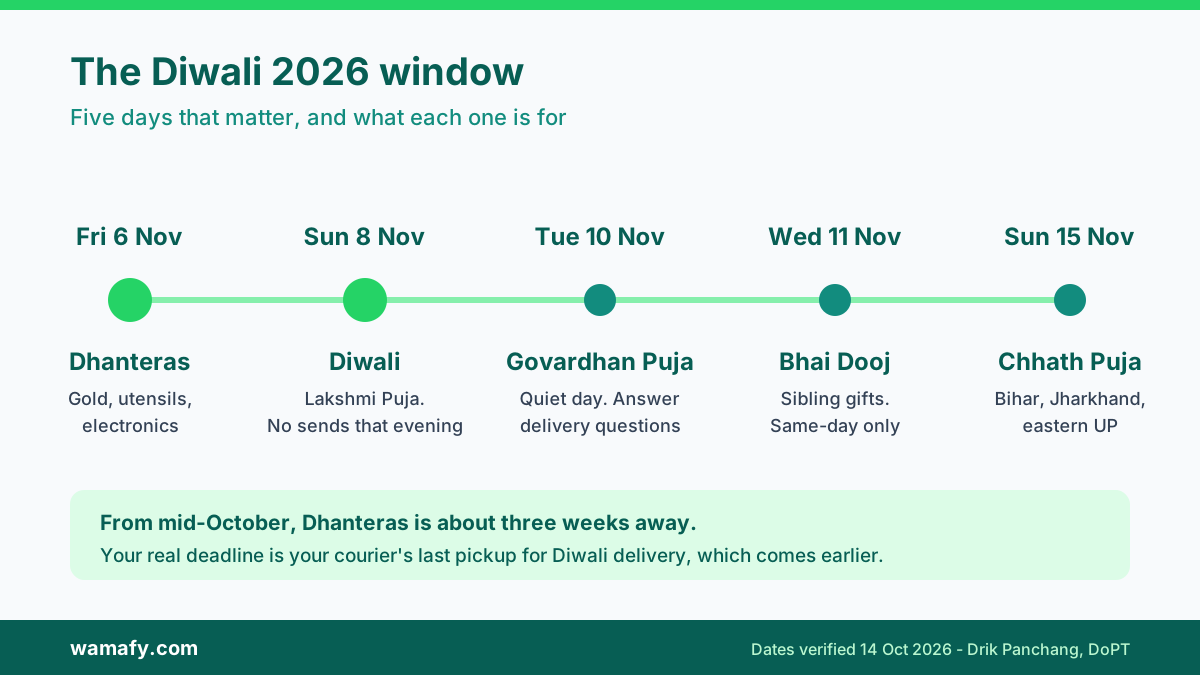
Dhanteras is on Friday 6 November. Diwali is on Sunday 8 November. Bhai Dooj follows on Wednesday 11 November. From mid-October, that gives you about three weeks. Your real deadline is earlier still: the last day your courier can promise delivery before Diwali.
This year has one more twist. It is the first Diwali since Meta started charging for replies. Since 1 October 2026, every answer you send inside the 24-hour chat window costs money in India. So do order updates sent inside that window. This Diwali WhatsApp marketing playbook covers the dates, what sells on which day, a four-send plan, the delivery cut-off message, and a full worked budget at today's rates.
The short version: replies cost a little. Broadcasts to cold contacts cost a lot. Plan your Diwali campaign around that.
The Diwali 2026 dates, and where each one comes from
Do not plan from memory. Festival dates follow the lunar calendar and move every year. These were checked on 14 October 2026.
| Day | Date | Source |
|---|---|---|
| Dhanteras | Friday 6 November | Drik Panchang |
| Diwali (Lakshmi Puja) | Sunday 8 November | Drik Panchang; central government holiday list (DoPT) |
| Govardhan Puja | Tuesday 10 November | Drik Panchang |
| Bhai Dooj | Wednesday 11 November | Drik Panchang |
| Chhath Puja | Sunday 15 November | Drik Panchang |
One regional note. The central government holiday order says some states mark Diwali on Naraka Chaturdashi instead. If many of your buyers are in the south, check your state's own holiday list. Your send day should follow your customers, not a national default.
What sells on which day
Diwali is not one buying day. It is a run of small ones, and each has its own shopper.
- Two to three weeks out: gifts that need delivery. Dry fruit boxes, home decor, clothes, gadgets. Corporate orders also land here.
- Dhanteras (6 November): gold, silver coins, utensils, electronics and vehicles. Many families buy something metal on this day for luck. Jewellers and appliance stores get their biggest day of the season.
- The two days before Diwali: sweets, diyas, rangoli colours, flowers, puja items. These are local, same-day buys. Shops near the buyer win.
- Diwali day (8 November): very little buying. People are at home with family. Your messages are noise that day.
- Bhai Dooj (11 November): gifts between brothers and sisters. Only worth a send if you can deliver the same day or the buyer can pick up.
Match your send to your slot. A sweet shop that broadcasts three weeks early is spending money too soon. An online gift store that starts on 5 November is too late, because its courier cannot deliver in time.
The four-send Diwali campaign plan
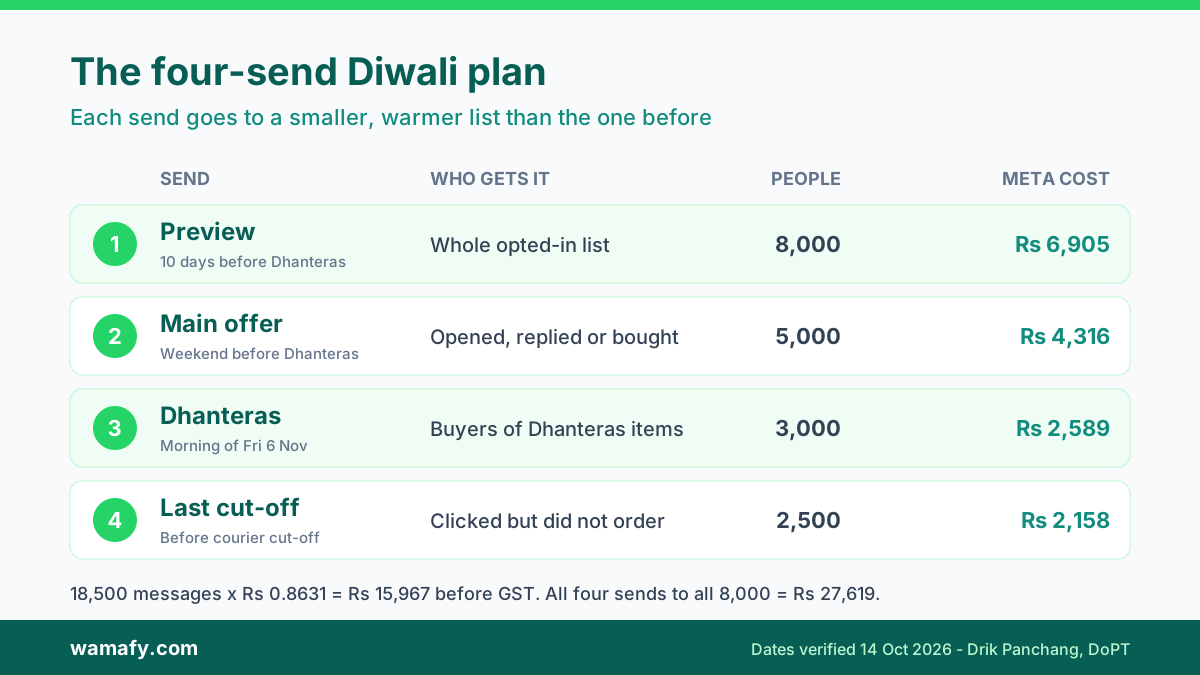
Most stores send one big blast to everyone, then another, then another. That is the expensive way. A better pattern is four sends. Each one goes to a smaller, warmer group than the one before.
Send 1: the preview (about 10 days before Dhanteras)
Send this to your whole opted-in list. Show the range, the price bands and the order deadline. Ask one easy question, like "Reply 1 for gifts under Rs 1,000". Every reply opens a 24-hour chat window and tells you who is interested.
Send 2: the main offer (the weekend before Dhanteras)
Send only to people who opened, replied or bought from you in the last six months. Cold contacts who ignored the preview will most likely ignore this too. Dropping them saves money and protects your quality rating.
Send 3: the Dhanteras send (morning of 6 November)
Keep this for buyers who fit Dhanteras: past buyers of gold, utensils, appliances or gift sets. A clothing store with no Dhanteras angle can skip it. Send it early in the morning. By evening, the buying is done.
Send 4: the last delivery cut-off
Send this the day before your courier's last pickup. Target people who clicked or replied but did not order. It is the most useful message of the season, and the next section explains why.
The delivery cut-off message saves the most work
The week before Diwali, the same question floods every store's chat: "Will it arrive before Diwali?" Now each answer costs money, and each one takes a person's time.
Answer it before anyone asks. Get the last safe order date from your courier for each zone. Then say it plainly, everywhere:
- In Send 4, as the main point: "Order by [date] for delivery before Diwali in [city list]."
- In your order confirmation, with the expected delivery date.
- In your WhatsApp greeting or auto-reply, so a new chat gets the answer at once.
- On your website banner and product pages.
Do not guess the date. Courier cut-offs change by pin code and by year. Use what your courier tells you this week, and update it if they change it.
After the cut-off, switch your offer. Push gift cards, store pickup or "delivered after Diwali" pricing. Do not keep selling a delivery promise you cannot keep. A late Diwali gift turns into a refund request and a bad review.
What changed on 1 October, and what it means for Diwali
Meta's own pricing docs set the new rule. From 1 October 2026, Meta charges per message for service messages, the free-form replies you send after a customer writes to you. It also charges for utility templates sent inside that open 24-hour window. Both were free before.
Here is what Meta charges in India today, before GST:
| Message type | Example | Rate per message |
|---|---|---|
| Marketing template | Diwali offer, preview, greeting | Rs 0.8631 |
| Utility template | Order confirmed, shipped, delivered | Rs 0.115 |
| Service reply | "Yes, it ships tomorrow" | Rs 0.115 |
One thing is still free. When someone messages you from a click-to-WhatsApp ad and you reply within 24 hours, a free entry point window opens. Meta says it can stay open for up to 7 days, and messages inside it are free. If you run Diwali ads, that window is the cheapest place to talk to a new buyer.
Correction, 11 November 2026: An earlier version said the free window after a click-to-WhatsApp ad lasts 72 hours. Meta's pricing page now says the free entry point window opens when a customer messages you from a click-to-WhatsApp ad on the WhatsApp Android or iOS app and you reply within 24 hours, and that it may stay open for up to 7 days (checked 11 November 2026). For the full rate card, see our guide to WhatsApp API pricing in India.
For the full rate card and the other changes, read the WhatsApp API pricing guide for India after 1 October.
A worked Diwali budget under the new rules
Take a home and gifting store with 8,000 opted-in contacts. It runs the four-send plan above and gets 600 Diwali orders.
- Marketing sends: 8,000 + 5,000 + 3,000 + 2,500 = 18,500 messages. At Rs 0.8631, that is Rs 15,967.35.
- Order updates: three per order (confirmed, shipped, delivered) = 1,800 messages. At Rs 0.115, that is Rs 207.
- Support replies: a busy week, say 4,000 replies. At Rs 0.115, that is Rs 460.
The total is Rs 16,634.35 before GST, or Rs 19,628.53 with 18 percent GST. That is about Rs 33 of messaging per order.
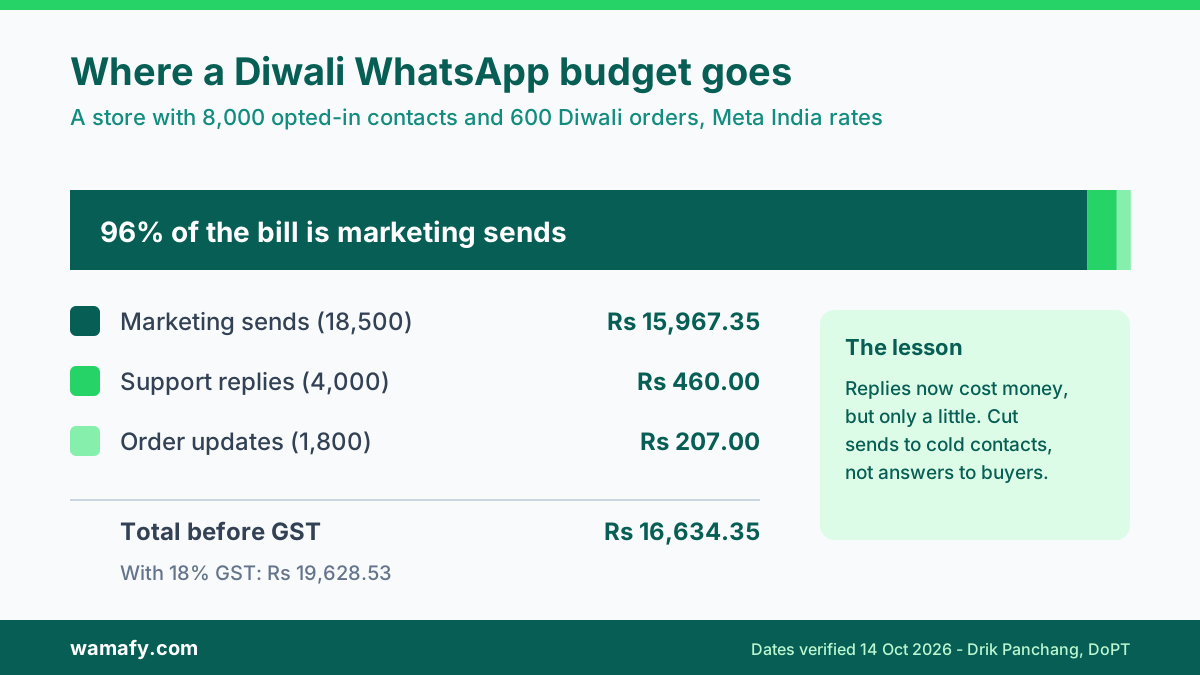
Look at where the money goes. The new reply charges added Rs 460 for the whole week. The marketing sends cost 35 times that. So the lesson of the 1 October change is not "reply less". Never cut answers to people who are trying to buy. Cut sends to people who never open.
There is one exception. If your platform adds a per-message markup on top of Meta's rate, that markup now applies to every reply and every order update too. On this bill, a 10 percent markup would add about Rs 1,660 for the week. Ask your provider how it bills replies. Platforms like Wamafy charge a flat monthly plan, and Meta bills you directly with no markup, so the numbers above are the whole messaging bill.
For a full season view across Navratri, Diwali and the post-festive weeks, see the festive season WhatsApp budget guide.
Use your Navratri results before you send
If you ran a Navratri campaign, you already have data most stores ignore. Spend an hour on it before 25 October.
- Who replied or bought? Tag them. They are your Send 2 and Send 3 list.
- Who never opened anything? Leave them out of every send after the preview.
- Which message got the most replies? Reuse its structure: the same opening line, the same kind of offer, the same button.
- Did your quality rating drop? Check it in WhatsApp Manager. If it fell, cut the list harder and space out your sends.
- Did you hit your messaging limit? If a broadcast stalled part way, read the messaging limits guide and split big sends across two days.
The Navratri and Dussehra playbook set aside budget for this exact moment. This is where you spend it.
Is a Diwali greeting worth sending?
Many stores send a "Happy Diwali" message to every contact. From a business, a greeting like that goes out as a marketing template. To 8,000 people, it costs Rs 6,904.80 before GST, the same as your preview send.
A greeting with no reason to reply also tends to get blocked or reported. That can lower your quality rating in the busiest week of the year. If you want to greet, send it to your best past buyers only, and give them something useful with it: a thank-you discount, an order deadline, store hours. And never send on the evening of Lakshmi Puja. Nobody is reading.
After Diwali: Bhai Dooj, Chhath and returns
The season does not end on 8 November.
- Bhai Dooj (11 November): a short send to past gift buyers, only if you can deliver the same day or offer pickup.
- Chhath Puja (15 November): a major festival in Bihar, Jharkhand and eastern Uttar Pradesh. If you have buyers there, a regional send for puja items, fruit baskets or new clothes can work. Skip it everywhere else.
- Returns and exchanges: they peak in the week after Diwali. A clear return-steps message, sent as a reply when someone asks, saves a dozen back-and-forth chats.
- Second orders: Diwali buyers are your warmest list for the next 30 days. The post-sale retention playbook shows how to turn them into repeat buyers.
Your Diwali WhatsApp checklist
- Confirm your courier's last safe order date for each zone.
- Tag Navratri responders and buyers. Mark contacts who never open.
- Get your four marketing templates approved now. Do not wait for the week before Dhanteras, when everyone else submits theirs.
- Set up order updates as utility templates, not marketing ones.
- Write your delivery cut-off into the greeting message and auto-reply.
- Schedule Send 1 for about 10 days before Dhanteras.
- Check your messaging limit against your biggest send.
- Staff the chat for the week before Diwali. Replies cost a little; a lost order costs a lot.
If you run on Shopify, the Wamafy Shopify add-on sends order confirmations and shipping updates on every order automatically, so the order-update line of your budget runs itself.
Frequently Asked Questions
When should I start my Diwali WhatsApp campaign?
Start with a preview about 10 days before Dhanteras, so around the last week of October. If you ship by courier, work back from your courier's last order date, not from Diwali. Local shops with same-day delivery can start later.
When is Diwali in 2026?
Lakshmi Puja is on Sunday 8 November 2026. Dhanteras is on Friday 6 November and Bhai Dooj on Wednesday 11 November, per Drik Panchang. Some states mark Diwali on Naraka Chaturdashi, so check your state's holiday list.
Is a Diwali greeting a marketing message?
Yes. A greeting from a business is sent as a marketing template, at Rs 0.8631 per message in India before GST. It is not a free hello. Send it only to people who are likely to welcome it.
Do WhatsApp replies cost money during Diwali?
Yes, since 1 October 2026. Each reply in the 24-hour chat window costs Rs 0.115 in India before GST. For most stores this adds a few hundred rupees in the busiest week, which is small next to marketing sends.
How many Diwali messages should I send?
Four sends is enough for most stores: a preview, a main offer, a Dhanteras send and a delivery cut-off. Send each one to a smaller, warmer list. More sends to the same cold list mostly raise your cost and your block rate.
Is anything still free on WhatsApp?
Yes. When a person messages you from your click-to-WhatsApp ad and you reply within 24 hours, a free entry point window opens. It can stay open for up to 7 days, and messages inside it are free.
Plan the cut-off, not just the offer
Every store will have a Diwali offer. Fewer will have a clear delivery date, a warm list and a budget they can explain. Those are the ones that keep their margins and their quality rating through the season.
If you want to run this plan on the official WhatsApp API with no markup on Meta's rates, start a 14-day free Wamafy trial. Your card is authorized when the trial starts and charged only on day 15.