The Navratri and Dussehra WhatsApp Playbook (2026)
Navratri starts on Sunday, 11 October. Dussehra closes it on Tuesday, 20 October. That is ten days, not one. And this year there is a twist most Navratri marketing plans have not caught.
Flipkart opens Big Billion Days on 9 October, with early access on the 8th. Amazon opens the Great Indian Festival on 8 October. So the two biggest sales of the year start three days before Navratri does. By the time you send your day-one Navratri message, your customer has already spent three days scrolling marketplace deals.
This is also the first festive campaign since Meta started charging for service replies on 1 October. Every "Is this in stock?" reply now has a small price.
This Navratri marketing WhatsApp playbook is built for both facts. It covers how to pace ten days, where the festival lands hardest, which businesses gain the most, and what the whole thing costs.
The dates, and where each one comes from
Festival and sale dates move. Here is each one with its source, checked on 27 September 2026:
- Navratri begins (Ghatasthapana): Sunday 11 October. Source: Drik Panchang.
- Dussehra (Vijayadashami): Tuesday 20 October. Source: the central government holiday list for 2026 (DoPT).
- Flipkart Big Billion Days: opens 9 October, early access 8 October. Source: Flipkart's own sale page. No end date has been announced.
- Amazon Great Indian Festival: opens 8 October. Source: Amazon India's announcement. No end date has been announced.
- Karwa Chauth: Thursday 29 October. Source: DoPT holiday list.
- Diwali: Sunday 8 November. Source: DoPT holiday list.
One more thing to know: regional calendars can differ by a day. Check your local panchang before you schedule a day-specific message, such as one for Ashtami.
The ten-day shape of Navratri marketing on WhatsApp
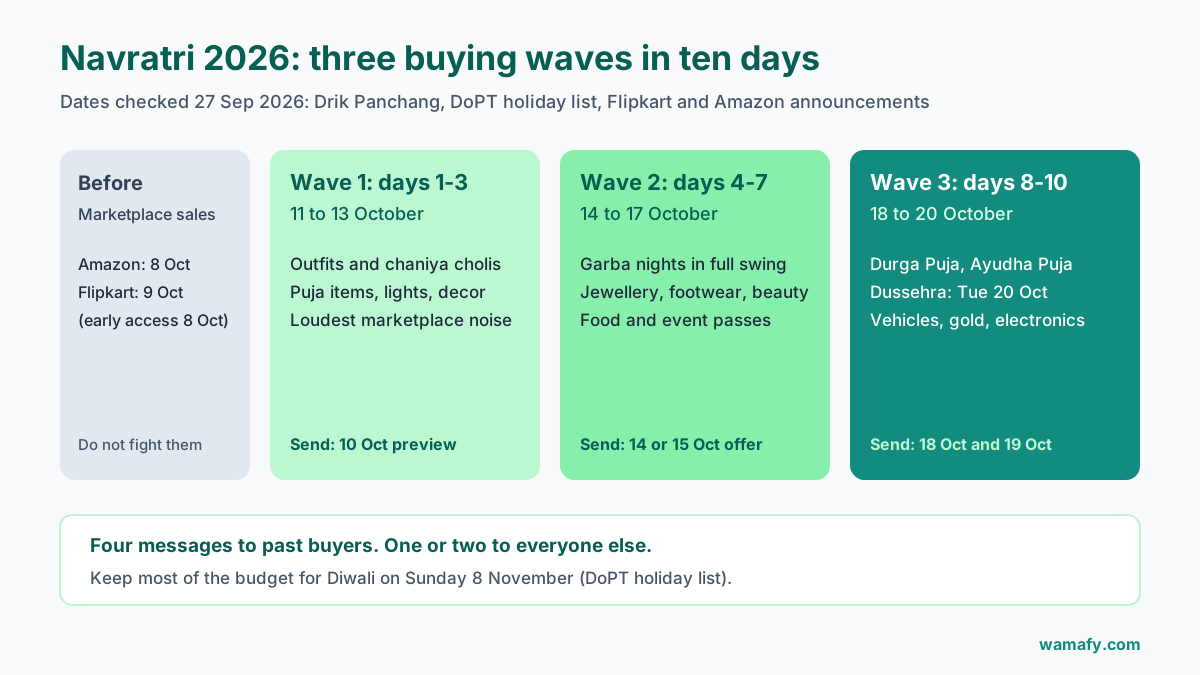
Buying across Navratri is not flat. It moves in three waves. Your messages should follow the waves, not the calendar.
Wave 1: days 1 to 3 (11 to 13 October)
This is outfit and decor time. People buy chaniya cholis, kurtas, puja items, lights and home decor. It is also when marketplace sales are loudest. Keep your message short, specific and about something the marketplaces do not do well, such as local delivery or custom stitching.
Wave 2: days 4 to 7 (14 to 17 October)
Garba nights are in full swing. Jewellery, footwear, beauty services and food orders rise. This is the quietest window for marketplace noise, so it is often your best window for a real offer.
Wave 3: days 8 to 10 (18 to 20 October)
Durga Puja's final days in the east, Ayudha Puja in the south, and Dussehra everywhere. This is when big-ticket buying happens. Vehicles, gold, electronics and property bookings cluster here because Dussehra is seen as an auspicious day to buy.
Where Navratri and Dussehra land hardest
A national blast wastes money. The festival looks very different by region. Tag your contacts by city or state, then send each region the message that fits it.
| Region | What people celebrate | What sells |
|---|---|---|
| Gujarat, Mumbai | Garba and dandiya, all nine nights | Outfits, jewellery, event passes, beauty |
| Maharashtra | Navratri, often with a colour for each day | Sarees, outfits, decor, gold on Dussehra |
| West Bengal, Assam, Odisha | Durga Puja, heaviest in the final days | Clothes, food, gifting, travel |
| North India | Ram Lila, fasting, Dussehra | Fasting food, sweets, vehicles and gold on Dussehra |
| Karnataka, Tamil Nadu | Dasara, Golu dolls, Ayudha Puja | Golu dolls, puja items, vehicle and tool servicing |
Two small notes from this table are easy to miss:
- Dussehra reaches wider than Navratri. A store in Delhi or Chennai may get little from a garba message, but it will get a lot from a Dussehra one.
- The colour-of-the-day habit is real in Maharashtra. The colour list is published fresh each year. Check this year's list before you build a campaign around it.
How to pace your Navratri campaign across ten days
The most common mistake is to send everything on day one. Your customer gets one message on 11 October, ignores it among fifty others, and hears nothing again. Or worse, you send a message every day, and some of them block you.
Blocks and reports hurt your quality rating. A low rating can cap how many people you can message. So pacing is not only about attention. It protects your number for Diwali.
A good shape for most businesses is four messages across ten days:
- 10 October, the evening before: "Navratri starts tomorrow. Here is what is new." Short, one image, one link.
- 14 or 15 October, middle of wave 2: your real offer. This is the quietest window for marketplace noise.
- 18 October: a Dussehra preview for big-ticket buyers. Booking slots, delivery before the 20th, or pre-orders.
- 19 October, the day before Dussehra: the last call. Keep it to one line and a link.
Only send all four to people who have bought from you before. Send new or cold contacts one or two at most. If you are unsure when to send each one, the best time to send a WhatsApp broadcast guide covers the hours that work in India.
Businesses that gain the most
Garba and event organisers
This is the most underserved group. A garba night is a ticketing, reminder and entry problem, and most organisers still run it on personal WhatsApp and screenshots of UPI payments.
WhatsApp fits every step:
- A pass confirmation with the date, venue and gate time.
- A reminder on the afternoon of the event.
- A same-day message if the venue or time changes because of rain.
- A "next year, early bird" list, built from this year's buyers.
Confirmations and reminders are utility messages. In India they cost Rs 0.115 each, which is about one-seventh of a marketing message. A 2,000-pass event with one confirmation and one reminder per pass costs about Rs 460 in Meta fees, before GST.
Salons and beauty services
Garba nights mean hair, makeup and mehendi, and slots sell out. A salon that lets clients book in chat fills the evening slots early. It also cuts the number of phone calls on the busiest days. The WhatsApp playbook for salons and spas covers the booking flow in detail.
Vehicle dealers, jewellers and electronics stores
Dussehra is a buying trigger for these businesses. Many buyers want the delivery or the booking to happen on the day itself. So the message is not "10 percent off". It is "Book now to take delivery on Dussehra." Send it on 14 to 16 October, when there is still time to arrange finance and stock.
Sweet shops, caterers and cloud kitchens
Fasting menus during Navratri and sweets for Dussehra both need pre-orders. The trick is to take orders early and give pickup slots. That smooths out the rush and stops you running out on the day. The restaurant and cloud kitchen guide has a full pre-order sequence.
What a Navratri campaign costs under the new rules
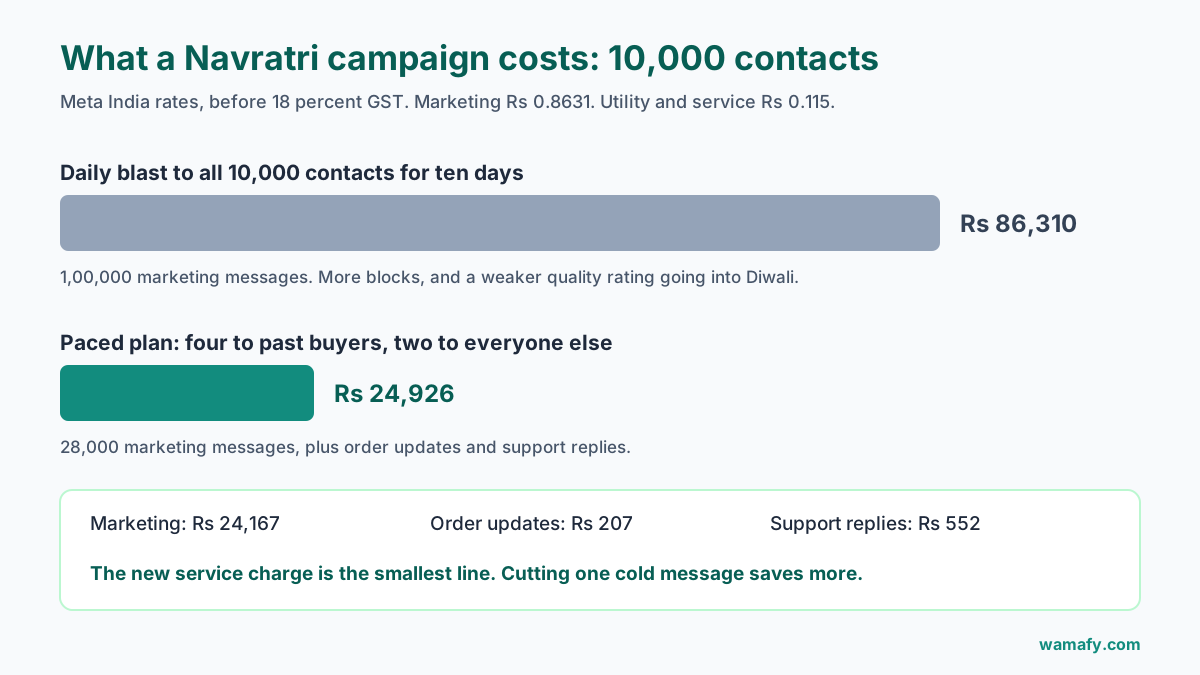
This is the first festive campaign since service replies became billable on 1 October. Here is the whole bill for a clothing store with 10,000 contacts. The store sends the four-message plan to 4,000 past buyers and two messages to 6,000 others.
| Line | Messages | Rate | Cost (before GST) |
|---|---|---|---|
| Marketing to past buyers (4 each) | 16,000 | Rs 0.8631 | Rs 13,810 |
| Marketing to others (2 each) | 12,000 | Rs 0.8631 | Rs 10,357 |
| Order updates (600 orders, 3 each) | 1,800 | Rs 0.115 | Rs 207 |
| Support replies (1,200 chats, 4 replies each) | 4,800 | Rs 0.115 | Rs 552 |
| Total | 34,600 | Rs 24,926 |
Add 18 percent GST and the total is about Rs 29,400. Now compare that with one message a day to all 10,000 contacts for ten days. That is 1,00,000 marketing messages and about Rs 86,300 before GST, over three times the cost. It also brings far more blocks.
Three points stand out in this table:
- The support line is small. Rs 552 for a busy ten days. Providers also report a free allowance of 1,000 service messages a month per number, which would cut it further. Meta's own pricing page does not state that allowance, so do not plan on it.
- The marketing line is where the money goes. Cutting one message to cold contacts saves more than the entire support bill.
- Markups matter at this scale. A platform that adds even 20 percent per message turns Rs 24,926 into about Rs 29,900 before GST. The festive sale week cost breakdown works through this in more detail.
Rates here are Meta's published India rates for marketing and for utility and service messages. Meta's rate card can change, so check it before you set a budget.
Hold back budget for Dhanteras and Diwali
Diwali is on 8 November this year. That is under three weeks after Dussehra. The Diwali week is bigger than Navratri for almost every category. So do not spend it all in October.
A simple rule works for most stores: spend no more than 40 percent of your festive WhatsApp budget by 20 October. Keep the rest for the Diwali week, and a little for the returns and follow-ups after it.
There is a second reason to hold back. Your quality rating needs to be healthy for Diwali. If Navratri messages get blocked, you go into your biggest week with a weaker number. A lighter Navratri protects the Diwali one.
Your checklist before 10 October
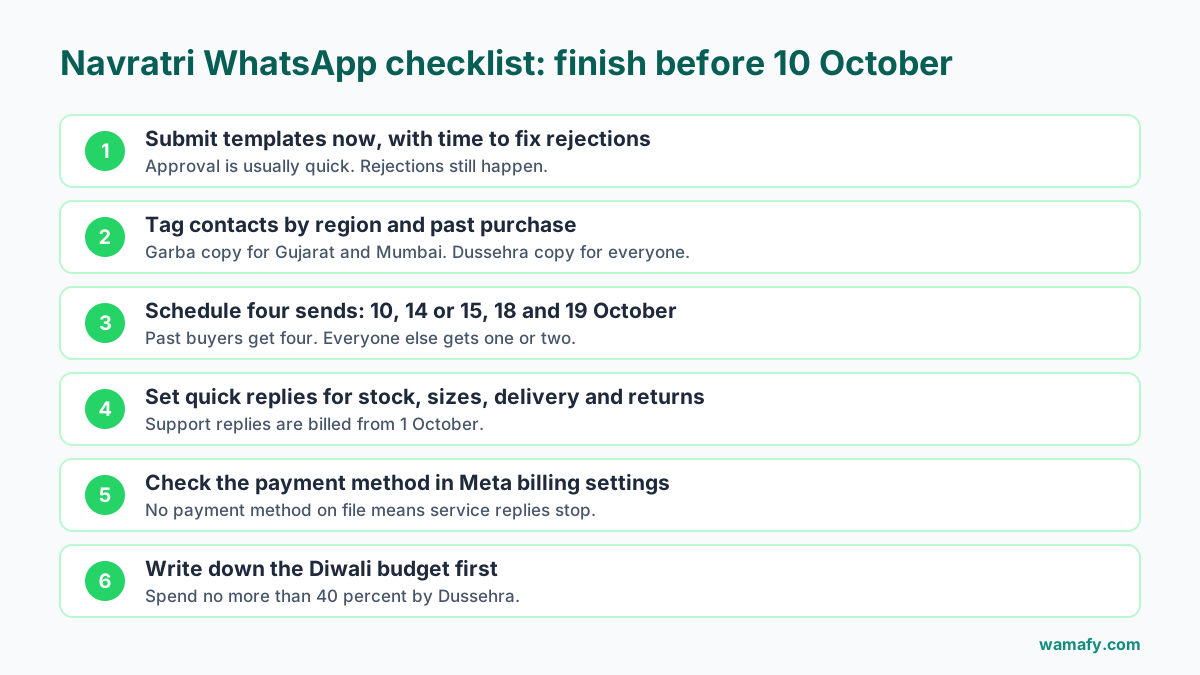
- Submit templates now. Approval is usually quick, but rejections happen. Leave time to fix and resubmit.
- Tag your list by region and past purchase. Past buyers get four messages. Everyone else gets one or two.
- Schedule the four sends. 10, 14 or 15, 18 and 19 October.
- Set up quick replies for the questions you will get most: stock, sizes, delivery date and returns.
- Check your payment method in Meta's billing settings. Service replies are billed from 1 October, and Meta said it would stop delivering them for accounts with no payment method on file.
- Write down your Diwali budget before you spend any of the Navratri one.
A platform like Wamafy helps with most of this list. You can tag contacts, schedule broadcasts to each segment, and share one inbox across your team so replies go out fast. You pay Meta's rates directly, with no markup added on top.
Frequently Asked Questions
When is Navratri in 2026?
Navratri 2026 starts on Sunday, 11 October, and ends with Dussehra on Tuesday, 20 October. Regional calendars can differ by a day for individual tithis, so check your local panchang before sending a day-specific message.
Should I send a WhatsApp message on all ten days of Navratri?
No. Daily messages lead to blocks, and blocks lower your quality rating before Diwali. Four messages to past buyers and one or two to everyone else works better for most stores.
Is Navratri or Dussehra the better sale day?
It depends on what you sell. Outfits, jewellery and beauty peak during the Navratri nights. Vehicles, gold, electronics and property peak on Dussehra, because it is seen as an auspicious day to buy.
How do I compete with Big Billion Days during Navratri?
Do not fight their opening days. Flipkart and Amazon open on 8 and 9 October, just before Navratri. Put your main offer in the middle of Navratri, and lead with what marketplaces cannot do, such as local delivery, custom work or same-day pickup.
Do WhatsApp support replies cost money during Navratri?
Yes. From 1 October 2026, Meta charges for service replies. In India that is Rs 0.115 per message before GST. For most small businesses the total is a few hundred rupees across the festival.
How much of my festive budget should I spend on Navratri?
A good rule is no more than 40 percent by Dussehra. Diwali is on 8 November and is bigger for almost every category, so keep most of your budget and your quality rating for it.
Plan ten days, not one
This Navratri is crowded. Marketplace sales start first, service replies now cost money, and Diwali follows fast. The stores that do well will send fewer, better-timed messages to the right region, and keep enough in reserve for Diwali.
If you want to run this plan without paying a markup on every message, start a 14-day free Wamafy trial. Your card is authorized when the trial starts and charged only on day 15.